


Browse the Knowledge Hub211 resources
Team Topologies: is it worth reading?
A model for organising engineering teams around flow, with direct implications for where QA belongs.
We earn nothing from any link on this page. No affiliate links anywhere in this library.
- published
- 2019
- key ideas
- 3
- reading path
- 1

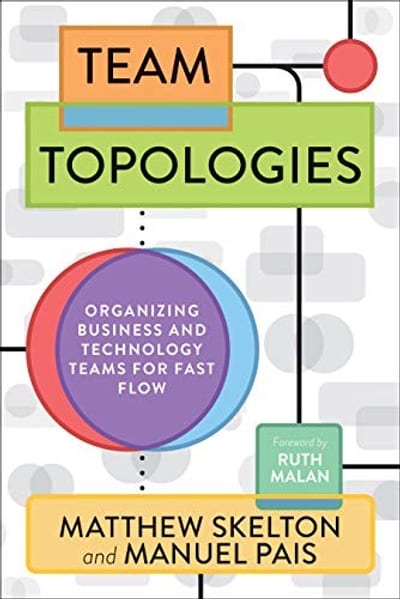
Team Topologies
Organizing Business and Technology Teams for Fast Flow
by Matthew Skelton, Manuel Pais
- Publisher
- IT Revolution
- Year
- 2019
- ISBN
- 9781942788812
Useful when you are: Senior / lead, Manager
Verdict
Should you read it?
Read it if
You are deciding how a QA function should be structured, or arguing against a centralised testing team that has become a queue.
Skip it if
You work in a single-team organisation. The model is about interactions between teams and has little to say below that scale.
The argument
What it argues
Four team types, stream-aligned, enabling, complicated-subsystem and platform, with three interaction modes between them. The argument is that team structure determines architecture and delivery speed, so it should be designed deliberately rather than inherited.
The implication for quality functions is direct and uncomfortable. A central QA team that every stream must route through is a bottleneck by construction. The model suggests quality specialists belong either embedded in stream-aligned teams or in an enabling team that raises capability without becoming a dependency.
It is the most useful book available for anyone deciding how a QA function should be structured.
Key ideas
Ideas worth taking from it
- 01
The four team types
Stream-aligned, enabling, complicated-subsystem, platform. A vocabulary for what a team is for, which most organisations have never made explicit.
- 02
Cognitive load as a design constraint
A team can only hold so much. Team boundaries should be drawn so that what each owns fits, which is a far better criterion than organisational convenience.
- 03
Enabling teams
A team that raises capability elsewhere and then withdraws, rather than performing the work permanently. The most promising model for a modern QA function.
Criticism
What has dated, and what it gets wrong
The four types are cleaner on paper than in practice, and real organisations contain teams that are two or three at once. It is also prescriptive in a way that invites cargo-culting: teams relabel themselves without changing interactions and conclude the model does not work.
Reading paths
On our reading paths
Leading a quality team
Book 3 of 4 · QA and engineering managers
A modern model for team design and the boundaries between teams, with direct consequences for where testing responsibility should sit.
 1. Peopleware
 2. The Mythical Man-Month
- 3. Team Topologies (this book)
 4. The Manager's Path
Keep reading
What to read next
Reading about quality is cheaper than learning it in production.
QAble runs QA for products in BFSI, gaming, healthcare and SaaS, with engineers who have read these and argued about them. Start with a free QA audit.