


Browse the Knowledge Hub211 resources
The Quality Engineering Operating System: is it worth reading?
How to build release confidence as a system rather than as a testing phase, written from engagements where it had to be rebuilt.
We wrote this one, so treat the assessment accordingly. The free download is linked below.
- published
- 2026
- key ideas
- 3

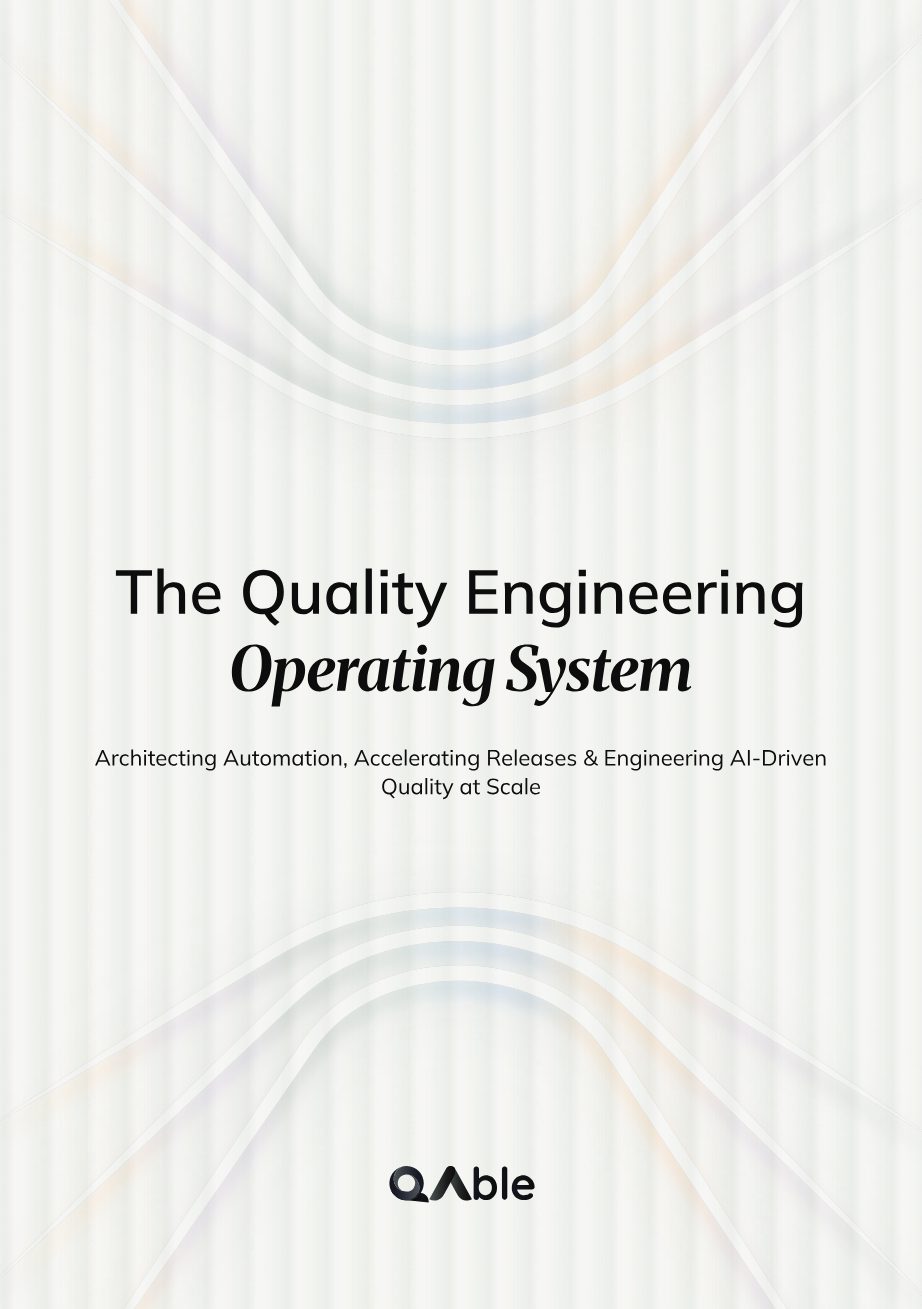
The Quality Engineering Operating System
A practical playbook for engineering release confidence at scale
by QAble
- Publisher
- QAble
- Year
- 2026
Useful when you are: Senior / lead, Manager
Verdict
Should you read it?
Read it if
You lead testing or delivery and the symptoms are familiar: testing squeezed every cycle, a regression suite nobody trusts, and a quality conversation that keeps being had at the wrong end of the process.
Skip it if
You are looking for test design technique or tool instruction. This is about how the system around testing is arranged, and it assumes you already know how to test.
The argument
What it argues
Most organisations treat quality as an activity performed near the end of delivery by a team whose job is to find problems. That arrangement produces a predictable set of symptoms: testing compressed into the final days, a regression burden that grows every release, defects discovered after the context that created them has been forgotten, and a quality function that is simultaneously overloaded and peripheral.
The argument here is that release confidence is a property of the whole delivery system rather than an output of a testing stage, and that it can be engineered deliberately. That means deciding where verification happens, what evidence a release decision actually requires, and which feedback loops have to be fast for the rest to work.
The book is organised around the decisions a team or a lead actually has to make, rather than around testing techniques. It is deliberately operational: what to measure, what to stop doing, and what to build first.
Key ideas
Ideas worth taking from it
- 01
Release confidence as a system property
Confidence comes from the arrangement of feedback loops across the whole pipeline, not from the thoroughness of a final check. Strengthening the last stage has diminishing returns once the earlier ones are weak.
- 02
Verification placement
Every check should sit at the lowest level that can meaningfully perform it. Most teams verify business rules through a browser out of habit, which is what makes suites slow and brittle.
- 03
Evidence for a release decision
What was covered, what was not, and what risk remains, stated explicitly. A percentage of tests passed is not evidence, because the denominator does not exist.
Criticism
What has dated, and what it gets wrong
It is written from consulting engagements, which means the examples skew toward organisations large enough to have the problem and to pay someone to fix it. A four-person startup will find parts of it disproportionate. It is also opinionated about where testing belongs, and a team committed to a separate QA gate will disagree with the premise rather than the detail.
Keep reading
What to read next
More in Engineering culture


Related on QAble
QA consulting services
Reading about quality is cheaper than learning it in production.
QAble runs QA for products in BFSI, gaming, healthcare and SaaS, with engineers who have read these and argued about them. Start with a free QA audit.