


Browse the Knowledge Hub211 resources
Agile Testing: is it worth reading?
The standard reference for how testing works inside iterative delivery, and the source of the testing quadrants.
We earn nothing from any link on this page. No affiliate links anywhere in this library.
- published
- 2009
- key ideas
- 3
- reading path
- 1

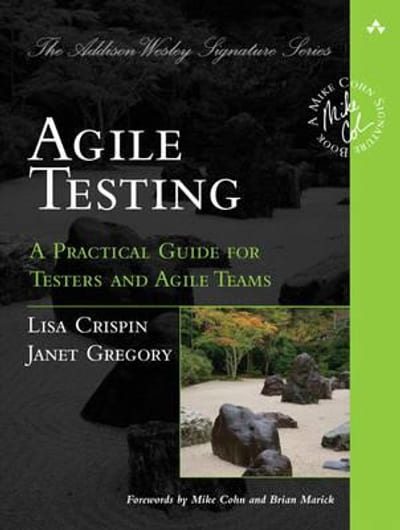
Agile Testing
A Practical Guide for Testers and Agile Teams
by Lisa Crispin, Janet Gregory
- Publisher
- Addison-Wesley
- Year
- 2009
- ISBN
- 9780321534460
Useful when you are: Practising tester, Senior / lead
Verdict
Should you read it?
Read it if
You are a tester in a Scrum or Kanban team, or you are introducing testers into one. It is the most complete answer to the question of what a tester does all sprint.
Skip it if
You work in a regulated waterfall environment where the phase structure is a compliance requirement. Much of the advice assumes a flexibility you do not have.
If you only read one thing
The quadrants chapter. Walk your own team through it and the coverage gaps surface in about twenty minutes.
The argument
What it argues
Testing in an agile team is not a compressed version of a testing phase. The book argues it is a different activity: continuous rather than staged, collaborative rather than independent, and weighted toward preventing defects rather than detecting them.
Its most durable contribution is the testing quadrants, which classify tests on two axes, business facing against technology facing, and supporting the team against critiquing the product. The model is useful mainly as a gap finder, because most teams discover they have good coverage in two quadrants and essentially nothing in the other two.
The rest is practical: how a tester contributes before code exists, how automation strategy has to change when the regression surface grows every iteration, and what the whole-team approach to quality actually requires from people other than testers.
Key ideas
Ideas worth taking from it
- 01
The agile testing quadrants
Business or technology facing, supporting the team or critiquing the product. Four quadrants that between them expose what a team is not testing, which is usually quadrants three and four.
- 02
Whole-team responsibility for quality
Quality is not delegated to a function that inspects at the end. The book is careful that this does not mean testing expertise is unnecessary, which is how it is usually misread.
- 03
The agile testing mindset
Collaborative, comfortable with incomplete information, and oriented toward prevention. A description of attitude rather than process, and the part that transfers best.
Criticism
What has dated, and what it gets wrong
Long, and it repeats itself. Published in 2009, so it predates mainstream continuous delivery, containerisation and the current automation tooling, and the technology sections have dated accordingly. The authors later wrote Agile Testing Condensed, which is a better entry point for most readers and says most of the same things in a fifth of the length.
Reading paths
On our reading paths
Your first year in testing
Book 3 of 4 · New to testing
Most testing now happens inside delivery teams. This is the standard map of how a tester contributes across a sprint, and the source of the testing quadrants you will hear about in interviews.
 1. Explore It!
 2. Lessons Learned in Software Testing
- 3. Agile Testing (this book)
 4. The Pragmatic Programmer
Keep reading
What to read next
Reading about quality is cheaper than learning it in production.
QAble runs QA for products in BFSI, gaming, healthcare and SaaS, with engineers who have read these and argued about them. Start with a free QA audit.