


Browse the Knowledge Hub211 resources
Continuous Delivery: is it worth reading?
The book that defined the deployment pipeline and made releasing frequently an engineering discipline.
We earn nothing from any link on this page. No affiliate links anywhere in this library.
- published
- 2010
- key ideas
- 3
- reading path
- 1

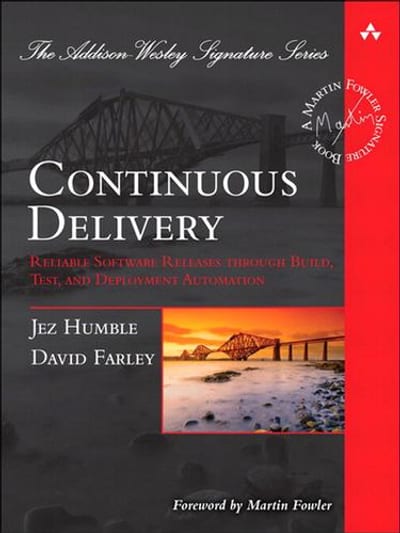
Continuous Delivery
Reliable Software Releases through Build, Test, and Deployment Automation
by Jez Humble, David Farley
- Publisher
- Addison-Wesley
- Year
- 2010
- ISBN
- 9780321670229
Useful when you are: Senior / lead, Manager
Verdict
Should you read it?
Read it if
You are building or improving a pipeline, or you need to explain why a two-week manual regression phase makes frequent release impossible.
Skip it if
You want current tooling guidance. The principles hold completely; the tool examples are from 2010 and most are gone.
The argument
What it argues
Software should always be in a releasable state, and the way to achieve that is a deployment pipeline: an automated sequence of stages that takes a commit through build, automated test, and deployment to production-like environments, with each stage providing faster or broader feedback.
The testing argument is central and specific. Fast, cheap tests run first; slow, expensive ones run later; and the pipeline is designed so that the most likely failures are found soonest. That ordering is a deliberate engineering decision rather than an accident of what is easy to automate.
It also argues that manual testing does not disappear but changes role, becoming exploratory and acceptance work rather than regression execution.
Key ideas
Ideas worth taking from it
- 01
The deployment pipeline
An automated path from commit to production with staged feedback. The organising concept that made continuous delivery concrete rather than aspirational.
- 02
Build once, deploy many
The same artefact moves through every environment. Rebuilding per environment means you never tested what you shipped.
- 03
Testing as the pipeline gate
Automated tests are what make frequent release safe. Without them, continuous delivery is continuously delivering untested changes.
Criticism
What has dated, and what it gets wrong
Dated in its specifics. It predates Docker, Kubernetes, modern CI services and infrastructure as code as currently practised, so the implementation chapters describe a world that no longer exists. The conceptual material is unaffected and remains the reference.
Reading paths
On our reading paths
Quality in continuous delivery
Book 2 of 5 · Delivery and DevOps
The founding text of the deployment pipeline, and still the clearest account of where each kind of automated test belongs in it.
 1. The Phoenix Project
- 2. Continuous Delivery (this book)
 3. Accelerate
 4. The DevOps Handbook
 5. Site Reliability Engineering
Keep reading
What to read next
Reading about quality is cheaper than learning it in production.
QAble runs QA for products in BFSI, gaming, healthcare and SaaS, with engineers who have read these and argued about them. Start with a free QA audit.