


Browse the Knowledge Hub211 resources
Explore It!: is it worth reading?
The book that made exploratory testing teachable rather than something good testers just happened to do.
We earn nothing from any link on this page. No affiliate links anywhere in this library.
- published
- 2013
- key ideas
- 3
- reading path
- 1

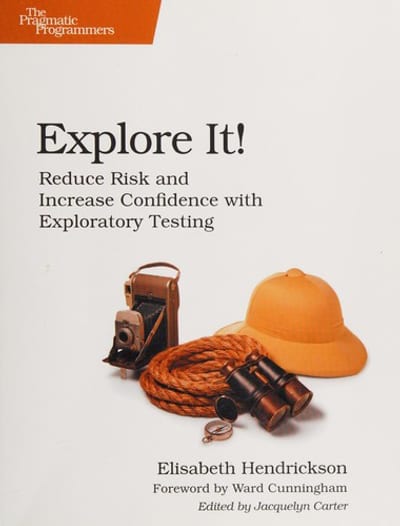
Explore It!
Reduce Risk and Increase Confidence with Exploratory Testing
by Elisabeth Hendrickson
- Publisher
- Pragmatic Bookshelf
- Year
- 2013
- ISBN
- 9781937785024
Useful when you are: New to testing, Practising tester, Senior / lead
Verdict
Should you read it?
Read it if
You test software at any level. It is the most directly useful testing book in this library, and the only one on this list that reliably changes how someone tests within a week of reading it.
Skip it if
You need to justify exploratory testing to a sceptical auditor or regulator. The book makes the practice rigorous; it does not solve the evidence problem in a regulated environment.
If you only read one thing
The chapters on charters. The format is the single most portable idea in the book and can be adopted the same afternoon.
The argument
What it argues
Exploratory testing is often described as unstructured, which is both wrong and the reason it gets dismissed as unprofessional. Hendrickson argues it is a rigorous discipline with its own structure: a charter that states what is being explored, a time box, deliberate variation, and recorded findings.
The central mechanism is the charter, phrased as exploring a target with some resource to discover some kind of information. That one sentence converts aimless clicking into a session with a mission and an output, which is what makes exploratory work plannable and reportable rather than invisible.
The second half is about systematically varying things: data, sequence, timing, configuration, interruptions. It supplies the heuristics that experienced testers use without being able to articulate, which is precisely what makes them teachable.
Key ideas
Ideas worth taking from it
- 01
The exploratory charter
Explore a target, with a resource, to discover information. A one-sentence mission that gives a session focus and makes its coverage statable afterwards.
- 02
Variation heuristics
Systematic ways to vary input, sequence, timing and state, which turn exploration from intuition into a repeatable practice that can be taught.
- 03
Testing as a learning activity
Design, execution and learning happen simultaneously, and what you learn in one test determines the next. Scripted testing cannot do this by construction.
Criticism
What has dated, and what it gets wrong
Thin on how exploratory testing coexists with heavy automation, which is the situation most teams are actually in now. It also underplays how much domain knowledge exploration depends on: the heuristics are teachable, but a tester who does not understand the business will explore competently and find little.
Reading paths
On our reading paths
Your first year in testing
Book 1 of 4 · New to testing
Start with practice rather than theory. Charters and variation heuristics change how you test within a week, and give you something concrete to try on Monday.
- 1. Explore It! (this book)
 2. Lessons Learned in Software Testing
 3. Agile Testing
 4. The Pragmatic Programmer
Keep reading
What to read next
Reading about quality is cheaper than learning it in production.
QAble runs QA for products in BFSI, gaming, healthcare and SaaS, with engineers who have read these and argued about them. Start with a free QA audit.