


Browse the Knowledge Hub211 resources
Lessons Learned in Software Testing: is it worth reading?
293 short lessons on testing judgement, and the foundational text of the context-driven school.
We earn nothing from any link on this page. No affiliate links anywhere in this library.
- published
- 2001
- key ideas
- 3
- reading path
- 1

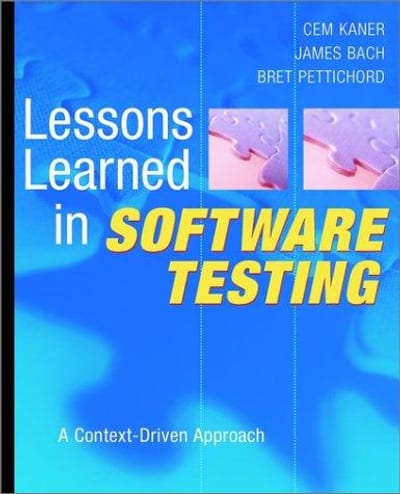
Lessons Learned in Software Testing
A Context-Driven Approach
by Cem Kaner, James Bach, Bret Pettichord
- Publisher
- Wiley
- Year
- 2001
- ISBN
- 9780471081128
Useful when you are: Practising tester, Senior / lead
Verdict
Should you read it?
Read it if
You have been testing for a year or two, you have started noticing that the processes you were taught do not fit the projects you are on, and you want a vocabulary for why.
Skip it if
You want a procedure to follow. The book is explicitly against supplying one, and readers who come for a methodology leave frustrated.
If you only read one thing
The lessons on reporting defects and on relationships with programmers. They are the most immediately applicable material in the book and the part most testers get wrong for years.
The argument
What it argues
Testing has no universal best practices, only practices that are appropriate in a context. The book is structured as several hundred numbered lessons rather than as a methodology, which is itself the argument: it refuses to supply a process because it does not believe one exists that survives contact with different projects.
The lessons cover the thinking rather than the mechanics. How to decide what to test when you cannot test everything. How to report a defect so it gets fixed. How to disagree with a developer without becoming the person nobody wants in the room. How to survive as a tester in an organisation that does not value testing.
It is the founding document of the context-driven testing school, and the clearest statement of the position that testing is a sceptical, investigative discipline rather than a confirmatory one.
Key ideas
Ideas worth taking from it
- 01
Context-driven testing
The value of any practice depends on its context. There are good practices in context, but no best practices, and a technique that works brilliantly in one project can be actively harmful in another.
- 02
Testing as investigation
The purpose is to discover information about the product, especially information that someone does not want to hear. That framing is materially different from verifying that it meets a specification.
- 03
The tester as a sceptic
A tester who assumes the specification is correct has given up the most valuable thing they bring. Much of the book is about how to hold that position professionally.
Criticism
What has dated, and what it gets wrong
It is from 2001 and the technology examples show it. More significantly, the context-driven school has at times been combative toward certification and formal process in a way that reads as doctrinaire rather than context-driven, and some lessons carry that tone. The format also works against it as a reference: several hundred short lessons are hard to navigate when you want a specific answer rather than a browse.
Reading paths
On our reading paths
Your first year in testing
Book 2 of 4 · New to testing
Once you have tested for a while, these short lessons explain the judgement behind the work: what to test when you cannot test everything, and how to report a bug so it gets fixed.
 1. Explore It!
- 2. Lessons Learned in Software Testing (this book)
 3. Agile Testing
 4. The Pragmatic Programmer
Keep reading
What to read next

Reading about quality is cheaper than learning it in production.
QAble runs QA for products in BFSI, gaming, healthcare and SaaS, with engineers who have read these and argued about them. Start with a free QA audit.