


Browse the Knowledge Hub211 resources
Perfect Software: is it worth reading?
Short, sharp demolition of the assumptions managers and developers hold about what testing can deliver.
We earn nothing from any link on this page. No affiliate links anywhere in this library.
- published
- 2008
- key ideas
- 3
- reading path
- 1

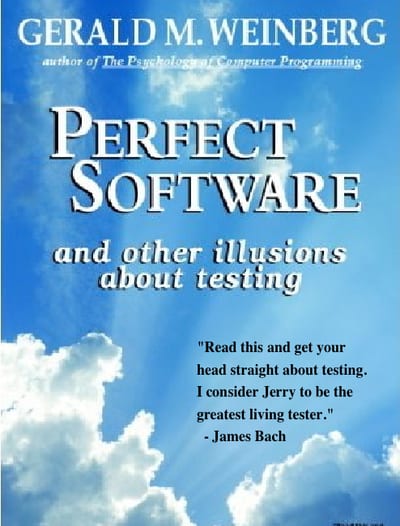
Perfect Software
And Other Illusions About Testing
by Gerald M. Weinberg
- Publisher
- Dorset House
- Year
- 2008
Useful when you are: Practising tester, Senior / lead, Manager
Verdict
Should you read it?
Read it if
You are repeatedly having the same argument about coverage, sign-off or why a defect escaped. It gives you the vocabulary to reframe that conversation rather than keep losing it.
Skip it if
You want technique. There is almost no practical testing instruction in it, by design.
The argument
What it argues
Weinberg takes the beliefs people hold about testing and examines them one at a time: that testing can find all the bugs, that more testing always means better quality, that a tester who finds no defects has done nothing, that testing can be fully automated, that quality can be measured by a number.
The underlying argument is that testing provides information for a decision, and that most dysfunction around testing comes from expecting it to provide certainty instead. Once you accept that testing informs rather than guarantees, a great many arguments about coverage, metrics and sign-off resolve themselves.
It is written for a mixed audience deliberately. The most useful thing a tester can do with it is give it to a manager.
Key ideas
Ideas worth taking from it
- 01
Testing gathers information
It does not improve quality directly and cannot prove absence of defects. Every reasonable expectation of testing follows from accepting this.
- 02
The meaningless metric
Defect counts, coverage percentages and pass rates all measure something other than what people believe. Weinberg takes each apart in turn.
- 03
Why testing gets blamed
An organisation that expects certainty from testing will blame testing when it does not arrive, regardless of how well the testing was done.
Criticism
What has dated, and what it gets wrong
The conversational style and invented dialogues grate on some readers, and the book is repetitive in the second half. It also diagnoses more than it prescribes, so a reader hoping to be told what to do instead will find it unsatisfying.
Reading paths
On our reading paths
From tester to test lead
Book 1 of 5 · Moving into a lead role
Read it before your next difficult stakeholder conversation. It explains what testing can and cannot tell anyone, which is the conversation a lead has every week.
- 1. Perfect Software (this book)
 2. More Agile Testing
 3. Fifty Quick Ideas to Improve Your Tests
 4. How Google Tests Software
 5. Accelerate
Keep reading
What to read next
Reading about quality is cheaper than learning it in production.
QAble runs QA for products in BFSI, gaming, healthcare and SaaS, with engineers who have read these and argued about them. Start with a free QA audit.