


Test automation is often introduced with clear expectations. Faster execution, better coverage, and improved efficiency. But for many organizations, one question remains unanswered.
Is automation actually delivering measurable business value?
Teams invest in automation frameworks, tools, and scripts, yet the impact is not always clearly visible beyond execution metrics. Faster test runs or higher automation coverage do not always translate into better release outcomes.
The real value of test automation lies in how it influences:
- Release Speed
- Product Quality
- Operational Efficiency
- Risk Reduction
Without a structured way to measure this impact, automation remains an engineering activity rather than a business enabler.
Measuring the business impact of test automation helps connect testing efforts with real outcomes such as fewer production defects, faster release cycles, and improved system reliability.
This blog explores how to evaluate the true impact of test automation, the metrics that matter, and how organizations can build a more insight-driven approach to quality and speed.
Related Read: How to Develop a Test Automation Strategy?
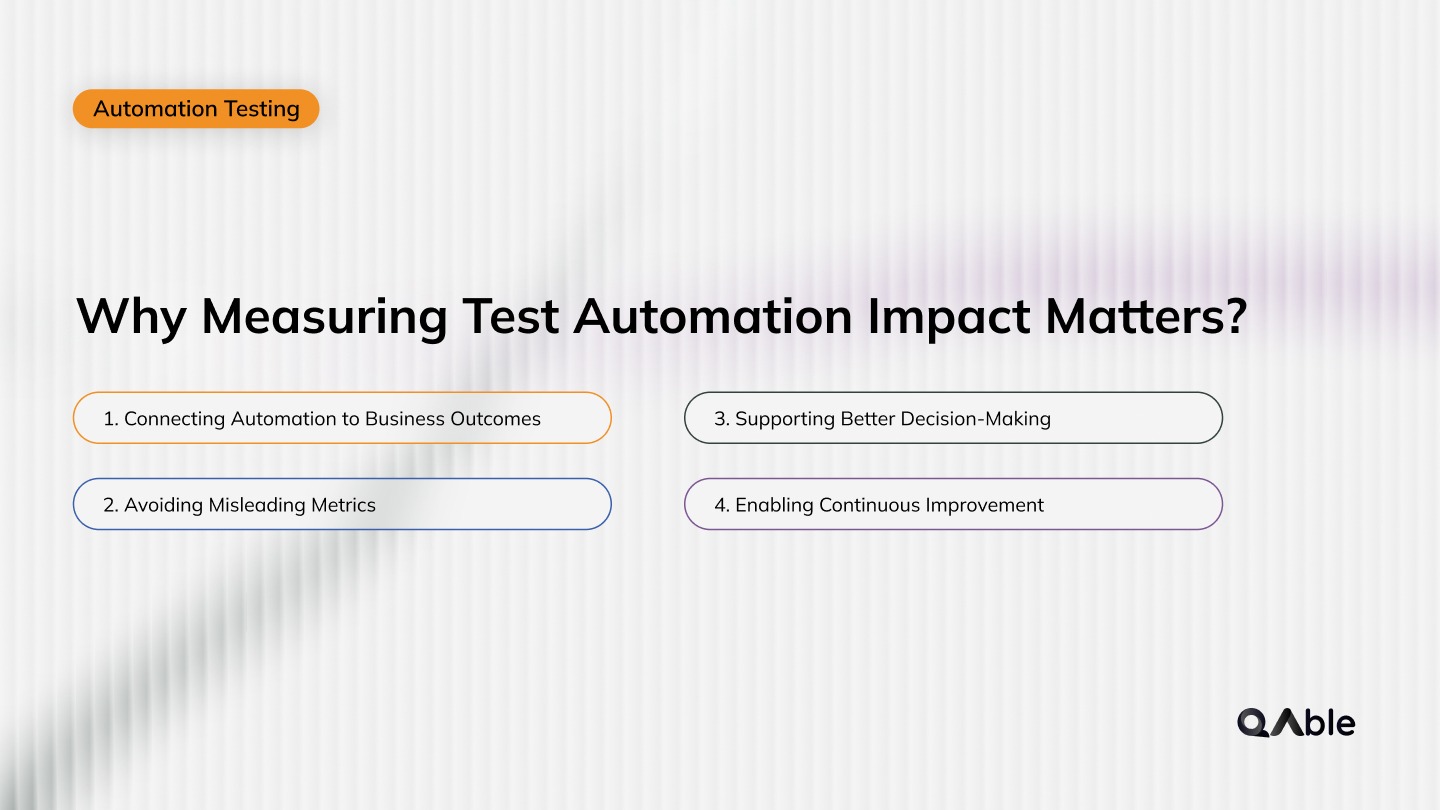
Why Measuring Test Automation Impact Matters?
Test automation is often measured using technical metrics such as execution time, number of automated tests, or coverage percentage. While these indicators are useful, they do not fully explain whether automation is delivering meaningful value to the business.
Without proper measurement, automation efforts can become disconnected from actual outcomes.
Organizations may continue investing in automation without clearly understanding:
- Whether it improves release speed
- How it impacts product quality
- Where it reduces risk
- What return it delivers over time
This lack of clarity creates challenges in scaling automation effectively.
1. Connecting Automation to Business Outcomes
The primary purpose of test automation is not just to execute tests faster. It is to improve how quickly and reliably software can be delivered.
Measuring impact helps you understand:
- How automation reduces release cycle time
- How it improves defect detection before production
- How it minimizes rework and operational delays
When these connections are visible, automation becomes easier to justify and expand.
2. Avoiding Misleading Metrics
Many teams rely on surface-level metrics such as:
- Number of automated test cases
- Percentage of test coverage
- Execution speed improvements
While useful, these metrics do not always reflect real impact.
For example, high automation coverage does not guarantee better quality if critical scenarios are not covered. Similarly, faster execution does not help if defects are still escaping to production.
Measuring impact ensures that automation is evaluated based on outcomes, not just activity.
3. Supporting Better Decision-Making
When automation impact is measurable, it becomes a decision-support tool.
Teams can:
- Identify high-risk areas
- Prioritize testing efforts
- Allocate resources effectively
- Decide where automation should be expanded
This reduces guesswork and improves planning across development and QA.
4. Enabling Continuous Improvement
Automation is not a one-time investment. It evolves with the system.
Measuring impact helps you:
- Identify gaps in automation coverage
- Detect inefficiencies in test execution
- Improve framework stability
- Refine automation strategy over time
This creates a feedback loop where automation continuously improves rather than becoming outdated.
Overview
Measuring the impact of test automation ensures that efforts are aligned with real business outcomes.
It helps organizations move beyond execution metrics and focus on what truly matters. Faster releases, better quality, and reduced risk.
Related Read: Best QA Testing Practices for New Projects
Key Metrics to Measure Test Automation Impact
Measuring test automation impact requires focusing on metrics that reflect real outcomes, not just execution activity.
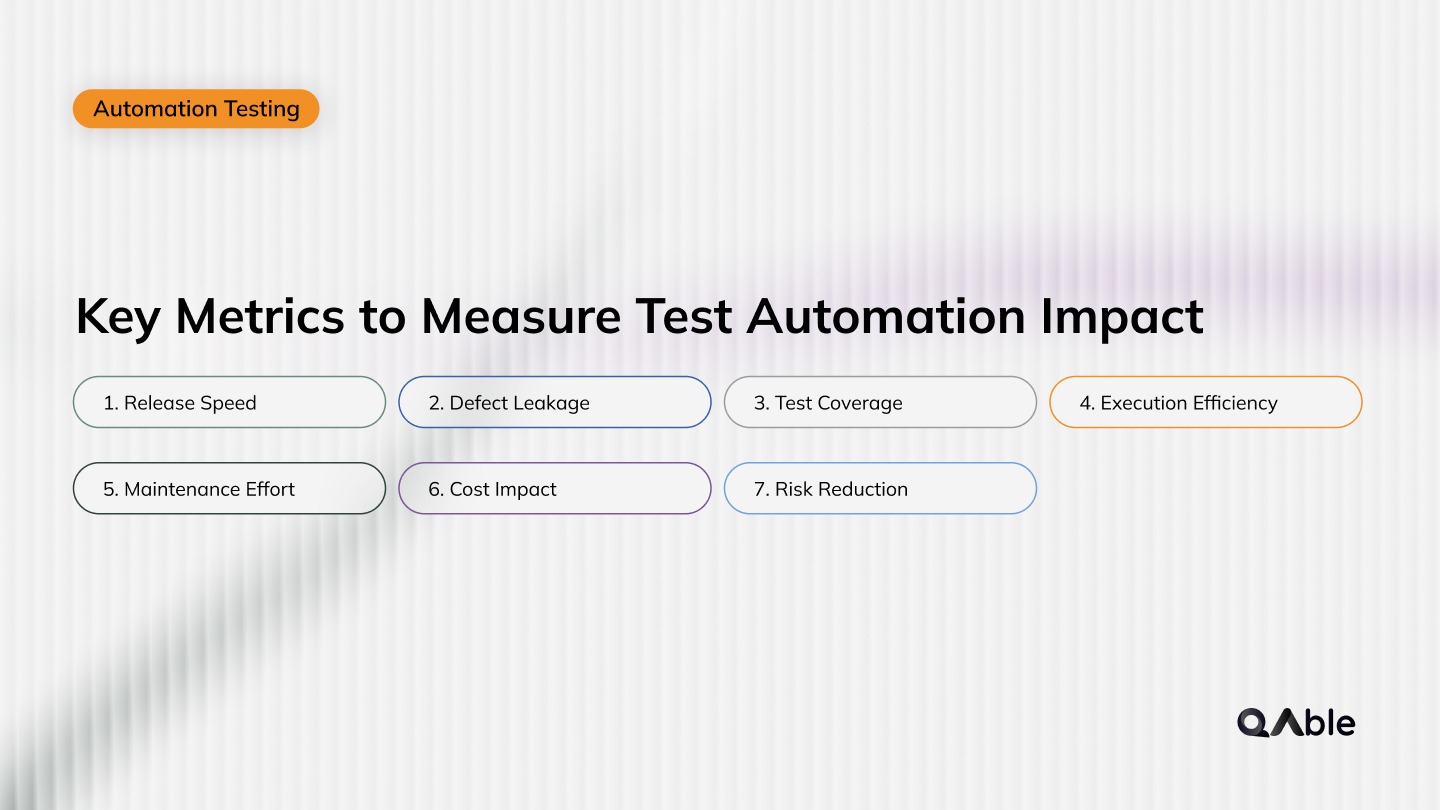
The right metrics help connect automation efforts with speed, quality, efficiency, and risk reduction.
1. Release Speed
Automation should directly influence how quickly software can be delivered.
- Cycle time
- Regression duration
- Release frequency
Tracking these metrics helps you understand whether automation is reducing testing time and enabling faster, more predictable releases.
2. Defect Leakage
One of the most important indicators of automation effectiveness is how many defects escape to production.
- Production defects
- Escaped bugs
- Hotfix frequency
Lower defect leakage indicates that automation is successfully identifying issues before release, improving overall product quality.
3. Test Coverage
Coverage should reflect meaningful validation, not just quantity.
- Critical workflows
- High-risk areas
- Regression scenarios
Measuring coverage ensures that automation focuses on the most impactful parts of the system rather than low-value test cases.
4. Execution Efficiency
Automation should optimize how testing is performed.
- Execution time
- Parallel runs
- Environment utilization
Improved efficiency reduces delays in the pipeline and supports continuous integration and delivery workflows.
5. Maintenance Effort
Automation value decreases if maintenance effort becomes too high.
- Script stability
- Update frequency
- Failure rates
Tracking maintenance helps ensure that automation remains sustainable and does not become a bottleneck.
6. Cost Impact
Automation should contribute to long-term cost optimization.
- Reduced manual effort
- Lower rework costs
- Improved resource utilization
Measuring cost impact helps evaluate the return on investment and justify further automation initiatives.
7. Risk Reduction
Automation should reduce uncertainty in releases.
- High-risk coverage
- Failure trends
- Defect patterns
Understanding how automation impacts risk helps teams prioritize testing efforts and improve release confidence.
Overview
The true value of test automation lies in how it improves speed, quality, and reliability.
Measuring the right metrics ensures that automation efforts are aligned with business outcomes and long-term scalability.
Related Read: The cost of bugs you pay in production
How to Measure Test Automation ROI?
Measuring ROI in test automation is not just about cost savings.
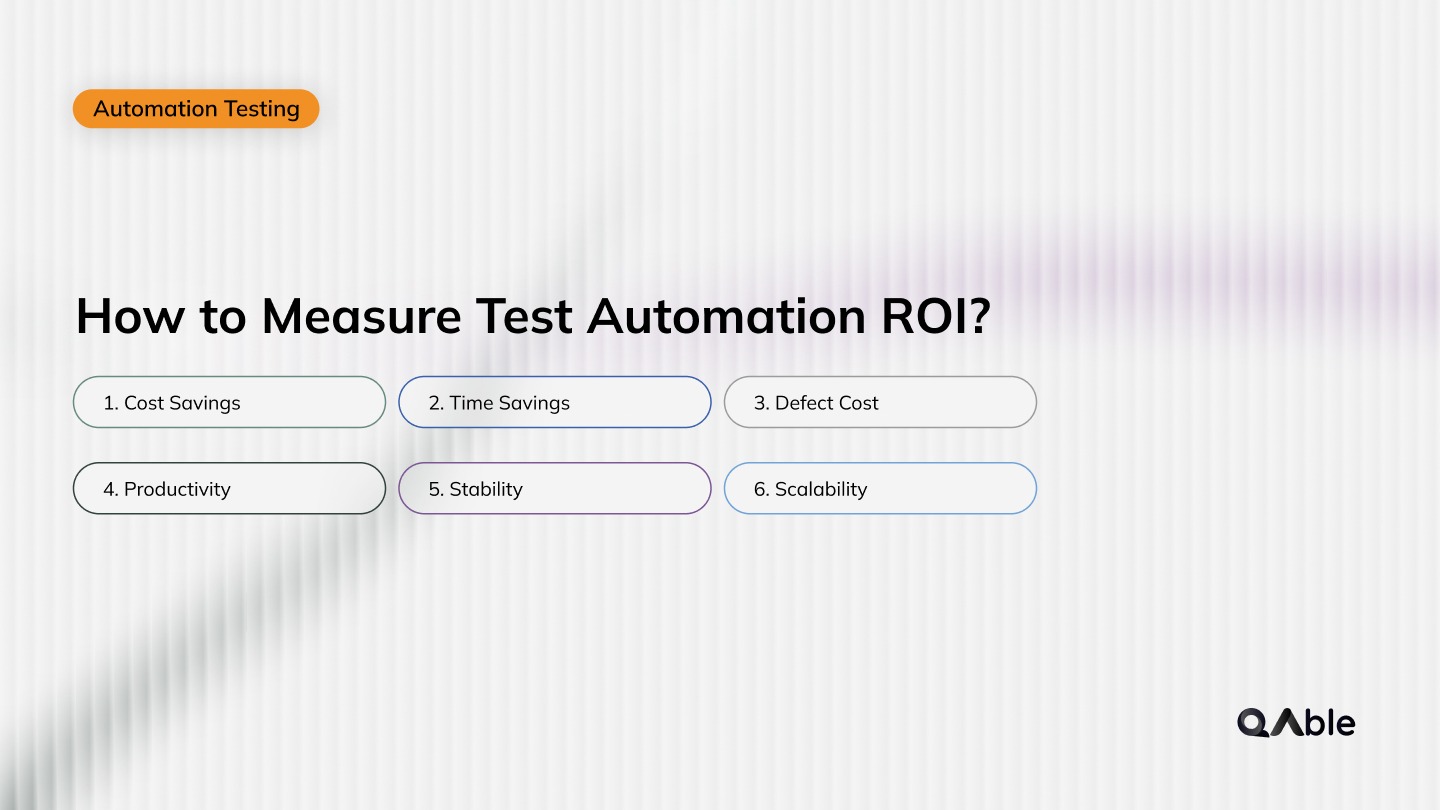
It is about understanding how automation improves speed, quality, and efficiency over time.
1. Cost Savings
Automation reduces the need for repetitive manual testing.
- Manual effort reduction
- Fewer testing hours
- Resource optimization
Over time, this leads to lower operational costs and more efficient use of QA resources.
2. Time Savings
Automation accelerates testing cycles and feedback loops.
- Faster regression cycles
- Reduced execution time
- Quicker feedback
This directly contributes to shorter release cycles and improved delivery speed.
3. Defect Cost
Early defect detection reduces the cost of fixing issues.
- Pre-release detection
- Fewer production bugs
- Reduced rework
Defects identified earlier in the lifecycle are significantly cheaper to fix compared to those found in production.
4. Productivity
Automation enables teams to focus on higher-value tasks.
- Reduced repetitive work
- Improved team efficiency
- Better test focus
This improves overall productivity across QA and development teams.
5. Stability
Reliable automation improves system stability and release confidence.
- Consistent validation
- Reduced human error
- Predictable outcomes
This helps teams deliver with greater confidence and fewer unexpected issues.
6. Scalability
Automation supports growth without proportional increase in effort.
- Increased test volume
- Faster scaling
- Consistent coverage
This ensures that testing can keep up with expanding systems and features.
Overview
Measuring ROI helps organizations understand the real value of automation beyond execution metrics.
It provides a clear view of how automation contributes to cost efficiency, faster delivery, and improved product quality.
Related Read: Benefits of QA outsourcing
Challenges in Measuring Test Automation Impact
Measuring the impact of test automation is not always straightforward.
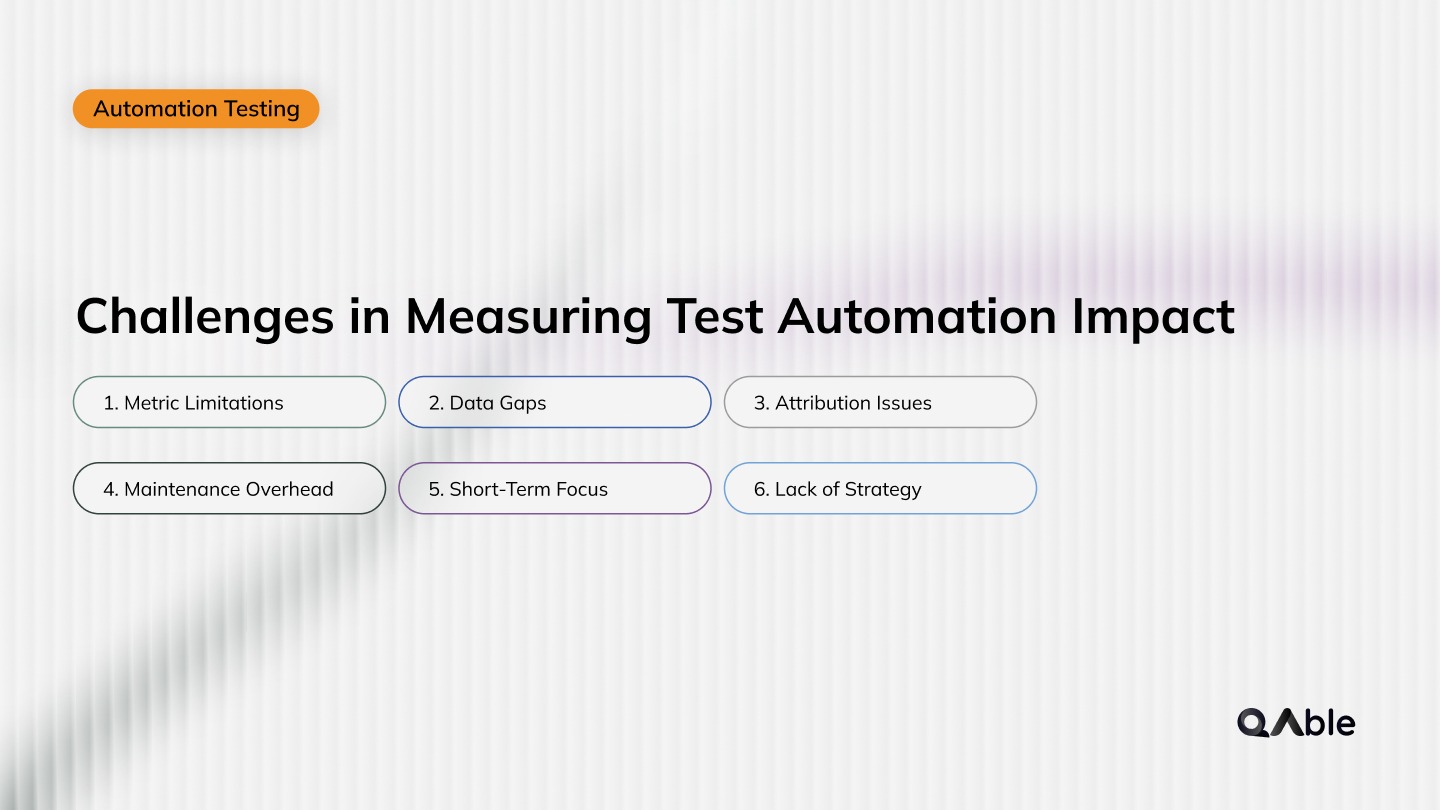
Many organizations struggle to connect automation efforts with real business outcomes due to gaps in strategy, data, and measurement approaches.
1. Metric Limitations
Not all metrics reflect actual value.
- Surface-level metrics
- Misleading coverage
- Execution-focused tracking
Relying only on execution metrics can create a false sense of progress, where automation appears effective but does not improve quality or speed.
2. Data Gaps
Incomplete or inconsistent data makes measurement difficult.
- Missing historical data
- Inconsistent reporting
- Fragmented tools
Without reliable data, it becomes challenging to track trends, identify improvements, or measure long-term impact.
3. Attribution Issues
It is often difficult to isolate the impact of automation alone.
- Multiple influencing factors
- Shared ownership
- Overlapping processes
Changes in quality or speed may result from multiple improvements, making it hard to attribute results directly to automation.
4. Maintenance Overhead
High maintenance effort can reduce perceived value.
- Unstable scripts
- Frequent updates
- Flaky tests
If automation requires constant fixes, its benefits may be offset by the effort needed to maintain it.
5. Short-Term Focus
Organizations often expect immediate results from automation.
- Unrealistic expectations
- Early-stage inefficiencies
- Lack of long-term view
Automation delivers the most value over time, but short-term evaluation can lead to incorrect conclusions about its effectiveness.
6. Lack of Strategy
Without a structured approach, measurement becomes inconsistent.
- Unclear goals
- Undefined success metrics
- Reactive tracking
A lack of strategy prevents teams from aligning automation efforts with business objectives.
Overview
Measuring test automation impact requires more than tracking metrics.
It requires clear goals, reliable data, and a structured approach to interpreting results.
Related Read: Risk Based Testing in Agile: What You Need to Know
How QAble Measures Test Automation Impact?
Measuring automation impact requires more than tracking isolated metrics.
It requires connecting testing data with system behavior, risk, and business outcomes.
1. Outcome Focus
Automation is evaluated based on results, not just activity.
- Release speed
- Defect reduction
- Stability improvements
Instead of measuring how much automation exists, the focus is on how it improves delivery and product reliability.
2. Risk Mapping
Automation is aligned with areas that carry the highest risk.
- Critical workflows
- High-impact modules
- Failure-prone areas
This ensures that automation efforts are focused where they deliver the most value rather than being spread evenly across the system.
3. Data Insights
Testing data is used to identify patterns and trends.
- Defect trends
- Failure patterns
- Execution insights
These insights help teams understand where issues originate and how automation contributes to improving system quality.
4. Continuous Tracking
Impact is measured continuously, not at a single point in time.
- Release comparisons
- Trend monitoring
- Performance tracking
This allows teams to track improvements over multiple cycles and refine strategies as systems evolve.
5. Decision Support
Automation data is used to support release and quality decisions.
- Risk visibility
- Readiness insights
- Prioritization guidance
This transforms automation from a testing activity into a system that supports informed decision-making.
6. Balanced Approach
Automation is combined with structured validation and expert review.
- Automated execution
- Human insight
- Contextual validation
This ensures that automation delivers both efficiency and accuracy without relying solely on scripts.
Overview
QAble approaches test automation as a system that connects execution, data, and decision-making.
By focusing on outcomes, risk, and continuous insights, automation becomes a driver of both quality and speed.
Related Read: Why Should Companies Outsource QA in Modern Software Development?
Final Thoughts
Test automation delivers value only when it improves both speed and quality in a measurable way.
Without clear visibility into its impact, automation risks becoming an activity rather than a business driver.
Measuring the right metrics helps teams move beyond execution and focus on outcomes such as faster releases, reduced defects, and improved system reliability.
A structured approach to measurement enables organizations to:
- Align automation with business goals
- Prioritize high-impact areas
- Improve release confidence
- Continuously refine testing strategies
At QAble, test automation is treated as part of a broader quality engineering system. By combining automation, structured validation, and quality intelligence, teams can ensure that automation contributes directly to delivery speed and product quality.
Related Read: Measuring Test Automation's Business Impact