


Cross-browser testing tools let you check that a website works and looks right in every browser your users have. The choice matters more than most tool lists admit, because the right answer depends on which browsers you must cover and whether you can run them yourself.
This guide reviews seven tools that are available in October 2026, checked on each tool's own website, and flags four older tools that you can no longer use. Before the list, we ran one small test in four browser engines on a Windows machine on 30 October 2026, to show what these tools actually catch. Every browser passed the functional check. One of them still showed our users a different form.
What our four-browser test found
We built a one-page sign-up form with an email field, a date of birth field and two buttons. Then we ran the same Playwright test against Chromium, Microsoft Edge, Firefox and WebKit on 30 October 2026, using Playwright 1.64.1. The test confirmed the form appeared and recorded what each browser reported about it.
All four passed the functional check. The differences were in what users would see and read.
The date field was not a date field everywhere
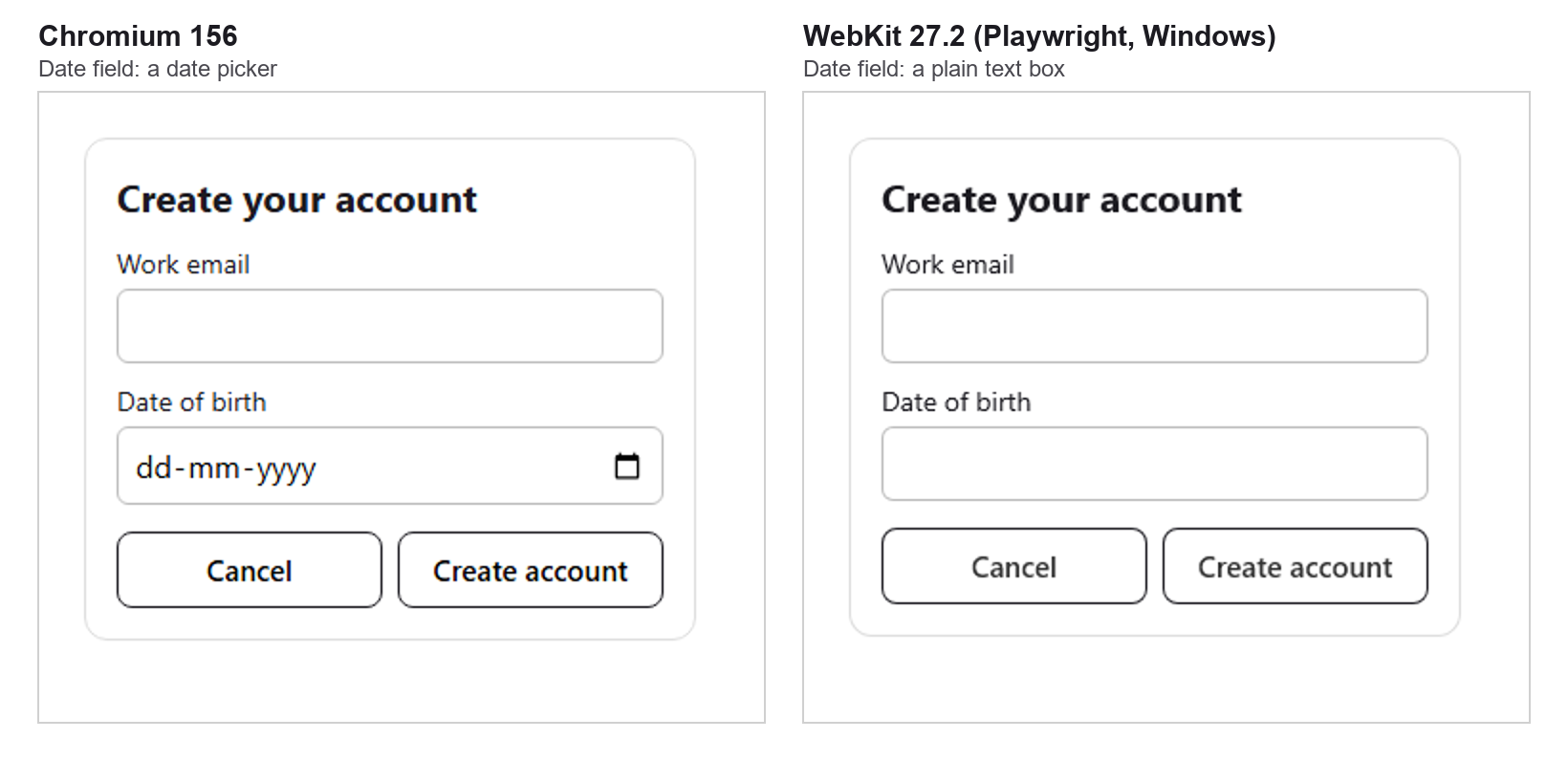
In Chromium, Edge and Firefox, the date of birth field showed a date picker. In WebKit it was a plain text box: the browser reported the field's type as "text" instead of "date". A user would have to guess the format, and a test that clicks a calendar icon would fail.
There is an important catch. The WebKit we ran is Playwright's own build for Windows, not Apple's Safari. Playwright's browser documentation says so directly: "Playwright doesn't work with the branded version of Safari since it relies on patches." It adds that "for the closest-to-Safari experience you should run WebKit on mac". So this result tells you that a WebKit-based browser can behave this way. It does not tell you what Safari on an iPhone does. To know that, you need real Safari, which is the main reason cloud testing platforms exist.
Error messages came in three wordings
Browsers write their own validation messages. When we left the required email field empty, Chromium, Edge and Firefox said "Please fill out this field." WebKit said "Fill out this field". When we typed name@ as the email address, each engine family wrote something different.
This matters for test design. A check that asserts on the exact message text will pass in one browser and fail in the next, for a reason that has nothing to do with your product. Assert that the field is invalid, or test your own error message if you show one, rather than the browser's wording.
Why these differences matter for accessibility
Both findings touch the Web Content Accessibility Guidelines. WCAG 2.2 success criterion 3.3.2, Labels or Instructions, requires that "Labels or instructions are provided when content requires user input." Where the date field falls back to a plain text box, the label "Date of birth" no longer tells the user what format to type. A visible hint such as "DD/MM/YYYY" next to the field fixes that in every browser, picker or not.
Success criterion 3.3.1, Error Identification, requires that when "an input error is automatically detected, the item that is in error is identified and the error is described to the user in text." The browser's own bubble message does describe the error, but its wording changes by engine and it disappears when the user moves on. Showing your own error text beside the field gives every user the same, lasting description, and gives your tests one stable thing to check.
Neither fix needs a new tool. They come from looking at the same form in more than one engine, which is the whole point of cross-browser testing.
One feature was missing in one engine
We also checked whether each browser offered a handful of newer web features. Nearly everything was present in all four, including the popover API and the CSS :has() selector. The exception was requestIdleCallback, a common way to schedule background work: Chromium, Edge and Firefox had it, WebKit did not. Code that calls it without checking first would throw an error only in that engine. The fix is to check for it first, with "requestIdleCallback" in window, and fall back to setTimeout when it is missing.
Default styles differ before you write any CSS
Browsers ship their own default styles for form controls. On elements our page did not style, an unstyled button had 1px 6px of padding in Chromium and Edge, 1px 4px in Firefox and 2px 6px 3px in WebKit. An unstyled dropdown was 19 px tall in Chromium and Edge, 22 px in Firefox and 28 px in WebKit.
Small as they look, these values decide whether a label fits its button or a row of controls lines up. Set the properties that matter to your layout yourself, and do not rely on browser defaults. A short reset that fixes padding, font and height on buttons, inputs and dropdowns removes most of these differences before testing starts.
Same page, different pixels
We compared screenshots of the unchanged form. Chromium and Edge, which share an engine, differed by 55 pixels out of 159,600. Firefox and WebKit each differed from them by about 2,500 to 2,900 pixels.
Most of that is font rendering and control styling, not a defect. It is still why visual comparisons need a separate approved screenshot for each browser, a point we cover in our guide to visual testing.
The test we ran
This is the test, exactly as it ran. It checks the form, then records what each browser reports and takes a screenshot.
// Runs the same checks in every configured browser and saves what each one reports.
const { test, expect } = require("@playwright/test");
const fs = require("fs");

test("same page, same checks", async ({ page, browser }, info) => {
  await page.goto("http://localhost:4243/");

  // The functional check: every browser must show the form and its submit button.
  await expect(page.getByRole("button", { name: "Create account" })).toBeVisible();

  const facts = await page.evaluate(() => {
    const email = document.getElementById("email");
    const emptyRequiredMessage = email.validationMessage;
    email.value = "name@";
    const badEmailMessage = email.validationMessage;
    email.value = "";

    // Default styles of controls the page does not style itself.
    const box = document.createElement("div");
    box.innerHTML = "<button>Go</button><select><option>A</option></select>";
    document.body.appendChild(box);
    const [button, select] = box.children;
    const defaults = { buttonPadding: getComputedStyle(button).padding, selectHeightPx: select.offsetHeight };
    box.remove();

    return {
      dateInputType: document.getElementById("dob").type,
      emptyRequiredMessage,
      badEmailMessage,
      requestIdleCallback: typeof window.requestIdleCallback === "function",
      popoverAPI: HTMLElement.prototype.hasOwnProperty("popover"),
      cssHas: CSS.supports("selector(:has(a))"),
      defaults,
    };
  });

  facts.browser = `${info.project.name} ${browser.version()}`;
  fs.mkdirSync("results", { recursive: true });
  fs.writeFileSync(`results/${info.project.name}.json`, JSON.stringify(facts, null, 1));
  await page.screenshot({ path: `results/${info.project.name}.png` });
});
The configuration runs it in four browsers. The msedge project uses the copy of Microsoft Edge installed on the machine; the others use Playwright's own browser builds.
const { defineConfig, devices } = require("@playwright/test");
module.exports = defineConfig({
  testDir: "./tests",
  reporter: [["list"]],
  use: { viewport: { width: 380, height: 420 } },
  projects: [
    { name: "chromium", use: { browserName: "chromium" } },
    { name: "firefox", use: { browserName: "firefox" } },
    { name: "webkit", use: { browserName: "webkit" } },
    { name: "msedge", use: { browserName: "chromium", channel: "msedge" } },
  ],
});
All four runs passed in 5.7 seconds.
The 7 cross-browser testing tools worth considering in 2027
Cross-browser testing can be slow work when done by hand, and the tools below speed up the process of cross browser testing. They fall into two groups. Open-source frameworks run browsers on machines you control. Cloud platforms rent you browsers, operating systems and real devices you do not own.
Every fact below comes from the tool's own website or documentation, checked on 30 October 2026. Prices and counts change often, so check them again before you buy.
1. Playwright
Playwright is Microsoft's open-source testing framework, released under the Apache 2.0 licence. Its documentation says it "can run tests on Chromium, WebKit and Firefox browsers as well as branded browsers such as Google Chrome and Microsoft Edge", and it can emulate tablets and phones. It is the tool we used for the test above.
- Best for: teams that want fast, free checks across the three main engines on every code change.
- Watch for: its WebKit is not Safari, as its own documentation states. Emulated phones are not real devices.
- Cost: free.
2. Selenium Grid
Selenium Grid is the part of the Selenium project that spreads tests across machines. Selenium's Grid documentation says it "allows the execution of WebDriver scripts on remote machines by routing commands sent by the client to remote browser instances". Its stated aims include running tests "in parallel on multiple machines" and testing "on different browser versions". We ran a Selenium suite on Grid in our Selenium automation testing guide.
- Best for: teams with an existing Selenium suite that want to run it in parallel on their own infrastructure.
- Watch for: you maintain the machines, browsers and drivers yourself.
- Cost: free, under the Apache 2.0 licence. Hardware is yours.
3. BrowserStack
BrowserStack is a cloud testing platform. It states that you can "Test on 3500+ real desktop & mobile browser combinations", alongside a cloud of real iOS and Android devices. Its documentation covers running Selenium, Playwright and Cypress tests, and Appium for mobile apps. Pages behind a firewall can be reached through BrowserStack Local.
- Best for: teams that need real Safari and real phones without owning the hardware.
- Free option: a free trial. We did not find a permanent free plan on its pricing page.
- Published starting price: $12.50 a month billed annually, or $19 month to month, for the Freelancer live testing plan.
4. TestMu AI (formerly LambdaTest)
LambdaTest changed its name. Its own announcement says: "LambdaTest rebranded to TestMu AI on January 12, 2026. Same team, same infrastructure, same customer accounts." Old lambdatest.com links now redirect to testmuai.com. It describes itself as "a cross browser testing tool with 3,000+ browser-OS combinations", and supports Selenium, Playwright, Cypress and Appium among other frameworks.
- Best for: teams that want a free tier to start with before paying.
- Free option: its pricing page describes a free plan with "limited 2-minute live testing sessions on 200+ desktop browsers", and for automation "100 lifetime minutes (not monthly) with 2 parallel sessions, no credit card required."
- Published starting price: $15 a month billed annually, or $19 monthly, for virtual live testing.
5. Sauce Labs
Sauce Labs describes itself as "Built by the company behind Selenium and Appium." Its homepage states "10,000+ real devices, 3,000+ OS/browser combinations." It supports Selenium, Cypress and Appium, Playwright through its saucectl tool, and Espresso and XCUITest for native mobile apps. Sauce Connect provides access to private sites.
- Best for: larger teams running big automated suites across browsers and mobile devices.
- Free option: a 28-day free trial with no credit card, which its sign-up page says includes "60 Automated and Live Testing minutes".
- Published starting price: $39 a month billed annually, or $49 month to month, for live testing.
6. BitBar (SmartBear)
BitBar is SmartBear's cloud for browsers and devices, described as "One cloud for all device and browser testing needs." SmartBear states it offers "Thousands of real devices at your fingertips", with public cloud, dedicated devices and private cloud options. Its documentation lists Windows, macOS and Linux browsers, plus iOS and Android.
- Best for: teams already using SmartBear tools, especially TestComplete.
- Free option: a 14-day trial with no credit card required.
- Published starting price: not listed on the pages we checked.
7. TestComplete (SmartBear)
TestComplete is a commercial tool for automated UI testing of desktop, web and mobile applications, with scripted and codeless options. SmartBear says you can "Run one GUI test across multiple browsers without any modifications." Its documentation, at version 15.85, says classic web testing runs "in any supported web browser, but only on the Windows operating system". For other browsers it connects to BitBar, which lets you test "in Safari, on Linux, macOS and so on".
- Best for: teams that prefer recorded or codeless tests and work on Windows.
- Free option: a 14-day free trial, "Full access for 14 days" and "No credit card required".
- Published starting price: not listed on the pages we checked.
Cross-browser testing tools compared
Prices are the lowest plans each vendor publishes for live or virtual testing, checked on 30 October 2026. Automation and real-device plans cost more.
Tools from older lists that are gone
The earlier version of this article recommended seven tools. Four of them are no longer usable, and a fifth has a new name.
CrossBrowserTesting was a SmartBear product. Its domain no longer resolves, and SmartBear's TestComplete documentation says: "Starting from version 14.72, the CrossBrowserTesting environment manager was deprecated and removed from the product." It recommends moving to BitBar. Browsershots and Browsera no longer respond at their addresses, and the Turbo Browser Sandbox page now returns an error. If a guide still recommends them, treat the rest of its advice with care too.
How to choose a cross-browser testing tool
Start from the browsers and devices you must cover, not from a tool's feature list. Your analytics tell you which browsers, versions and devices your users actually have. Cover those first, then add the browsers your contracts or customers require.
For most teams the answer is two tools, not one:
- A local framework for daily checks. Playwright or Selenium runs on every code change, in seconds, at no cost. It catches most functional and engine-level problems, like the date field and the missing feature in our test.
- A cloud platform for what you cannot run. Real Safari on Mac and iPhone, older browser versions and real Android devices. Run these checks before releases, or nightly, rather than on every commit, because cloud minutes cost money.
Three questions settle the cloud choice:
- Does it support the framework you already use? BrowserStack, TestMu AI and Sauce Labs all state support for Selenium, Playwright and Cypress. Check the versions you run.
- Can it reach your test environment? Staging sites behind a firewall need a tunnel, such as BrowserStack Local, Sauce Connect or the TestMu AI Tunnel.
- How many tests must run at once? Plans are priced by parallel sessions or minutes. Count your suite's runtime before you compare prices.
Make cross-browser checks part of the pipeline
A cross-browser tool only helps if it runs routinely. Put the local engines in your continuous integration pipeline so every pull request runs in at least Chromium, Firefox and WebKit. Schedule the cloud run on real Safari and real devices nightly, or before each release.
Keep the suite small for the expensive browsers. Run your critical journeys, such as sign-up, search and checkout, everywhere. Run the full regression suite in one engine. Most defects are not browser-specific, and the ones that are tend to sit in forms, layout and newer features, which our test touched in a single page.
Finally, write assertions that survive different engines. Check behaviour and state rather than browser wording, set the styles your layout depends on, and test for a feature before you use it.
Cover the browsers your users actually have
A good cross-browser setup pairs a free local framework for every change with a cloud platform for real Safari and real devices. Check which tools on any list still exist before you adopt one: four on the earlier version of this list no longer do.
If you want a team to plan and run cross-browser and device testing for your product, QAble provides compatibility testing services.