


Choosing the right web automation testing tools is harder than it used to be.
A few years ago, most teams were comparing a handful of frameworks. Today, the options are everywhere. Open-source frameworks, cloud browser testing platforms, low-code automation tools, AI-powered testing solutions, enterprise automation suites. Every tool claims faster testing, better coverage, and easier automation.
That sounds great until you actually have to choose one.
Because in QA, picking the wrong tool is not just a tooling mistake.
It becomes a delivery problem.
A framework that looks easy during evaluation may become difficult to maintain six months later. A browser automation testing tool that works well for a small regression suite may struggle when cross-browser coverage grows. Some tools fit developer-heavy teams. Others work better for enterprise QA teams with larger governance needs.
This is why most teams are no longer asking:
“Which automation tool is popular?”
They are asking:
“Which tool actually fits how our team works?”
The right web automation testing tool helps teams reduce repetitive regression effort, improve release confidence, and scale automated browser testing without creating unnecessary maintenance pain.
The wrong one creates flaky tests, debugging headaches, CI/CD friction, and constant framework upkeep.
In this guide, we break down the best web automation testing tools for modern QA teams in 2026, compare where each one fits, and help you choose based on real QA needs instead of marketing claims.
Key Takeaways
- The best web automation testing tools are not defined by popularity alone, but by how well they fit your team structure, automation ownership model, and long-term delivery goals.
- Selenium, Playwright, Cypress, BrowserStack, LambdaTest, and enterprise automation platforms each solve different operational challenges, which makes use-case fit more important than feature comparisons alone.
- Teams should evaluate web automation testing tools based on practical factors such as browser coverage, maintenance overhead, framework ownership, scalability, debugging visibility, and team technical maturity.
- Browser automation decisions made only for short-term convenience often create long-term maintenance pain, unstable execution, and framework migration challenges.
- Open-source browser automation frameworks offer greater control and customization, while cloud automation platforms help teams scale browser coverage without infrastructure ownership.
- Successful automation outcomes depend on more than tool selection, as release confidence, execution reliability, QA productivity, and long-term sustainability are equally important.
- Teams that want faster automation maturity without building framework architecture from scratch often benefit from structured automation delivery models instead of isolated tool adoption.
- The strongest automation investments are the ones that create trusted engineering signals, predictable release confidence, and sustainable quality engineering outcomes.
How to Evaluate Web Automation Testing Tools?
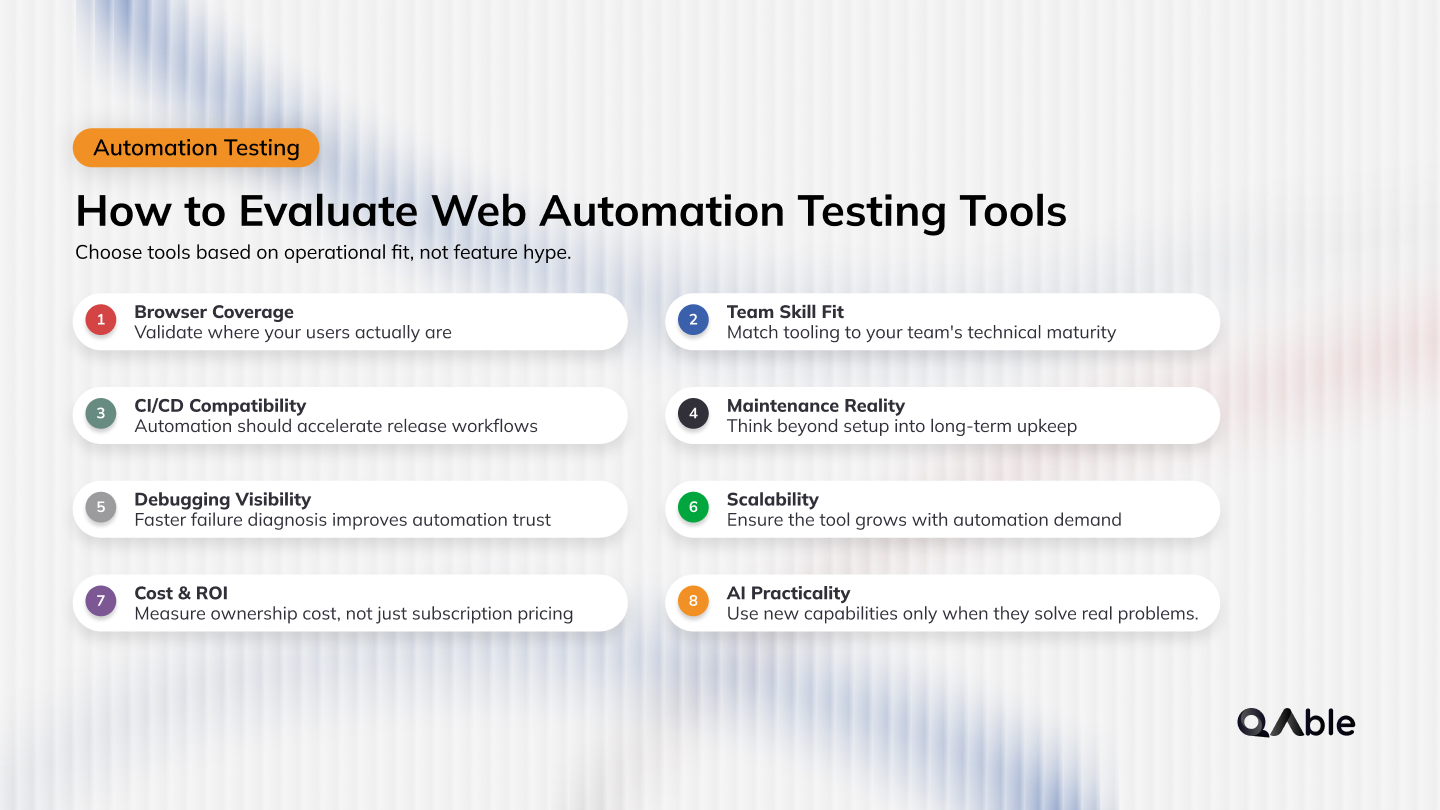
The best web automation testing tools are not always the ones with the longest feature list or the biggest market presence.
The right choice depends on how well the tool fits your product, engineering workflows, QA maturity, and long-term automation goals. Before comparing platforms or frameworks, these are the questions worth asking.
1. Browser Coverage
Not every team has the same browser testing requirements. A startup validating a Chrome-first SaaS product has very different needs compared to an enterprise supporting Chrome, Firefox, Safari, Edge, and multiple operating environments.
Browser support should be evaluated based on actual user traffic, not assumptions.
Questions to ask:
- Which browsers do our users actually use?
- Do we need real cross-browser validation or limited browser coverage?
- Will browser coverage needs grow as the product scales?
- Do we need cloud browser execution?
The right browser automation testing tool should match your real compatibility requirements instead of forcing unnecessary complexity.
2. Team Skill Fit
Some web automation tools are built for engineering-heavy teams comfortable with code-first automation. Others are designed for broader QA adoption through low-code or simplified workflows.
A technically powerful tool becomes a poor choice if the team struggles to use or maintain it.
Questions to ask:
- Who will build and maintain the automation?
- Does our QA team prefer code-first automation or lower-code workflows?
- Do we have in-house framework ownership capability?
- Will developer dependency slow adoption?
The best tool is the one your team can realistically scale, not the one that looks strongest in demos.
3. CI/CD Compatibility
Automation should support release workflows, not sit outside them.
If your engineering teams rely on fast deployments, browser automation must integrate cleanly into CI/CD pipelines without creating execution bottlenecks or unreliable feedback.
Questions to ask:
- Do we need automation inside CI/CD pipelines?
- How important is fast execution feedback?
- Will slow browser automation affect release velocity?
- Does the tool support our engineering workflow?
Strong CI/CD alignment turns automated browser testing into a release accelerator instead of a QA dependency.
4. Maintenance Overhead
Initial setup is only a small part of automation ownership.
Long-term effort often comes from maintaining locators, updating workflows, handling flaky tests, upgrading frameworks, and keeping automation stable as products evolve.
Questions to ask:
- How much maintenance will this tool require at scale?
- Will framework ownership become a burden?
- How easy is test suite maintenance?
- Does the tool help reduce flaky automation?
A tool that saves setup time but increases long-term maintenance may become expensive quickly.
5. Debugging Experience
Test failures are useful only when teams can understand and act on them quickly.
Poor debugging visibility slows investigation and creates frustration, especially in larger automation programs.
Questions to ask:
- How easy is root cause analysis?
- Does the tool provide screenshots, logs, traces, or execution evidence?
- How quickly can teams diagnose failures?
- Will debugging become harder as automation grows?
Better debugging reduces engineering friction and improves trust in automation results.
6. Scalability
A framework that works for 50 test cases may behave very differently at 2,000.
Scalability is not just about execution speed. It includes browser expansion, infrastructure overhead, maintenance growth, and operational sustainability.
Questions to ask:
- Will this tool scale with larger regression suites?
- Can it handle parallel execution efficiently?
- What happens when browser coverage expands?
- Does scaling increase operational complexity?
The right web automation testing tool should support long-term growth, not just early adoption.
7. Pricing Model
Tool pricing often looks straightforward during evaluation, but total ownership costs can grow quickly depending on execution scale, infrastructure needs, licensing, and team size.
Cost evaluation should go beyond subscription pricing.
Questions to ask:
- Is this open-source, paid, or usage-based?
- Will cloud execution costs increase over time?
- What infrastructure ownership costs should we expect?
- Does pricing still make sense as automation scales?
The cheapest tool upfront is not always the most cost-effective long term.
8. AI and Low-Code Capabilities
AI-assisted automation and low-code platforms are becoming more common in modern testing workflows.
But these capabilities should be evaluated based on practical value, not vendor positioning.
Questions to ask:
- Do we actually need AI-assisted test creation?
- Will low-code improve adoption or create limitations?
- Does AI reduce maintenance effort meaningfully?
- Are these capabilities relevant to our QA maturity?
New capabilities are useful only when they solve real operational problems.
Summary
Choosing between web automation testing tools becomes easier when the evaluation is grounded in real QA needs instead of feature marketing.
The strongest decisions come from understanding browser coverage, team fit, maintenance expectations, scalability, and how automation will support long-term delivery goals.
Related Read: Root Cause Analysis in Software Testing
Best Web Automation Testing Tools for Modern QA Teams
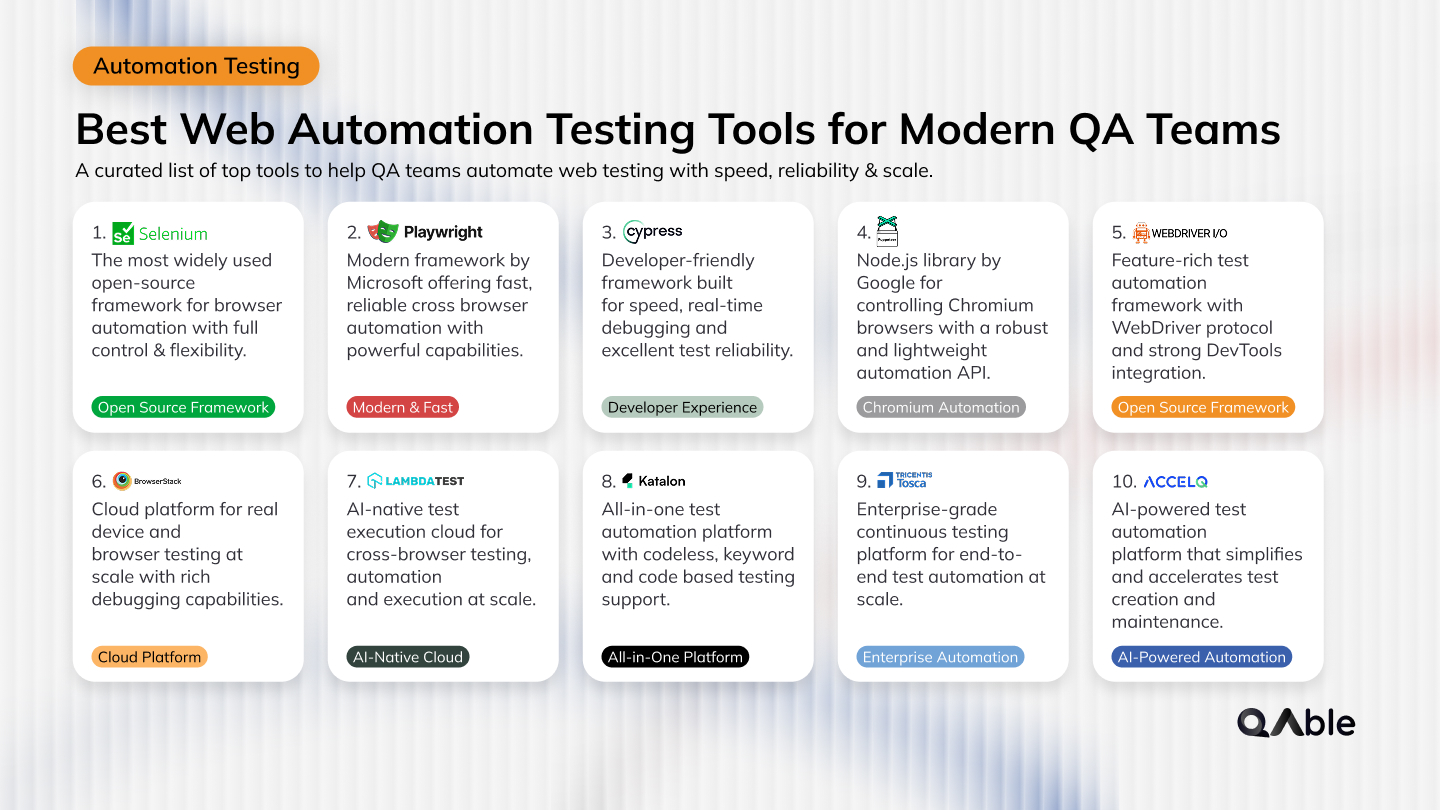
The best web automation testing tools are not necessarily the ones with the biggest community, the newest features, or the loudest market presence.
The right choice depends on how your QA team works, how much automation ownership you want, the complexity of your application, and what outcomes you expect from automation.
Some teams need full framework control and engineering flexibility. Others want faster browser automation adoption with less maintenance overhead. Enterprise teams may prioritize governance, reporting, and scalability, while product teams may focus on speed, CI/CD alignment, and quick debugging.
That is why comparing browser automation testing tools only on features often leads to poor decisions.
A tool that works well for one QA structure may create friction for another.
To make evaluation easier, we are looking at the most widely adopted web automation testing tools based on market authority, practical usage, and where they fit best in real QA environments.
This is not a “best tool wins” list.
It is a practical decision guide to help you match the right automation tool to your team, delivery model, and testing goals.
1. Selenium
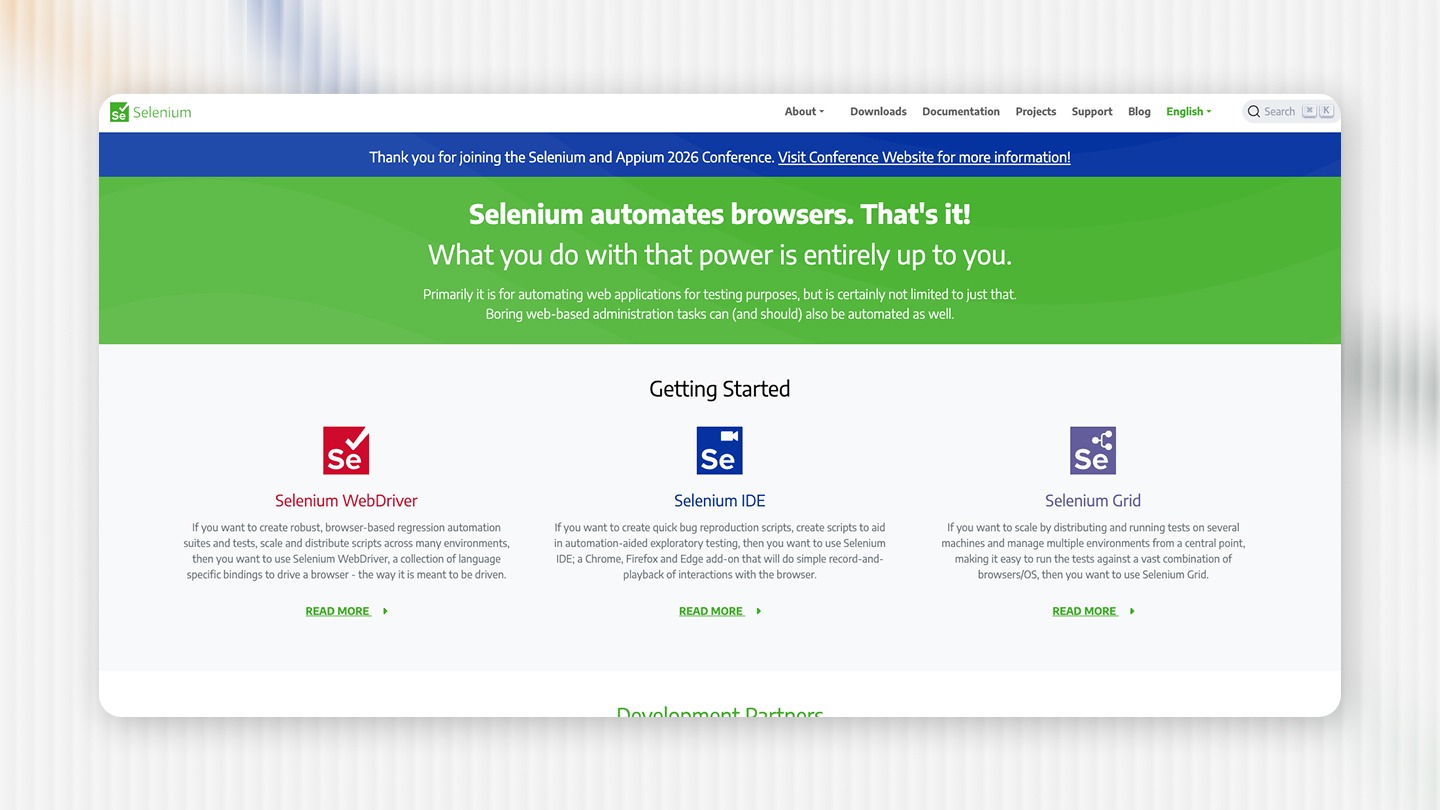
Selenium is one of the most widely used browser automation testing frameworks in the QA industry. It has been around for years and remains a common choice for teams that want full control over how their automation framework is built, customized, and scaled.
Because Selenium is open source and highly flexible, it is often used in mature automation ecosystems where teams are comfortable owning framework engineering rather than relying on managed platforms.
Best suited for:
- Engineering-led QA teams
- Organizations with in-house automation expertise
- Teams needing custom automation framework control
- Products requiring broad browser compatibility
- Enterprise environments with long-term automation ownership
Things to consider:
- Requires stronger coding expertise compared to low-code platforms
- Framework setup and maintenance effort can be significant
- Poor architecture decisions often lead to flaky automation
- Debugging can become time-consuming without proper framework design
Choose this if:
If your team needs flexibility, full framework ownership, and broad browser automation support, Selenium remains a practical fit.
2. Playwright
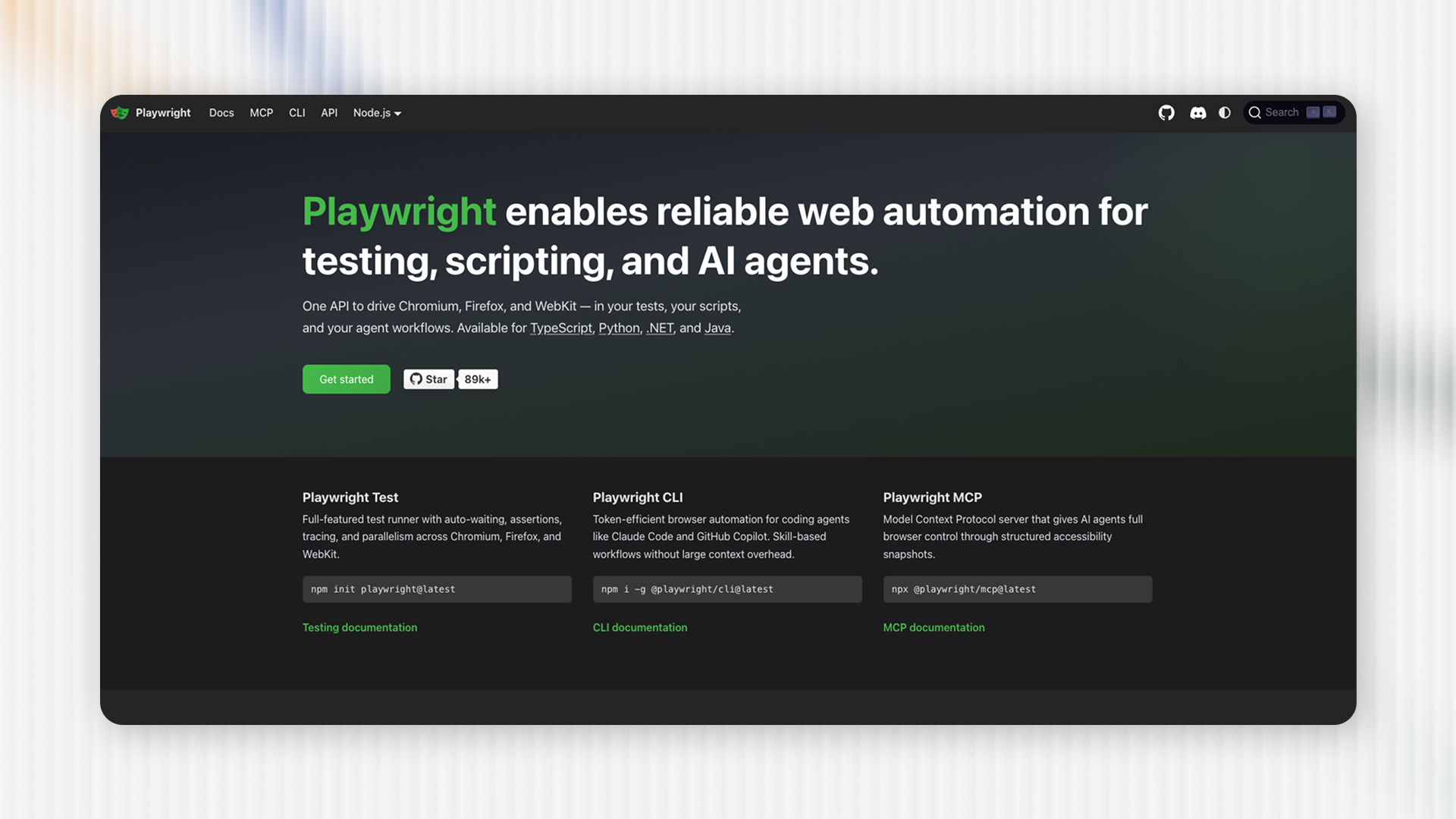
Playwright has become one of the most talked-about web automation testing tools among modern QA and engineering teams. It was built to solve many of the reliability and speed issues teams experienced with older browser automation frameworks.
It is especially popular among teams building modern web applications where faster execution, better debugging, and cleaner automation workflows matter.
Best suited for:
- Modern product engineering teams
- Developer-led automation teams
- Fast-moving SaaS teams
- QA teams prioritizing automation reliability
- Organizations adopting CI/CD-driven testing
Things to consider:
- May require JavaScript or TypeScript familiarity depending on implementation
- Less legacy enterprise familiarity compared to Selenium
- Teams migrating from older frameworks may need framework adaptation
- Some organizations may still prefer more established enterprise ecosystems
Choose this if:
If your priority is faster browser automation, modern framework architecture, and cleaner developer-friendly workflows, Playwright is a strong fit.
3. Cypress
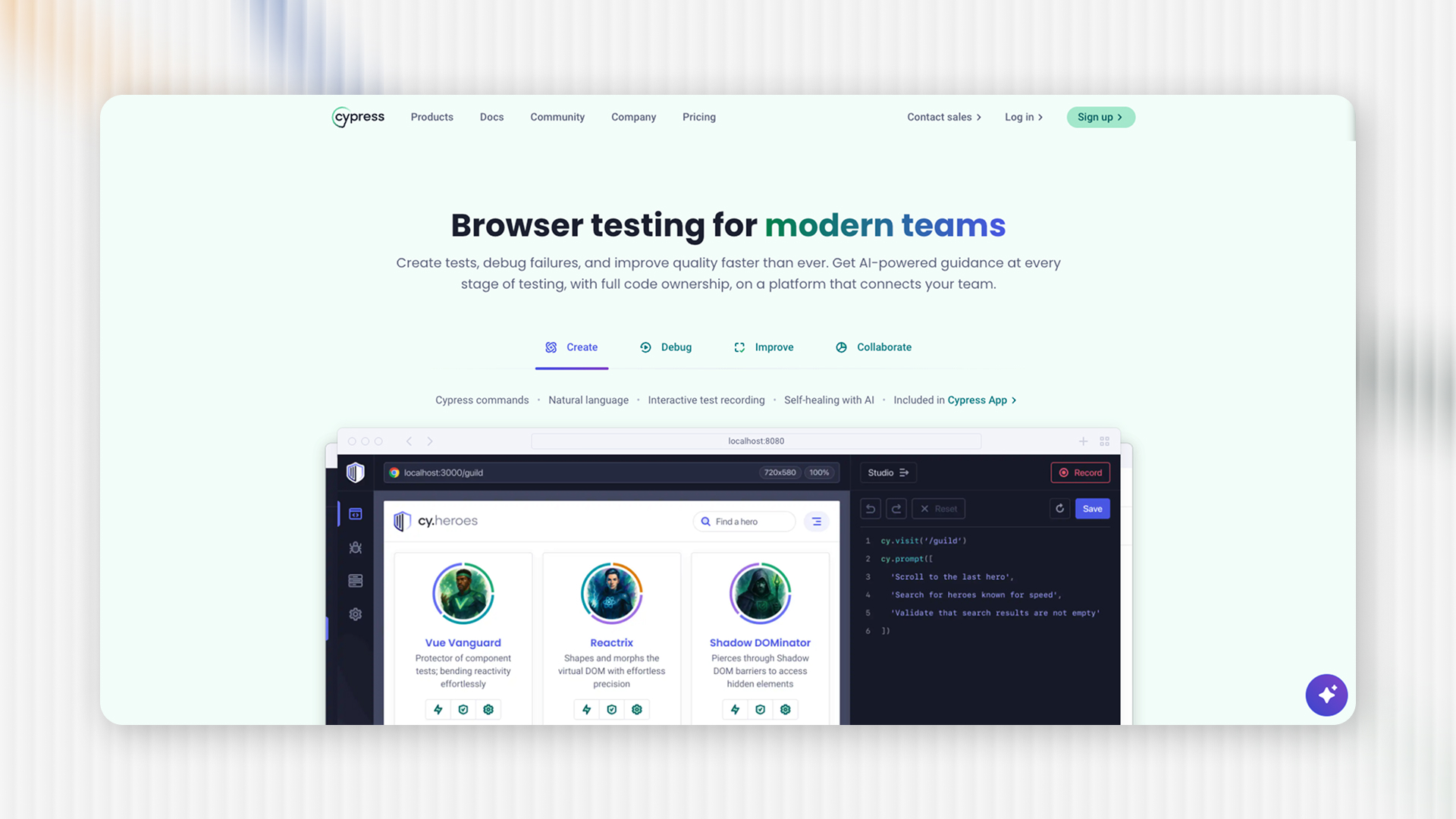
Cypress is a browser automation testing tool that gained strong adoption because of its developer-friendly experience and simpler automation workflows. Many frontend and product teams prefer it because it reduces setup friction and makes test debugging easier compared to traditional frameworks.
Its strength is usability, especially for teams that want quick feedback and fast browser automation workflows.
Best suited for:
- Frontend-focused engineering teams
- Product teams needing quick automation adoption
- QA teams working closely with developers
- Fast feedback testing workflows
- Modern JavaScript-heavy web applications
Things to consider:
- Browser support expectations should be evaluated carefully
- May not align with every enterprise browser testing requirement
- Large-scale framework ownership still requires planning
- Tool fit depends heavily on application architecture
Choose this if:
If your team values ease of adoption, fast debugging, and developer-friendly browser automation workflows, Cypress can be a practical fit.
4. BrowserStack Automate
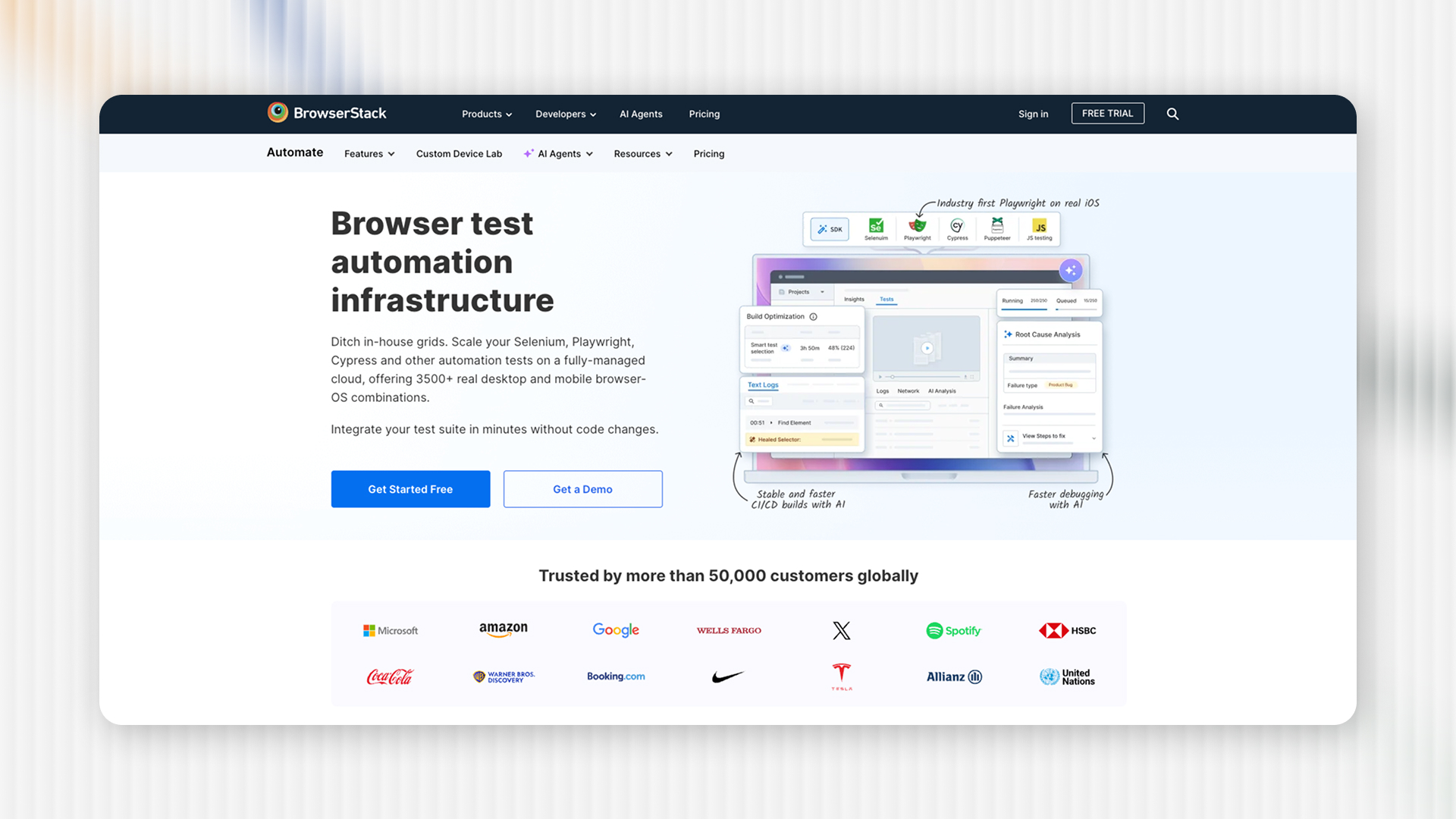
BrowserStack Automate is different from traditional browser automation frameworks because it focuses on execution infrastructure rather than framework ownership. Teams commonly use it when they need scalable browser and device validation without building or maintaining their own testing infrastructure.
It is often shortlisted when browser coverage and execution scale matter more than framework customization.
Best suited for:
- Teams needing broad cross-browser coverage
- QA teams validating across multiple environments
- Organizations avoiding infrastructure ownership
- Enterprise teams with compatibility-heavy testing needs
- CI/CD-driven release workflows
Things to consider:
- Works differently from framework-first tools like Selenium or Playwright
- Cloud execution costs should be evaluated as testing scales
- Tool selection depends on browser coverage strategy
- Teams still need strong automation design practices
Choose this if:
If your biggest requirement is scalable cross-browser execution without infrastructure management, BrowserStack Automate is a strong fit.
5. LambdaTest (TestMu AI)
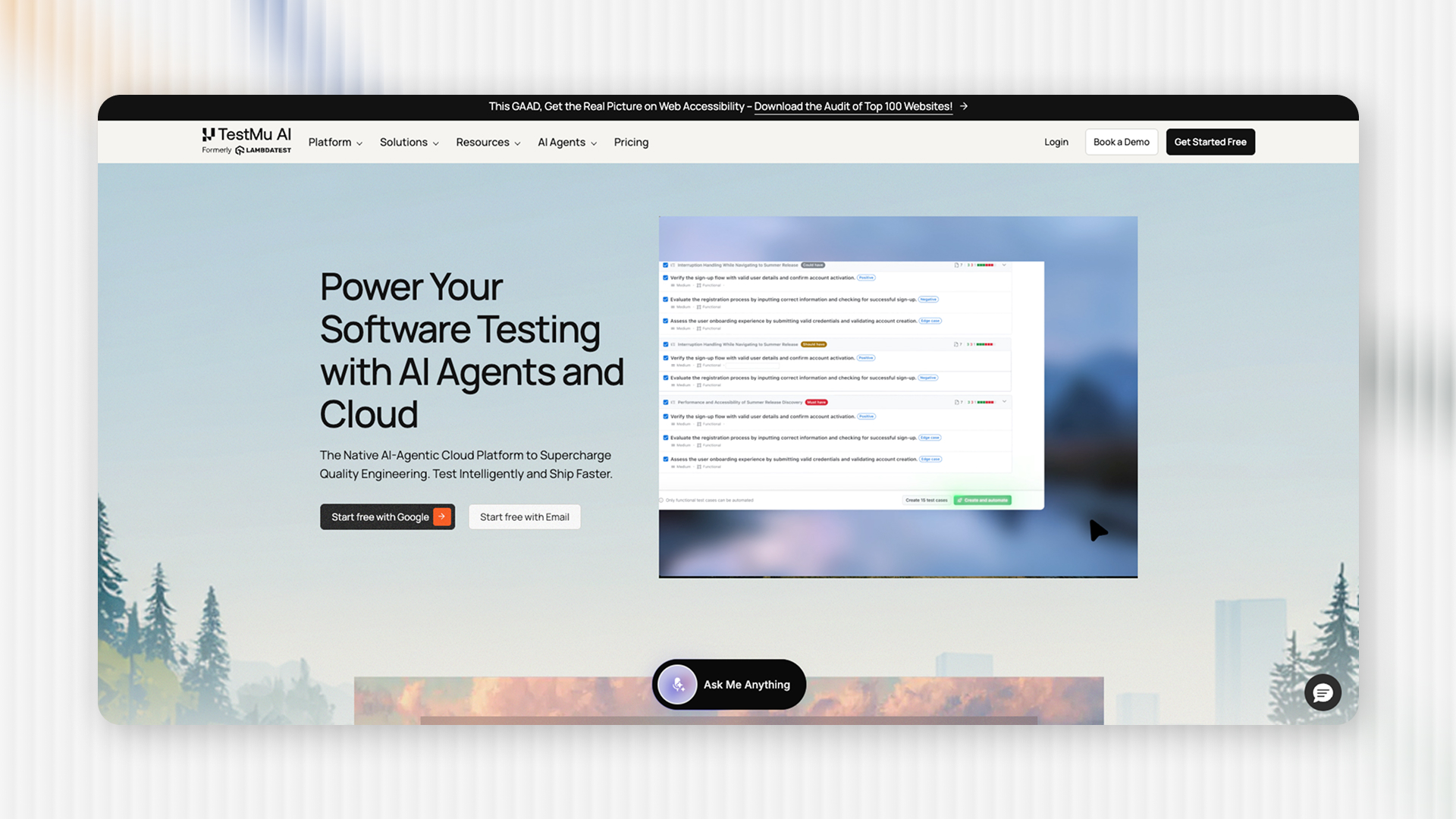
LambdaTest is a cloud-based browser automation testing platform built for teams that need scalable cross-browser validation without managing their own testing infrastructure. It is often evaluated alongside BrowserStack by teams looking to run automated browser testing across multiple browser and OS combinations efficiently.
For QA teams focused on browser compatibility, faster execution environments, and CI/CD-connected testing, LambdaTest is a practical evaluation option.
Best suited for:
- Teams with strong cross-browser testing requirements
- QA teams avoiding infrastructure ownership
- Organizations scaling browser compatibility validation
- CI/CD-driven engineering environments
- Teams needing cloud-based browser execution
Things to consider:
- Platform costs should be evaluated as execution volume grows
- Tool fit depends on browser testing complexity and usage scale
- Teams still need stable automation framework design
- Vendor selection often comes down to workflow fit and execution experience
Choose this if:
If your priority is scalable browser automation testing without infrastructure management, LambdaTest is a practical fit.
6. Puppeteer
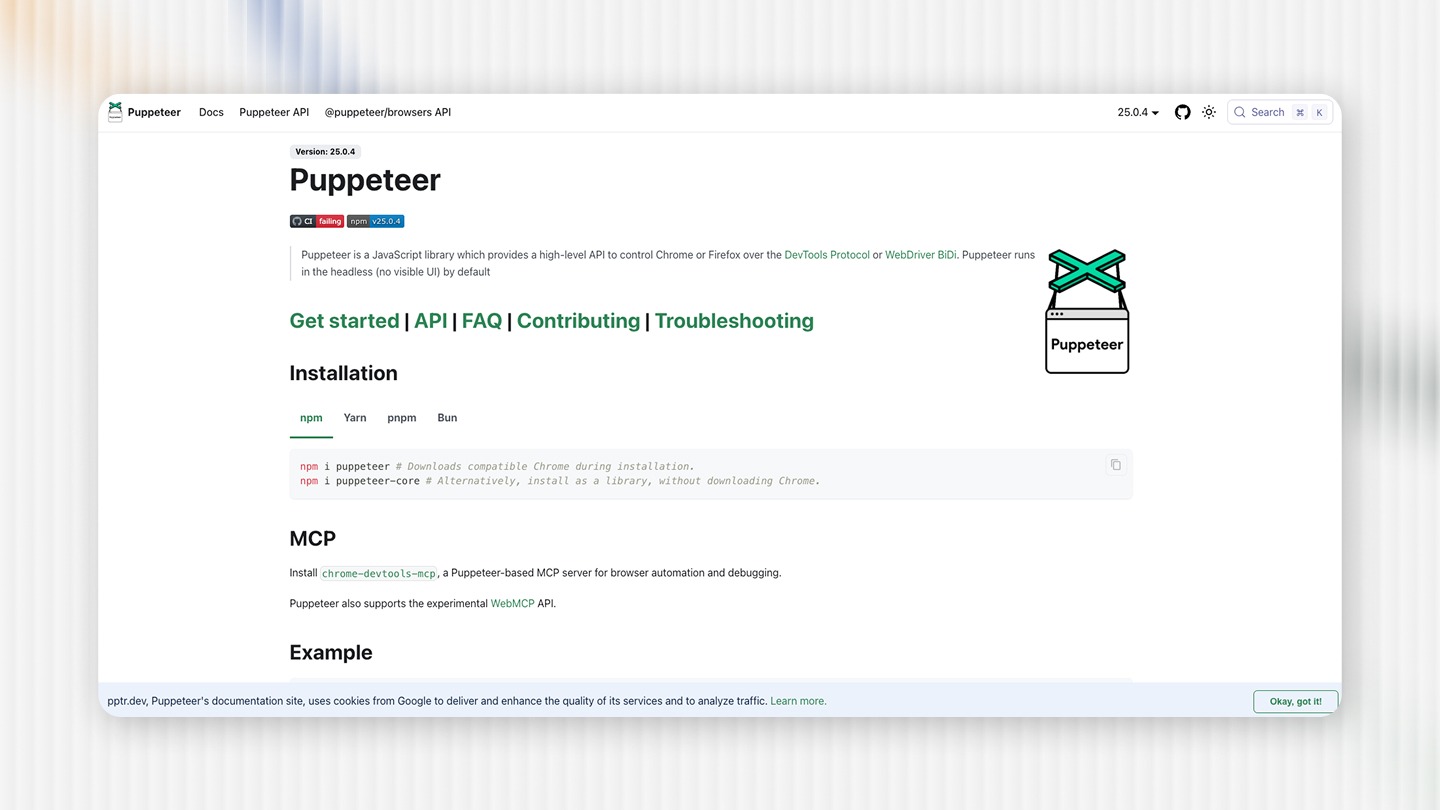
Puppeteer is a browser automation framework commonly used by engineering teams that need direct browser control, especially within Chrome-based environments. It is often used beyond traditional testing use cases, including browser interaction automation, web workflows, and scripted browser tasks.
Because of its focused architecture, Puppeteer is often chosen for specific automation needs rather than broad QA automation programs.
Best suited for:
- Developer-led automation teams
- Chrome-focused testing workflows
- Engineering teams needing browser scripting flexibility
- Specialized browser automation use cases
- JavaScript-driven product teams
Things to consider:
- Browser coverage requirements should be assessed carefully
- May not fit broader enterprise cross-browser testing strategies
- Team skill fit matters for long-term ownership
- Better suited for targeted automation use cases than generalized QA coverage
Choose this if:
If your requirement involves browser control, Chrome-focused automation, or engineering-driven browser scripting workflows, Puppeteer can be a strong fit.
7. WebdriverIO
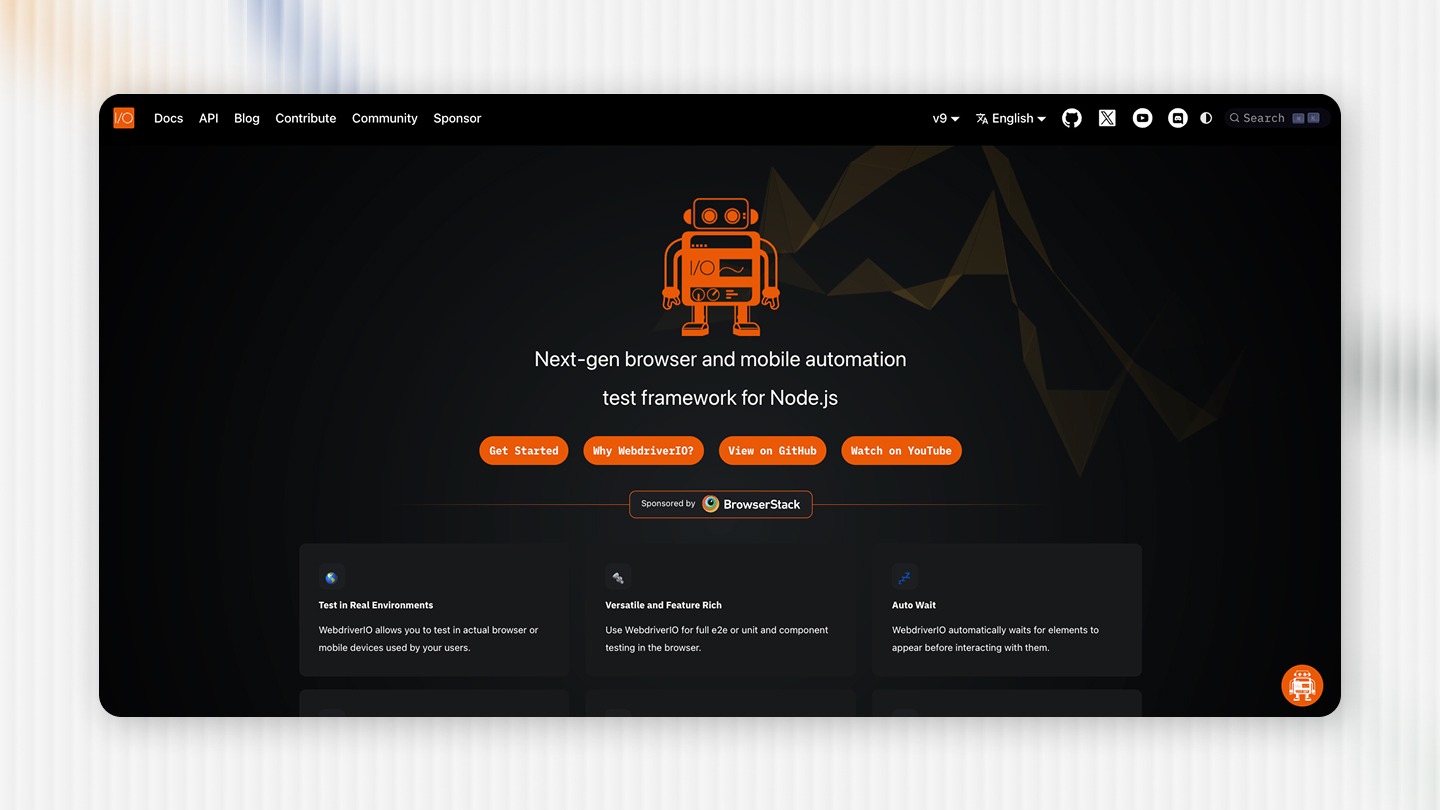
WebdriverIO is a browser automation framework that is popular among teams working heavily within the JavaScript ecosystem. It gives teams flexibility to build browser automation frameworks while offering strong plugin support, framework integrations, and modern automation workflows.
It is often considered by teams that want more framework control while staying within familiar JavaScript tooling.
Best suited for:
- JavaScript-heavy engineering teams
- Teams wanting customizable browser automation frameworks
- Developer-led QA automation environments
- Organizations needing plugin ecosystem flexibility
- Teams integrating browser automation into modern workflows
Things to consider:
- Framework ownership still requires engineering discipline
- Learning curve depends on team experience with JavaScript automation
- Maintenance planning is still important as coverage grows
- Tool fit depends on internal automation maturity
Choose this if:
If your team works deeply in the JavaScript ecosystem and wants flexible browser automation framework ownership, WebdriverIO is worth evaluating.
8. Katalon
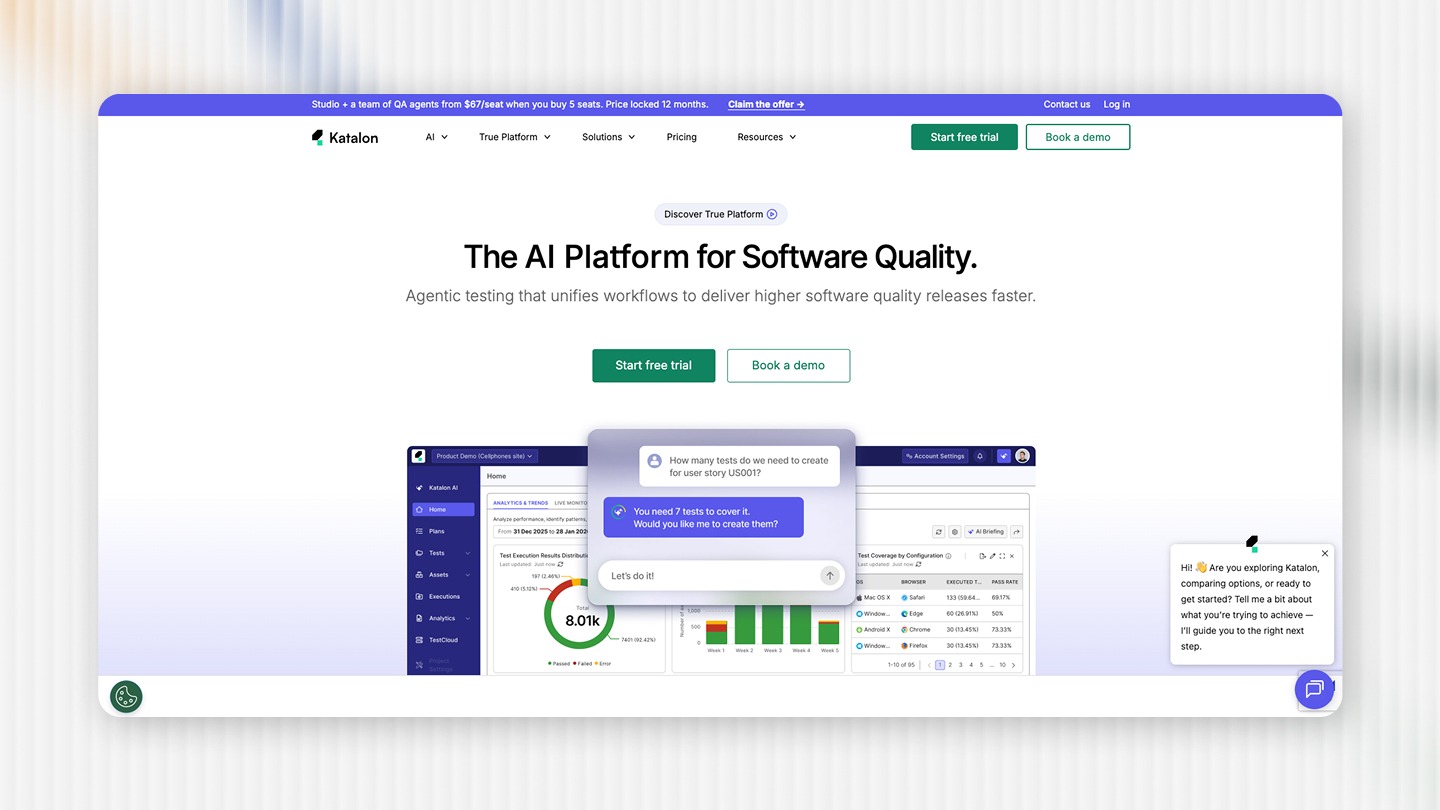
Katalon is an automation testing platform designed for teams that want faster automation adoption without building everything from scratch. It combines browser automation capabilities with a more structured testing environment, which makes it appealing for teams that want to balance automation speed with usability.
It is commonly evaluated by QA teams looking for broader automation capabilities without committing to fully custom framework ownership.
Best suited for:
- QA teams wanting faster automation adoption
- Organizations with mixed technical skill levels
- Teams looking for structured automation workflows
- Businesses reducing custom framework dependency
- Mid-sized to enterprise QA teams
Things to consider:
- Platform flexibility may differ from open framework ownership models
- Long-term fit depends on workflow complexity and team expectations
- Tool evaluation should consider scaling and customization requirements
- Commercial licensing should be factored into ownership planning
Choose this if:
If your team wants structured browser automation with faster adoption and less framework engineering overhead, Katalon is a practical fit.
9. Tricentis Tosca
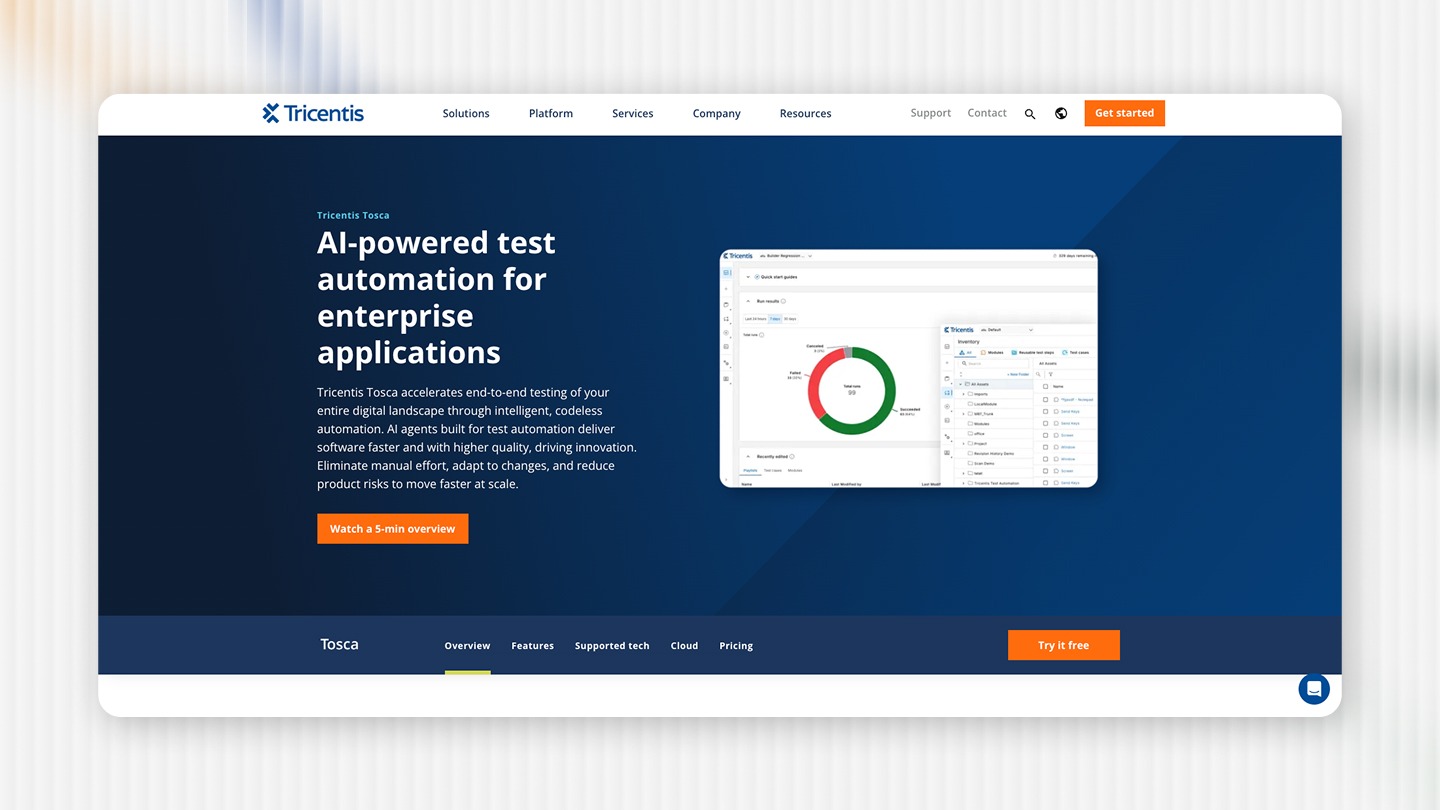
Tricentis Tosca is widely known in enterprise QA environments where automation decisions are influenced by governance, process standardization, reporting, and large-scale testing operations. It is often evaluated by organizations managing complex delivery ecosystems rather than smaller engineering-led product teams.
Its positioning is different from code-first browser automation frameworks because the focus is broader enterprise automation management.
Best suited for:
- Large enterprise QA organizations
- Regulated industries with governance-heavy QA requirements
- Teams prioritizing process standardization
- Organizations managing large testing programs
- Businesses evaluating enterprise-scale automation platforms
Things to consider:
- Tool complexity should align with organizational scale
- Evaluation should consider team adoption models
- May be more than what smaller product teams require
- Commercial investment expectations should be assessed carefully
Choose this if:
If your organization prioritizes governance, large-scale QA operations, and enterprise automation standardization, Tricentis Tosca is worth evaluating.
10. ACCELQ
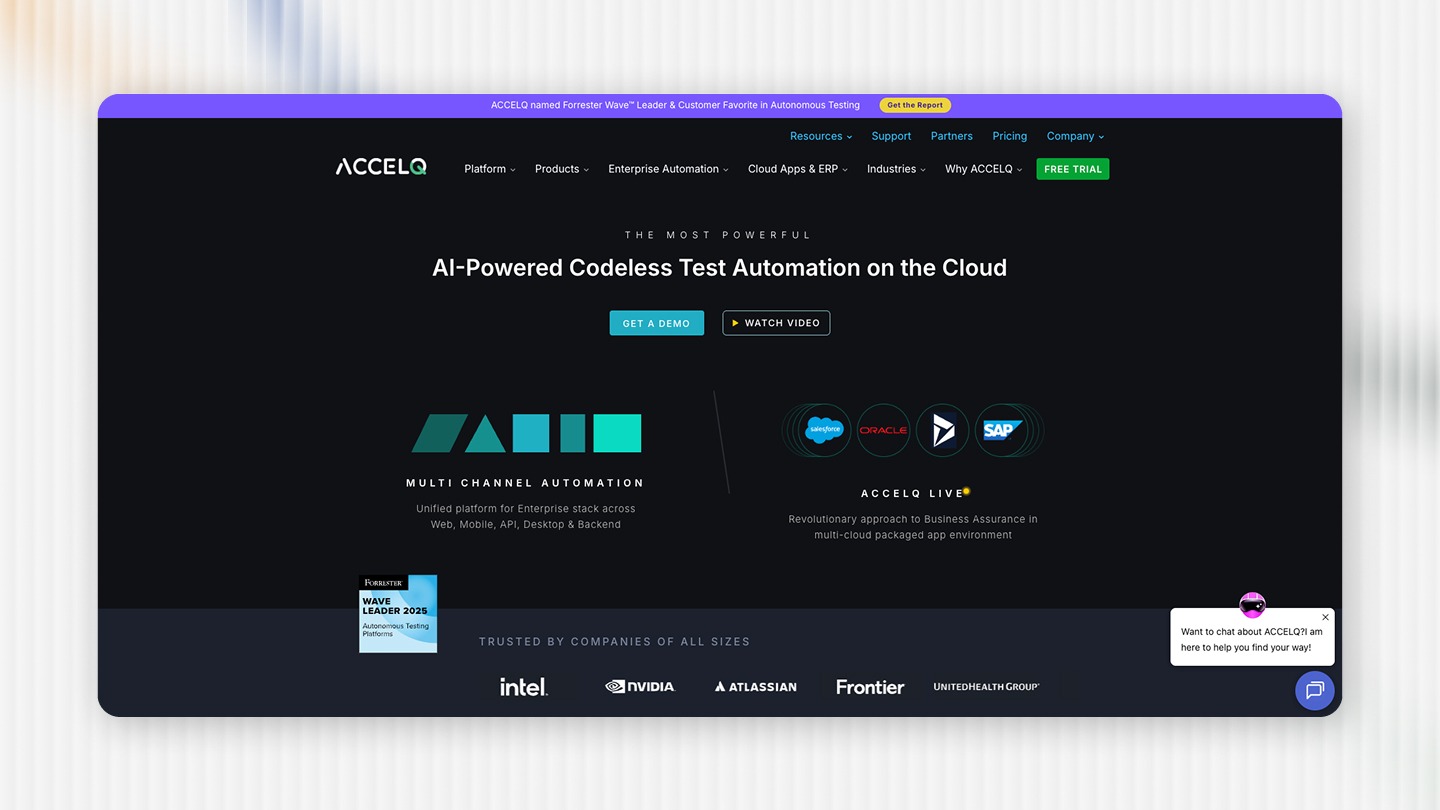
ACCELQ is a modern automation platform positioned for teams looking to accelerate automation adoption with less dependency on traditional framework engineering. It is often considered by organizations exploring scalable automation with lower coding overhead and faster test creation workflows.
Its fit is strongest where teams want automation scale without the complexity of fully custom framework ownership.
Best suited for:
- Enterprise teams scaling automation programs
- QA organizations exploring lower-code automation models
- Businesses reducing dependency on framework engineering
- Teams focused on faster automation rollout
- Organizations modernizing QA workflows
Things to consider:
- Platform fit depends on automation ownership expectations
- Teams should evaluate flexibility against specific testing requirements
- Long-term scalability should be assessed based on workflow complexity
- Commercial platform investment should be considered early
Choose this if:
If your goal is scaling automation faster while reducing custom engineering ownership, ACCELQ can be a strong evaluation candidate.
Related Read: Selenium vs Playwright vs Cypress
Web Automation Testing Tools Comparison
Choosing between web automation testing tools gets easier when you compare them based on team fit, ownership expectations, and practical use cases instead of just feature lists.
This comparison table gives a quick decision-making view of where each tool fits best.
Tool | Best For | Team Type | Learning Curve | Framework Ownership | Best Use Case |
Selenium | Flexible browser automation with full control | Engineering-led QA teams, enterprise teams | High | High | Custom automation frameworks and large-scale browser testing |
Playwright | Modern browser automation with speed and reliability | Product engineering teams, developer-led QA teams | Medium | Medium to High | Fast browser automation for modern web applications |
Cypress | Fast automation adoption and easier debugging | Frontend teams, product QA teams | Medium | Medium | JavaScript-heavy browser testing with quick feedback |
BrowserStack Automate | Scalable browser execution without infrastructure ownership | QA teams, enterprise teams | Medium | Low to Medium | Cross-browser validation across cloud environments |
LambdaTest | Cloud-based browser compatibility testing | QA teams, CI/CD-focused teams | Medium | Low to Medium | Browser coverage scaling without infrastructure management |
Puppeteer | Browser scripting and targeted browser automation | Developer-led teams | Medium to High | High | Chrome-focused automation and browser interaction workflows |
WebdriverIO | JavaScript-based automation framework flexibility | Engineering teams, JavaScript-heavy QA teams | Medium to High | High | Custom browser automation within JS ecosystems |
Katalon | Structured automation with faster adoption | QA teams, mid-sized organizations | Low to Medium | Low | Faster browser automation with less framework engineering |
Tricentis Tosca | Large-scale enterprise automation governance | Enterprise QA organizations | Medium to High | Low | Governance-heavy enterprise automation programs |
ACCELQ | Scalable lower-code automation adoption | Enterprise QA teams, automation modernization teams | Low to Medium | Low | Faster automation rollout with reduced engineering dependency |
Summary
No single tool is the best fit for every QA team.
The right decision depends on how much framework ownership your team wants, the technical maturity of your automation practice, and the outcomes you expect from browser automation.
Related Read: Top 10 Automated QA Testing Tools in 2026
Common Mistakes When Choosing Automation Tools
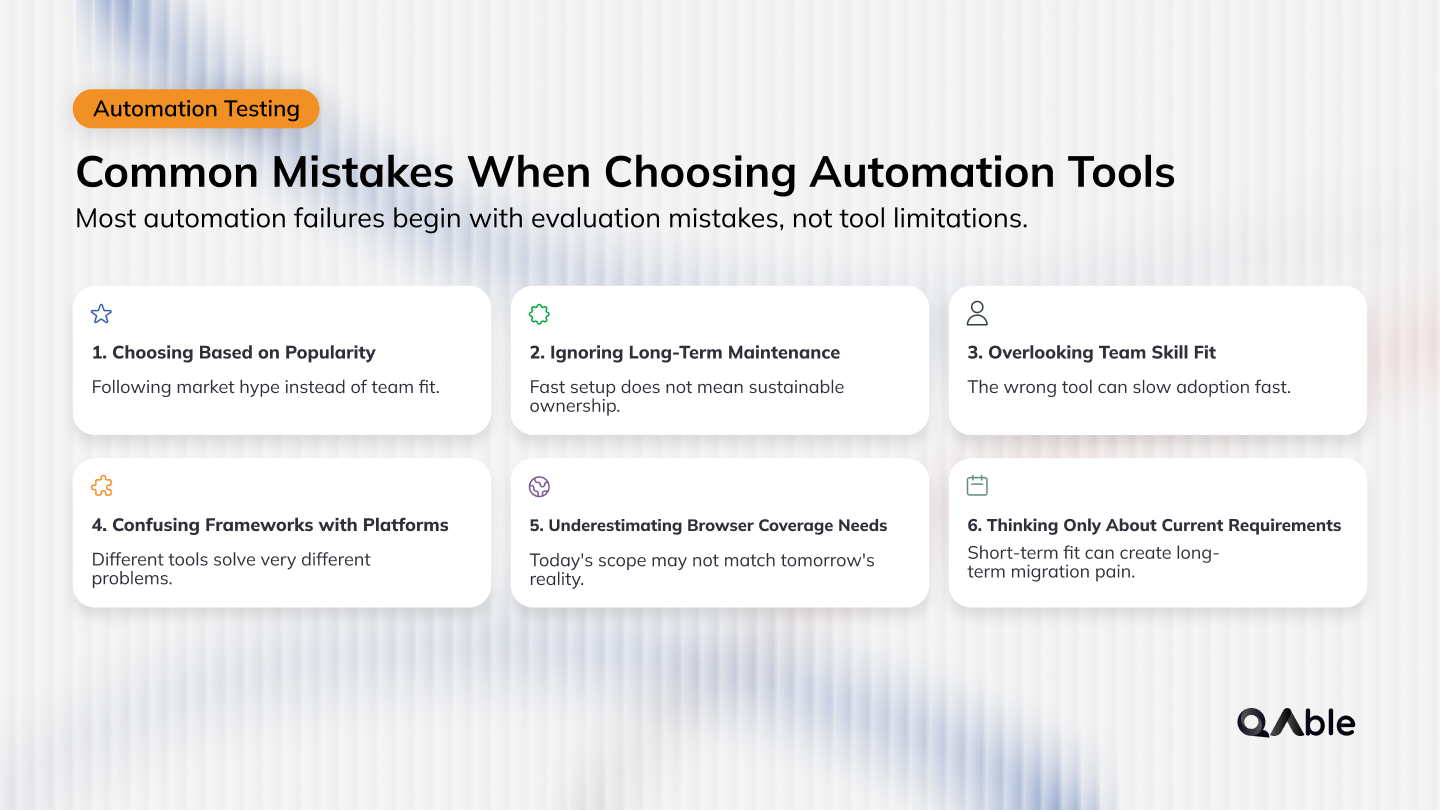
Choosing a web automation testing tool often starts with good intent, but many teams make decisions based on short-term convenience instead of long-term fit. That usually shows up later as maintenance pain, slow execution, unstable automation, or framework migration discussions.
Here are some of the most common mistakes teams make during evaluation.
1. Choosing Based on Popularity
A tool being widely used does not automatically make it the right fit for your team. Many QA leaders shortlist tools because they are well-known in the industry, heavily discussed in engineering communities, or frequently recommended in comparison blogs.
- Strong community adoption can create false confidence
- Popular tools may not match your team structure
- Market visibility does not guarantee operational fit
- Trend-driven decisions often ignore delivery realities
The best tool for your automation program is the one that aligns with your workflows, not the one with the loudest market presence.
2. Ignoring Long-Term Maintenance
Initial setup is often only a small part of automation ownership. The real operational cost comes later through locator updates, flaky execution fixes, framework upkeep, test refactoring, and automation stability management.
- Test maintenance grows as coverage expands
- Product changes increase automation upkeep
- Weak framework design creates repeated engineering effort
- Maintenance ownership is often underestimated
A tool that looks fast to adopt can become expensive if long-term maintenance is ignored.
3. Overlooking Team Skill Fit
Not every automation tool matches every QA team. Some require strong coding ownership and engineering discipline, while others are easier for broader QA adoption.
A mismatch here slows adoption and creates dependency on a small group of specialists.
- Coding expectations may exceed team capability
- Developer dependency can slow execution
- Broader QA adoption may become difficult
- Training overhead can increase unexpectedly
Tool adoption succeeds faster when the team can realistically own the automation.
4. Confusing Frameworks with Platforms
Frameworks and automation platforms solve different problems, but many teams evaluate them as direct alternatives.
A code-first browser automation framework offers control and flexibility, while a managed platform may prioritize speed, infrastructure convenience, or lower ownership effort.
- Framework ownership expectations differ significantly
- Infrastructure responsibilities may change
- Scaling models are not the same
- Operational effort varies by tool category
The right comparison starts with understanding what problem the tool is actually designed to solve.
5. Underestimating Browser Coverage Needs
Browser automation requirements often grow over time. Teams may start with limited browser validation, only to later discover the need for broader compatibility testing across browsers, operating systems, and environments.
If this is not considered early, tool limitations can create friction.
- Customer browser expectations may expand
- Cross-browser validation can become operationally expensive
- Compatibility workflows may grow faster than expected
- Infrastructure needs may change over time
Browser strategy should be evaluated based on product reality, not current assumptions alone.
6. Thinking Only About Today’s Requirements
A tool that fits current automation scope may not fit future scale.
As regression coverage grows, CI/CD adoption increases, and delivery expectations become faster, some tools create operational bottlenecks that were not visible during early evaluation.
- Execution scale may become a challenge
- Maintenance pressure increases with growth
- Delivery workflows evolve
- Automation maturity changes over time
Strong automation decisions account for where the team is going, not just where it is today.
Summary
Most automation tool selection mistakes are not technical mistakes.
They are evaluation mistakes.
The strongest web automation testing decisions come from understanding team fit, ownership expectations, maintenance realities, and long-term delivery needs before committing to a tool.
Related Read: What to Automate First?
What Teams Gain with QAble’s Automation Services?
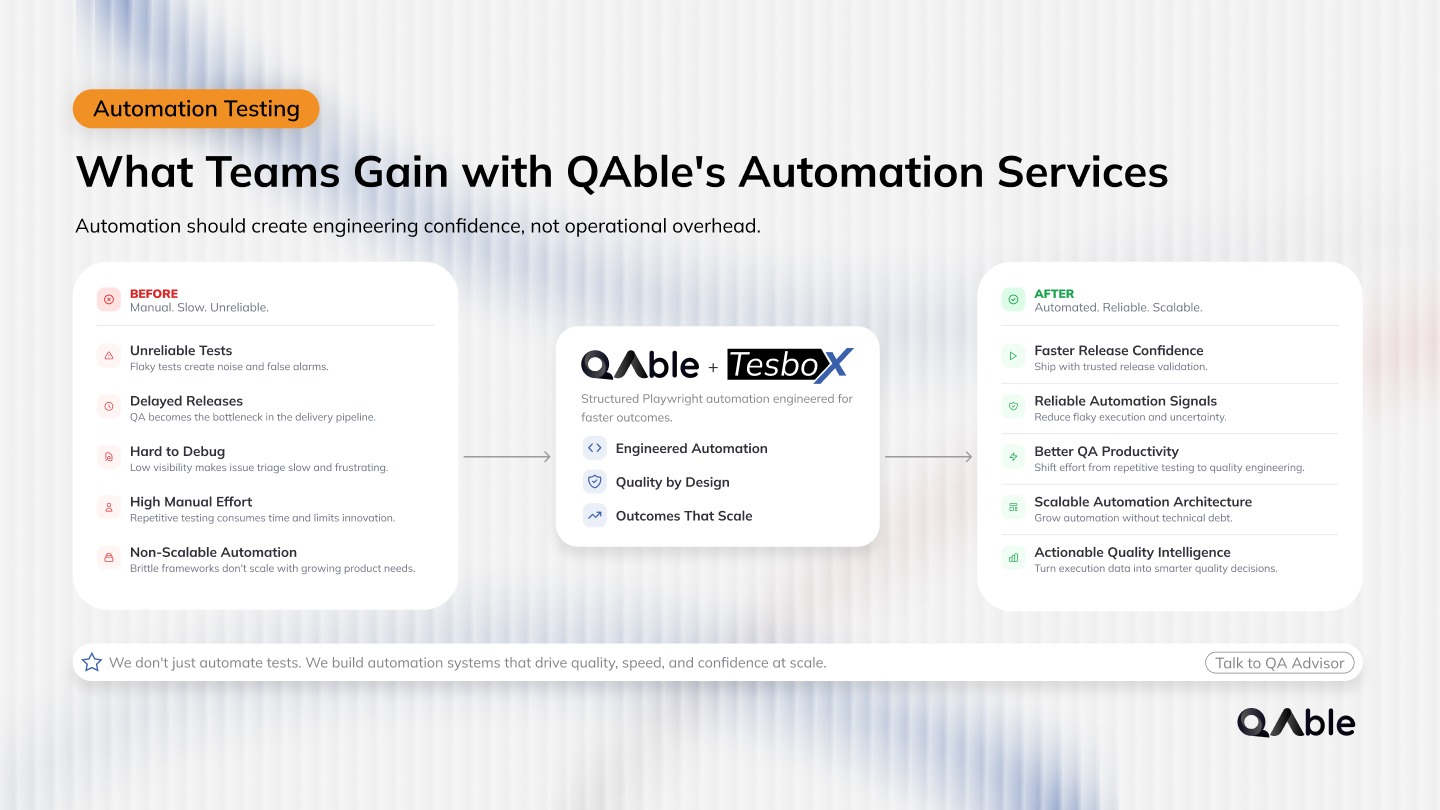
Choosing the right web automation testing tool is an important decision, but for many teams, the bigger challenge begins after the tool is selected.
Framework setup takes time. CI/CD integration needs engineering effort. Test architecture decisions affect long-term maintainability. Flaky execution reduces trust. Scaling browser automation across releases becomes operationally expensive.
This is where many automation initiatives slow down.
At QAble, automation is not approached as isolated test creation.
It is delivered as an outcome-driven quality engineering capability.
For teams looking to accelerate automation adoption with a structured, ready-to-deploy solution, QAble offers Tesbo-X, our automation testing solution built on Playwright.
TesboX combines framework architecture, tooling, execution workflows, reporting structure, and delivery engineering into a pre-engineered automation model that adapts into client workflows with minimal operational disruption.
The focus is simple: faster automation maturity with stronger engineering outcomes.
1. Faster Release Confidence
Automation should improve release confidence, not become another dependency before deployment.
QAble helps teams move from uncertain validation cycles to structured release confidence by aligning automation with critical business workflows and engineering delivery expectations.
With TesboX, teams avoid spending months designing automation foundations before seeing value.
- Critical business flow automation
- CI/CD-ready automation workflows
- Faster regression readiness
- Release smoke validation
- Predictable release verification
The result is faster release decision-making backed by trusted automation signals.
2. Reliable Automation Signals
One of the fastest ways automation loses value is when teams stop trusting the results.
Flaky failures, unstable synchronization, weak framework architecture, and inconsistent execution quickly turn automation into noise instead of engineering confidence.
QAble addresses this through disciplined automation engineering, while TesboX provides a structured automation foundation already designed around stable execution practices.
- Stable Playwright-based automation architecture
- Better synchronization discipline
- Reduced flaky execution risk
- Structured failure visibility
- Consistent automation governance
Reliable automation allows engineering teams to act on test outcomes instead of repeatedly validating whether failures are real.
3. Better QA Productivity
QA teams should spend more time improving product quality, not repeatedly executing regression checks or managing unstable automation.
A well-structured automation model reduces repetitive QA effort and creates more room for exploratory testing, risk analysis, and higher-value quality work.
TesboX helps accelerate this shift by removing much of the setup and framework engineering burden that slows adoption.
- Reduced repetitive regression execution
- Faster automation onboarding
- Lower framework ownership overhead
- Better QA engineering efficiency
- Improved collaboration with development teams
The outcome is stronger QA productivity with less operational testing friction.
4. Scalable Automation Architecture
Many automation programs start well but become difficult to sustain as coverage grows.
What works for 50 test cases often struggles at 500 or 5,000 when browser combinations, release speed, and maintenance expectations increase.
QAble engineers automation for long-term sustainability, while TesboX provides a structured Playwright-based architecture that is already designed for scalable delivery.
- Modular automation architecture
- Scalable test suite structure
- Maintainable framework governance
- Faster automation expansion
- Lower long-term framework rebuild risk
This helps teams scale automation without accumulating technical debt.
5. Actionable Quality Intelligence
Automation should do more than produce pass/fail reports.
Modern engineering teams need execution clarity, debugging visibility, and actionable signals that support faster quality decisions.
QAble’s quality intelligence approach ensures automation contributes to engineering visibility, not just test execution volume.
- Failure visibility
- Root cause clarity
- Better debugging context
- Release readiness insight
- Actionable quality reporting
The result is automation that improves engineering decision-making instead of simply increasing test count.
Summary
The strongest automation programs are not defined by the tools they choose.
They are defined by the outcomes they create.
With QAble’s automation engineering services and Tesbo-X, teams gain faster automation adoption, stronger release confidence, scalable architecture, and a structured path to automation maturity without building everything from scratch.
Related Read: Measuring Automation ROI
Final Thoughts
The best web automation testing tools are not defined by popularity alone.
A framework with a massive community may be the right fit for one team and the wrong choice for another. A cloud testing platform may solve browser coverage challenges for one organization while creating unnecessary complexity for another. A low-code automation platform may accelerate adoption for some teams but limit flexibility for others.
That is why automation tool selection should never be treated as a checklist exercise.
The real question is not:
Which tool is best?
It is:
Which tool helps our team achieve the outcomes we actually care about?
For some teams, that means full framework control and long-term customization. For others, it means faster browser automation adoption, lower maintenance overhead, stronger release confidence, or scalable automation without infrastructure ownership.
The right decision depends on your team structure, engineering maturity, delivery model, and how much automation ownership you want to manage internally.
Because successful automation is rarely about the tool alone.
It is about how automation is designed, integrated, maintained, and scaled over time.
The teams that create the most value from web automation testing are not necessarily the ones using the most popular frameworks.
They are the ones building automation that engineering teams trust, QA teams can sustain, and leadership can rely on for release decisions.
That is where automation shifts from being a testing initiative to becoming a real quality engineering advantage.