


If you've been involved in test automation over the last few years, you've probably come across countless discussions comparing Selenium and Playwright. Most of them focus on technical features such as execution speed, auto-waiting, browser support, or developer experience. While these comparisons are useful, they rarely answer the question engineering leaders are actually trying to solve.
Should we migrate at all?
Migrating from Selenium to Playwright is not simply a framework upgrade. It is an engineering investment that requires time, budget, skilled resources, and organizational commitment. Rewriting automation scripts, updating CI/CD pipelines, retraining teams, and validating new workflows all come with costs. If your current Selenium framework is already delivering reliable releases, maintainable automation, and predictable execution, migrating may not generate enough value to justify the effort.
On the other hand, if your automation has become difficult to maintain, flaky tests are slowing releases, onboarding new engineers takes longer than expected, or your testing framework is limiting engineering productivity, continuing with the status quo can become even more expensive than migrating.
That is why the decision should never be based on which framework is newer or more popular. It should be based on the outcomes your engineering team wants to achieve.
In this article, we'll move beyond feature comparisons and explore when migrating from Selenium to Playwright makes strategic sense, when staying with Selenium is the better choice, and how to evaluate the decision based on engineering outcomes, business value, and long-term maintainability rather than trends.
Key Takeaways
- Migrating from Selenium to Playwright should be driven by business and engineering outcomes, not by technology trends or framework popularity.
- Before considering a migration, identify whether your current challenges stem from framework limitations or from issues such as test design, automation architecture, infrastructure, or engineering practices.
- Common signals that may justify a Selenium to Playwright migration include increasing maintenance effort, complex synchronization logic, slower regression cycles, lengthy debugging, and growing framework complexity.
- A successful migration starts with proper preparation. Inventory your existing automation assets, eliminate technical debt, define migration objectives, and understand which Selenium components can be reused, refactored, or rewritten.
- Treat the migration as an automation modernization initiative, not a code conversion project. Adopting Playwright’s recommended practices delivers greater long-term value than recreating an existing Selenium framework.
- Organizations can significantly reduce migration risk by starting with a pilot, running Selenium and Playwright in parallel, migrating high-value test suites first, and validating each migration phase before retiring Selenium.
- Staying with Selenium can be the right decision if your framework continues to deliver reliable automation, manageable maintenance, and supports your engineering and business goals effectively.
- The success of a Selenium to Playwright migration should be measured through tangible outcomes such as lower maintenance effort, faster regression feedback, improved test stability, higher engineering productivity, and greater release confidence rather than the number of migrated test cases.
Start with the Outcome, Not the Framework
One of the biggest mistakes organizations make when evaluating automation frameworks is starting with the technology instead of the problem they are trying to solve.
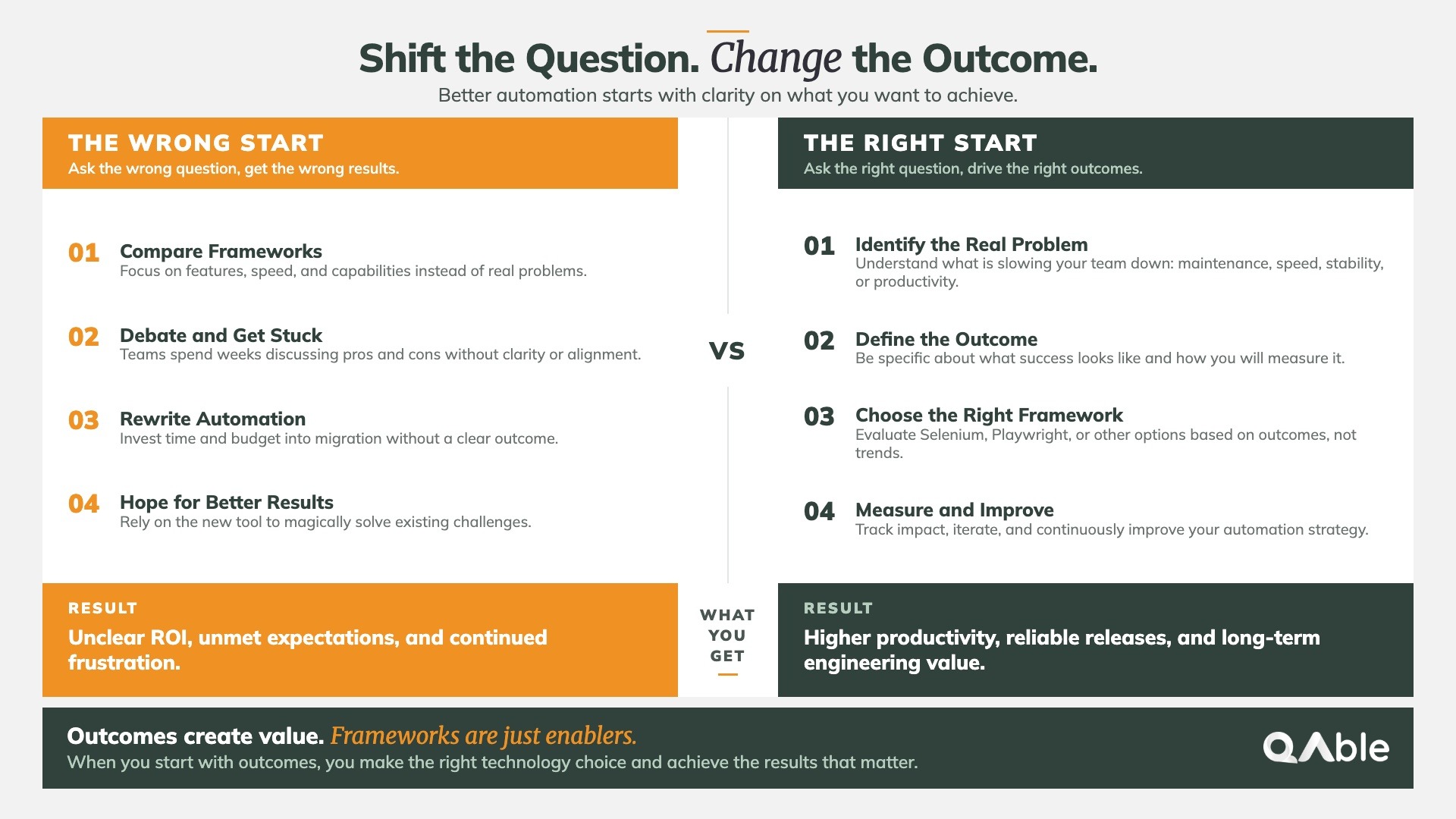
Engineering teams often ask, "Should we migrate to Playwright?" when the more valuable question is, "What are we trying to improve?"
Framework migration is not an objective in itself. It is a means to achieve better engineering outcomes. Before investing time in rewriting automation scripts or introducing a new testing framework, organizations should clearly define the challenges they want to address.
For example, your team may be looking to:
- Reduce flaky automated tests.
- Shorten regression execution time.
- Simplify test maintenance.
- Improve CI/CD reliability.
- Accelerate developer feedback.
- Make automation easier for new team members to contribute.
- Increase confidence in production releases.
Each of these outcomes requires a different approach. In some cases, migrating to Playwright may help achieve these goals. In others, the root cause may lie in automation architecture, test design, infrastructure, or engineering processes rather than the framework itself.
This is why successful engineering teams avoid making framework decisions based solely on industry trends or community popularity. Instead, they evaluate whether their current automation strategy is helping them achieve measurable business and engineering outcomes.
A migration should solve a real problem. If it does not, it simply replaces one technology with another while consuming valuable engineering time and resources.
Ask These Questions Before Considering a Migration
Before comparing Selenium and Playwright, take a step back and evaluate your current automation ecosystem.
Ask yourself:
- What specific problem are we trying to solve?
- Is the framework the actual bottleneck, or is it our automation strategy?
- Are our maintenance costs increasing year after year?
- Is automation helping us release software faster, or slowing us down?
- Will migrating deliver measurable improvements, or are we chasing industry trends?
The answers to these questions often provide far more clarity than any feature comparison.
Key Takeaway
Framework migration should always begin with a clearly defined business or engineering objective. The goal is not to adopt a newer tool. The goal is to improve outcomes such as release confidence, automation maintainability, engineering productivity, and delivery speed. Once those outcomes are clearly defined, it becomes much easier to determine whether migrating from Selenium to Playwright is the right decision.
Related Read: How to Develop a Test Automation Strategy?
Signs It May Be Time to Migrate from Selenium to Playwright
Most engineering teams don’t wake up one day and decide to migrate from Selenium to Playwright. The decision usually comes after recurring automation challenges begin affecting engineering productivity, release velocity, and confidence in test automation.
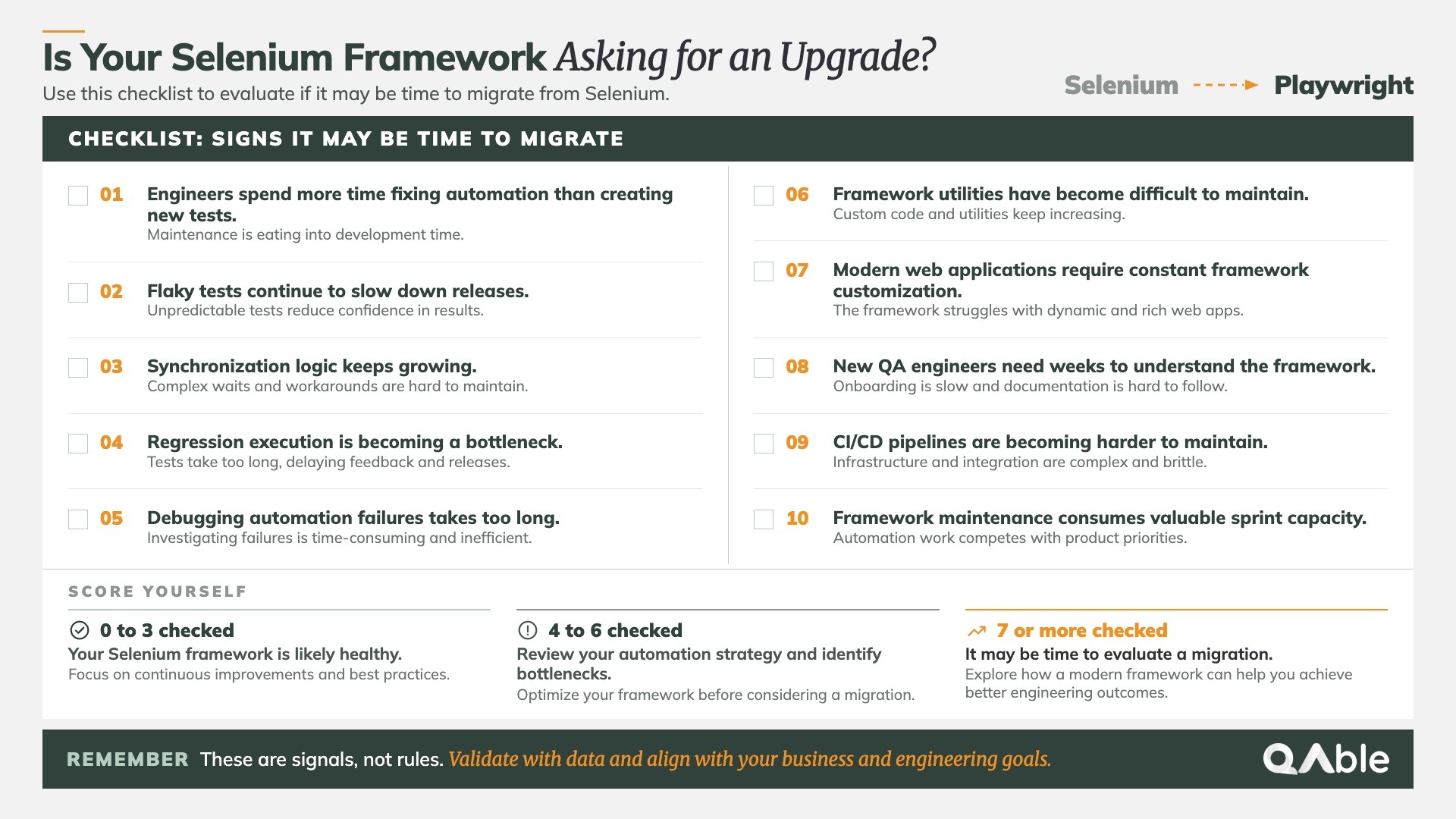
The difficulty is that these challenges rarely point directly to the automation framework. Slow pipelines, unstable tests, and rising maintenance costs can be caused by application complexity, automation architecture, testing practices, or framework capabilities.
The key is identifying whether your current Selenium implementation has become the limiting factor. If the following situations sound familiar, it may be time to evaluate whether Playwright is a better fit for your testing needs.
1. Your Team Is Spending More Time Managing Synchronization Than Writing Tests
What you’re experiencing:
- Tests pass locally but fail intermittently in CI.
- Engineers frequently modify explicit waits or retry logic.
- Small UI timing changes cause automation failures.
What’s really happening?
Modern web applications rely heavily on asynchronous rendering, background network requests, and dynamic UI updates. Selenium provides explicit, implicit, and fluent wait mechanisms to handle these scenarios, but engineers are responsible for implementing the appropriate synchronization strategy throughout the framework. As applications become more dynamic, synchronization logic often grows alongside the automation suite. Official Selenium documentation recommends using explicit waits to avoid race conditions, but these still require thoughtful implementation.
How does playwright approach it differently?
Playwright automatically waits for elements to become actionable before performing interactions such as clicking, typing, or selecting. This reduces the amount of explicit synchronization code required for many common UI interactions, although engineers still need to handle application-specific waiting scenarios where appropriate.
Migration Signal:
If synchronization logic continues to grow despite following Selenium’s recommended waiting practices, evaluating Playwright may help simplify your automation framework.
2. Maintaining Your Automation Framework Is Consuming Sprint Capacity
What you’re experiencing:
- Minor UI updates require widespread test changes.
- Engineers spend more time repairing existing automation than building new coverage.
- Framework utilities continue growing every quarter.
What’s really happening?
This is often a sign that the automation framework has accumulated years of custom abstractions, helper libraries, locator strategies, and synchronization utilities. While these additions solve immediate problems, they can gradually increase the long-term maintenance cost of the framework.
How does playwright approach it differently?
Playwright promotes web-first locators based on roles, labels, placeholders, and other user-facing attributes. Combined with built-in waiting behavior, many teams find they need fewer custom framework utilities compared to mature Selenium implementations. However, maintainability still depends on good test architecture and engineering practices.
Migration Signal:
Your framework continues becoming harder to maintain even after refactoring and improving coding standards.
3. Regression Testing Is Limiting Your Release Frequency
What you’re experiencing:
- Regression execution continues getting longer.
- Developers wait too long for pipeline feedback.
- Releases are delayed because automation hasn’t completed.
What’s really happening?
Long execution times are rarely caused by the framework alone. They are influenced by test suite size, infrastructure, browser configuration, parallel execution strategy, and CI/CD resources. However, older Selenium frameworks often require additional engineering effort to optimize large-scale execution as applications grow.
How does playwright approach it differently?
Playwright includes built-in support for parallel test execution, browser contexts, and a modern test runner that simplifies scaling browser automation. For teams running browser-based UI tests, this can make execution easier to optimize without relying on multiple external components.
Migration Signal:
Your regression pipeline remains a release bottleneck even after optimizing your Selenium execution strategy and infrastructure.
4. Debugging Automation Failures Is Slowing Engineering Teams
What you’re experiencing:
- Engineers spend significant time reproducing failed tests.
- Failure analysis depends on multiple reporting tools.
- Root cause investigation delays issue resolution.
What’s really happening?
Many Selenium projects rely on third-party reporting frameworks, screenshots, logging utilities, and browser recordings that need to be integrated separately. While these tools are powerful, investigating failures often requires gathering information from multiple sources before engineers can determine what happened.
How does playwright approach it differently?
Playwright provides built-in tracing, screenshots, videos, network inspection, and execution artifacts that simplify failure analysis. Having these capabilities available as part of the testing workflow can reduce the time required to investigate browser automation failures.
Migration Signal:
Engineers consistently spend more time diagnosing automation failures than resolving product defects.
5. Your Web Applications Have Evolved Beyond Your Existing Automation Approach
What you’re experiencing:
- Applications rely heavily on dynamic UI behavior.
- Engineers continue adding framework extensions to support modern frontend patterns.
- Automation complexity increases with every major application update.
What’s really happening?
Modern web applications increasingly use client-side rendering, asynchronous interactions, and highly dynamic interfaces. While Selenium fully supports automating modern browsers, many long-running Selenium frameworks require additional engineering effort to accommodate evolving frontend architectures because they were originally designed years earlier under different application assumptions.
How Playwright approaches it differently?
Playwright was designed specifically for modern browser automation and includes built-in support for scenarios such as multiple browser contexts, network interception, multiple tabs, and modern rendering behavior without requiring additional libraries.
Migration Signal:
Supporting new application capabilities requires continuous framework customization rather than straightforward test development.
6. Growing the Automation Team Has Become More Difficult
What you’re experiencing:
- New engineers need weeks before contributing meaningful automation.
- Framework knowledge is concentrated among a few senior engineers.
- Extensive internal documentation is required to explain framework conventions.
What’s really happening?
Over time, enterprise Selenium frameworks often become highly customized to meet organizational needs. While this flexibility is one of Selenium’s strengths, it can also increase onboarding complexity if the framework evolves without regular simplification or standardization.
How does playwright approach it differently?
Many organizations use migration as an opportunity to simplify their automation architecture, reduce custom framework code, and standardize development practices around Playwright’s built-in capabilities. This can improve maintainability and shorten onboarding, provided the new framework is designed with the same discipline.
Migration Signal:
Framework complexity is becoming a barrier to scaling your QA and engineering teams.
Key Takeaway
Migrating from Selenium to Playwright should never be based solely on feature comparisons or industry trends. Instead, it should be driven by measurable engineering challenges that persist despite following Selenium best practices and optimizing your existing automation framework.
If synchronization complexity, maintenance overhead, regression bottlenecks, debugging effort, framework customization, or onboarding challenges continue limiting your team’s productivity, it may be the right time to evaluate whether Playwright offers a better long-term fit for your engineering goals.
Related Read: How to Identify and Fix Flaky Tests?
Prerequisites Before Migrating from Selenium to Playwright
Migrating from Selenium to Playwright involves much more than replacing one automation framework with another. It requires careful planning across your test suite, automation architecture, infrastructure, engineering processes, and team readiness.
Before writing your first Playwright test, make sure you’ve prepared the following areas.
1. Inventory Your Existing Selenium Assets
Before planning the migration, create a complete inventory of your current Selenium ecosystem.
This should include:
- Test suites
- Page Object Models (POMs)
- Utility classes
- Custom Selenium wrappers
- Test data management
- Reporting integrations
- CI/CD pipelines
- Browser configurations
- Environment configurations
- Third-party integrations
Without understanding your current assets, it’s difficult to estimate migration effort or identify reusable components.
2. Categorize Tests Before Migration
Not every Selenium test should be migrated.
Classify your automation into categories such as:
- Business-critical user journeys
- Smoke tests
- Regression tests
- Integration tests
- End-to-end workflows
- Legacy or low-value tests
This helps prioritize high-value automation while avoiding unnecessary migration of obsolete tests.
3. Remove Technical Debt Before Rewriting Tests
Migration is the ideal opportunity to improve automation quality.
Before moving to Playwright:
- Remove duplicate tests.
- Eliminate obsolete scenarios.
- Archive unused utilities.
- Fix unstable test cases.
- Consolidate reusable components.
- Simplify Page Object Models where appropriate.
Avoid carrying unnecessary complexity into the new framework.
4. Review Your Framework Architecture
Migrating to Playwright is not a code conversion exercise.
Review whether your current architecture should evolve.
Evaluate:
- Project structure
- Page Object implementation
- Test organization
- Shared utilities
- Configuration management
- Environment handling
- Reporting strategy
Many Selenium design decisions were made years ago and may not align with modern automation practices.
5. Identify Selenium-Specific Dependencies
One of the most overlooked activities is identifying framework-specific code.
Review your project for:
- WebDriver initialization
- Driver managers
- Explicit wait utilities
- Custom synchronization helpers
- Selenium Actions API
- JavaScriptExecutor usage
- Browser capability configuration
- Selenium Grid configuration
These areas will require redesign rather than direct migration.
6. Understand Playwright’s Development Model
Before rewriting tests, engineers should understand how Playwright approaches browser automation.
Key concepts include:
- Browser contexts
- Built-in auto-waiting
- Locator API
- Fixtures
- Playwright Test Runner
- Projects for cross-browser execution
- Trace Viewer
- Network interception
Trying to recreate Selenium patterns inside Playwright often results in unnecessary complexity.
7. Prepare Your CI/CD Pipeline
Migration also affects your delivery pipeline.
Review:
- Pipeline configuration
- Browser installation
- Parallel execution strategy
- Test reporting
- Artifact collection
- Environment variables
- Secrets management
Updating CI/CD early helps avoid deployment issues during migration.
8. Validate Third-Party Integrations
Many Selenium projects integrate with:
- Test management tools
- Reporting platforms
- Cloud execution providers
- Browser farms
- Defect management systems
Confirm that your existing integrations are supported or determine whether new integrations will be required after migration.
9. Define a Migration Strategy
Avoid rewriting everything at once.
Common migration approaches include:
- Module-by-module migration
- Application-by-application migration
- Feature-based migration
- Critical user journey first
- Parallel Selenium and Playwright execution
For most enterprise projects, incremental migration minimizes delivery risk.
10. Define Success Metrics Before Migration
Success should not be measured by:
Number of tests migrated.
Instead measure:
- Reduction in maintenance effort
- Regression execution time
- Test stability
- Pipeline reliability
- Debugging time
- Engineering productivity
- Release confidence
These metrics demonstrate whether the migration is delivering meaningful engineering outcomes.
Key Takeaway
A successful Selenium to Playwright migration begins with preparation rather than implementation. Organizations that inventory their automation assets, eliminate technical debt, redesign framework architecture where necessary, prepare their teams and CI/CD pipelines, and define clear success metrics are significantly more likely to complete a smooth migration while realizing long-term engineering benefits.
Related Read: Playwright Testing Framework Setup Best Practices
What Can Be Reused and What Needs to Be Rewritten?
One of the biggest misconceptions about migrating from Selenium to Playwright is that everything has to be rebuilt from scratch. In reality, many engineering assets remain valuable, while others need to be redesigned to align with Playwright’s architecture and development model.
Understanding this distinction early helps teams estimate migration effort more accurately and avoid unnecessary rework.
Existing Selenium Asset | Migration Recommendation | Migration Effort | Why? |
Test scenarios and business workflows | Reuse | Low | Business logic remains unchanged regardless of the automation framework. |
Test cases and acceptance criteria | Reuse | Low | Functional requirements do not need to be recreated. |
Test data and datasets | Reuse | Low | Existing test data can typically be used without modification. |
Environment configurations | Mostly Reuse | Low | Environment variables and configuration values usually remain applicable. |
CI/CD strategy | Adapt | Medium | Pipeline concepts remain the same, but execution commands and dependencies will change. |
Reporting goals and quality metrics | Reuse | Low | KPIs such as pass rate, defect leakage, and release confidence remain unchanged. |
Test management and defect tracking integrations | Mostly Reuse | Medium | Existing integrations often remain, although adapters or plugins may require updates. |
Page Object Models (POMs) | Refactor | Medium | Business structure can remain, but implementation should adopt Playwright’s Locator API and best practices instead of directly porting Selenium code. |
Framework architecture | Redesign | High | Review project structure, fixtures, configuration management, and test organization to align with Playwright’s testing model. |
WebDriver initialization and lifecycle management | Rewrite | High | Playwright manages browser instances differently and does not use the WebDriver architecture. |
Explicit wait utilities and synchronization helpers | Replace | High | Playwright’s built-in auto-waiting reduces the need for many custom synchronization utilities. |
Selenium-specific helper libraries | Review Individually | Medium to High | Evaluate each utility to determine whether Playwright already provides equivalent functionality. |
Selenium Actions API implementations | Rewrite | Medium | User interactions should be implemented using Playwright’s native interaction APIs. |
JavaScriptExecutor-based interactions | Review | Medium | Many interactions can be replaced with Playwright’s native APIs, although some application-specific scenarios may still require JavaScript execution. |
Driver management utilities | Remove | Low | Playwright manages browser binaries internally, eliminating the need for separate WebDriver management. |
Selenium Grid configuration | Review | Medium | Your execution strategy may change depending on whether tests run locally, in containers, or on cloud execution platforms. |
What This Means for Your Migration
The table highlights an important reality. Most of your business investment can be preserved, while much of your framework implementation should be modernized.
This means you’re not starting from zero. Your team already has valuable assets, including business workflows, test scenarios, quality metrics, and testing knowledge. The primary effort lies in redesigning the automation framework so it aligns with Playwright’s architecture instead of attempting a one-to-one code conversion.
Organizations that treat migration as an opportunity to modernize their automation strategy, rather than simply translating Selenium code into Playwright, typically achieve better maintainability, cleaner test architecture, and greater long-term engineering value.
Key Takeaway
Successful Selenium to Playwright migrations preserve business knowledge while modernizing technical implementation. Understanding what can be reused, what should be refactored, and what must be rewritten allows engineering teams to estimate migration effort more accurately, reduce project risk, and focus their investment where it delivers the greatest value.
Related Read: Manual Testing to Test Automation
What Changes When You Move from Selenium to Playwright?
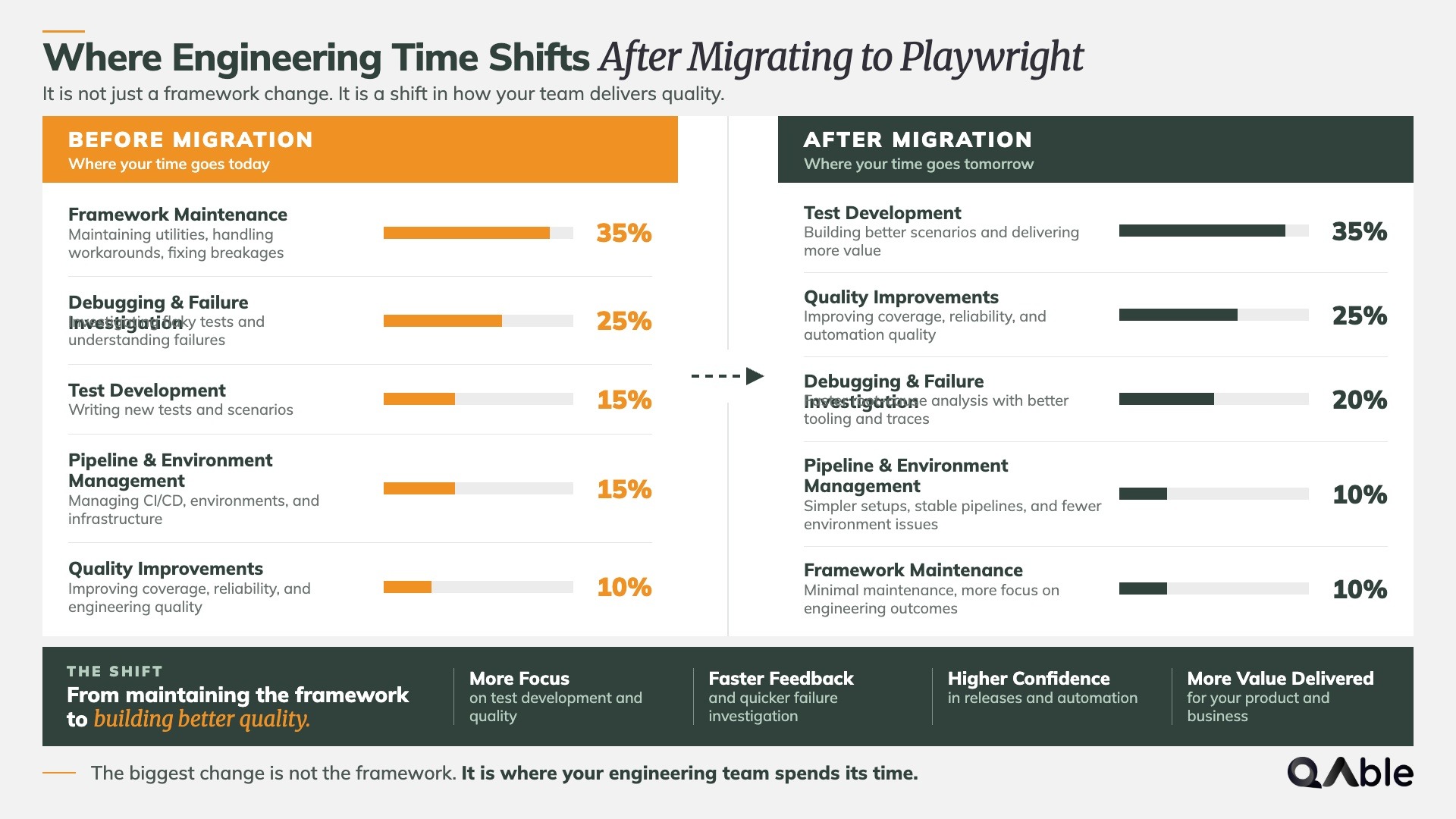
Migrating from Selenium to Playwright is more than replacing one testing framework with another. It changes how your team develops automation, investigates failures, maintains test suites, and delivers software.
The transition doesn’t require changing what you test. Instead, it changes how your team approaches test automation and where engineers spend most of their time.
Here are the biggest changes organizations typically experience after migrating.
Test Development Becomes Simpler
Many Selenium frameworks evolve over several years. As applications become more complex, teams often build additional utilities, wrappers, helper methods, and framework extensions to support their automation strategy.
When moving to Playwright, many of these custom implementations can be simplified because the framework provides several commonly required capabilities out of the box.
For engineering teams, this often means spending less time maintaining framework code and more time developing meaningful test scenarios.
Maintenance Shifts from Framework Management to Test Quality
Maintaining a Selenium framework often involves updating synchronization logic, browser configurations, and custom framework components alongside application changes.
After migrating to Playwright, teams generally spend less effort maintaining framework infrastructure and more effort improving test quality, expanding coverage, and validating business scenarios.
The focus gradually shifts from keeping the framework running to making the tests more valuable.
Debugging Becomes Faster
Understanding why an automated test failed is often one of the most time-consuming parts of test automation.
Many organizations moving to Playwright notice that investigating failures becomes faster because execution details are easier to review and reproduce.
Instead of spending significant time collecting evidence from different tools, engineers can often identify the root cause more quickly and return to development sooner.
Teams Need to Learn a Different Way of Building Automation
One of the biggest adjustments is not technical. It is a mindset change.
Teams that try to recreate their Selenium framework inside Playwright often carry unnecessary complexity into the new framework.
Instead, engineers should embrace Playwright’s recommended development practices and use the migration as an opportunity to simplify automation rather than replicate years of accumulated framework decisions.
Migration Creates an Opportunity to Modernize
Many organizations discover that the biggest benefit of migration is not Playwright itself.
It is the opportunity to review years of accumulated technical debt, remove outdated automation, simplify framework architecture, improve coding standards, and establish more maintainable engineering practices.
Organizations that treat migration as a modernization initiative typically realize greater long-term value than those performing a direct framework replacement.
The Team’s Success Metrics Also Change
After migration, success should not be measured by how many Selenium tests have been rewritten.
Instead, engineering teams should evaluate whether the migration has delivered meaningful improvements, such as:
- Lower automation maintenance effort
- Faster regression feedback
- Better test stability
- Shorter debugging time
- Higher engineering productivity
- Greater release confidence
These outcomes provide a far more accurate measure of migration success than the number of converted test scripts.
Key Takeaway
Migrating from Selenium to Playwright changes more than the technology stack. It changes how engineering teams build, maintain, and scale test automation. Organizations that use the migration to simplify their automation strategy, improve engineering practices, and focus on measurable business outcomes are more likely to achieve lasting value than those that simply replace one framework with another.
Related Read: Discover how engineering teams structure maintainable automation frameworks for long-term success.
When, Staying with Selenium is the Better Decision?
Migrating to Playwright should be a strategic engineering decision, not an automatic technology upgrade.
Although Playwright offers several advantages for modern browser automation, Selenium continues to power automation frameworks across thousands of organizations worldwide. If your current framework is helping your engineering team achieve its objectives, migrating simply because another framework is newer may not deliver meaningful business value.
Before committing to a migration, evaluate whether your current Selenium implementation is truly limiting your organization or whether your existing investment is still serving your engineering goals.
Your Automation Is Stable, Trusted, and Maintainable
One of the strongest reasons to continue using Selenium is that your automation framework consistently delivers reliable results.
If your regression suites execute successfully, engineers trust automation outcomes, and maintenance remains predictable, your framework is already achieving what every automation solution is expected to do.
In this situation, migrating may introduce unnecessary engineering effort without significantly improving software quality or delivery speed.
Staying with Selenium makes sense when your automation continues to provide reliable, predictable, and maintainable test execution.
Your Engineering Challenges Are Not Caused by Selenium
Not every automation problem originates from the framework.
If recurring challenges are caused by poor test design, unstable environments, inconsistent test data, weak automation standards, or inefficient CI/CD practices, migrating to Playwright is unlikely to resolve those issues.
Addressing the root cause should always take priority over changing the framework.
Staying with Selenium makes sense when improving engineering practices will deliver greater value than replacing the automation framework.
Your Current Framework Supports Business Growth
Every framework should ultimately be evaluated against business outcomes.
If your Selenium implementation continues to support release confidence, acceptable regression execution times, growing automation coverage, and engineering productivity, there may be little justification for a migration.
Framework decisions should be driven by measurable outcomes rather than industry trends.
Staying with Selenium makes sense when your current framework continues to support your business and engineering objectives effectively.
The Cost of Migration Outweighs the Expected Benefits
Framework migration requires a significant investment beyond rewriting test scripts.
Organizations must also account for:
- Engineering effort
- Team training
- Framework redesign
- CI/CD updates
- Validation and parallel execution
- Temporary productivity loss during the transition
If the expected improvements are relatively small, the migration may not produce a positive return on investment.
Staying with Selenium makes sense when the business case for migration is weak or the expected benefits do not justify the implementation effort.
Key Takeaway
Playwright is a powerful automation framework, but it is not the right choice for every organization. If your Selenium implementation is reliable, maintainable, aligned with your business goals, and your challenges originate outside the framework, continuing to invest in Selenium may be the smarter engineering decision. The goal is not to adopt the latest technology. The goal is to choose the framework that delivers the greatest long-term value for your organization.
Related Read: Selenium vs Playwright vs Cypress
How to Migrate from Selenium to Playwright Without Disrupting Releases?
One of the biggest concerns engineering leaders have about migrating from Selenium to Playwright is the potential impact on ongoing software delivery.
The good news is that a successful migration doesn’t require abandoning Selenium overnight. Most organizations achieve better results by treating migration as an incremental engineering initiative rather than a complete framework replacement.
A phased approach allows teams to continue shipping software while gradually building confidence in the new automation framework.
1. Start with a Pilot Instead of Migrating Everything
Avoid beginning with your largest regression suite.
Instead, identify a small but representative set of test cases that reflect your application’s complexity.
Good candidates include:
- Critical user journeys
- Smoke tests
- High-frequency regression scenarios
- Tests that are actively maintained
A pilot allows your team to understand Playwright’s development model, estimate migration effort, and identify implementation challenges before expanding the migration.
2. Keep Selenium and Playwright Running Together
Migration does not have to be an all-or-nothing decision.
During the transition, many organizations maintain both frameworks in parallel.
This approach allows teams to:
- Continue releasing software without interruption.
- Validate Playwright tests against existing Selenium automation.
- Compare execution results.
- Build confidence before retiring Selenium suites.
Selenium should only be phased out after Playwright has demonstrated consistent reliability for the migrated scenarios.
3. Prioritize High-Value Test Suites First
Not every automated test provides the same business value.
Instead of migrating thousands of tests sequentially, prioritize automation that directly supports release confidence.
Consider migrating in this order:
- Smoke tests
- Critical business workflows
- Frequently executed regression tests
- High-maintenance Selenium suites
- Remaining regression coverage
This approach delivers measurable benefits earlier while reducing project risk.
4. Don’t Rewrite Selenium Line by Line
One of the most common migration mistakes is treating Playwright as another syntax for Selenium.
Instead of translating existing code directly, use the migration to simplify your automation framework.
Review opportunities to:
- Remove obsolete utilities.
- Eliminate duplicate abstractions.
- Adopt Playwright’s recommended patterns.
- Simplify project structure.
- Improve test readability.
Migration should modernize your framework, not preserve years of accumulated technical debt.
5. Validate Every Migration Phase
Each migration milestone should be validated before expanding the project.
Measure outcomes such as:
- Test stability
- Regression execution time
- Maintenance effort
- Failure investigation time
- CI/CD reliability
If expected improvements are not being achieved, pause the migration and identify the underlying cause before proceeding further.
6. Retire Selenium Gradually
Avoid deleting Selenium tests immediately after creating their Playwright equivalents.
Instead:
- Run both frameworks in parallel for an agreed validation period.
- Compare execution consistency.
- Confirm production release confidence.
- Monitor automation reliability.
Only retire Selenium automation after Playwright has consistently demonstrated equivalent or better reliability.
This gradual transition minimizes operational risk and protects release quality.
Key Takeaway
Successful Selenium-to-Playwright migrations are built on planning, validation, and incremental delivery rather than speed. Organizations that begin with a pilot, migrate high-value automation first, run both frameworks in parallel, validate every phase, and gradually retire Selenium can modernize their automation framework while maintaining release confidence throughout the transition.
Related Read: Mastering Playwright End-to-End Testing Guide
Common Selenium to Playwright Migration Mistakes to Avoid
A successful migration is not determined by how quickly you move to Playwright. It depends on making the right engineering decisions throughout the transition.
The following do’s and don’ts summarize the practices that help organizations migrate successfully while avoiding common pitfalls.
Do’s | Don’ts |
Define clear business and engineering objectives before starting the migration. | Don’t migrate simply because Playwright is gaining popularity. |
Audit your existing Selenium framework and identify what truly needs to be migrated. | Don’t migrate every test case without evaluating its business value. |
Remove duplicate, obsolete, and low-value automation before rewriting tests. | Don’t carry years of technical debt into the new framework. |
Start with a pilot project and validate the results before expanding the migration. | Don’t rewrite your entire regression suite in one phase. |
Run Selenium and Playwright in parallel until the new framework is proven stable. | Don’t retire Selenium immediately after creating Playwright tests. |
Adopt Playwright’s recommended development practices and architecture. | Don’t recreate your Selenium framework inside Playwright. |
Train engineers on Playwright before beginning large-scale migration. | Don’t assume the team will become productive without structured enablement. |
Measure success using engineering outcomes such as maintenance effort, execution time, and release confidence. | Don’t measure success by the number of migrated test cases. |
Review CI/CD pipelines, reporting, and integrations before migration begins. | Don’t focus only on test scripts while overlooking the surrounding automation ecosystem. |
Continuously evaluate migration progress and adjust the strategy based on results. | Don’t continue migrating if the expected engineering outcomes are not being achieved. |
Key Takeaway
The most successful Selenium-to-Playwright migrations are guided by careful planning rather than speed. By focusing on business outcomes, modernizing the automation framework, validating each migration phase, and avoiding common implementation mistakes, organizations can reduce migration risk while maximizing the long-term value of their investment.
Related Read: Measuring Test Automation’s Business Impact
Final Thoughts
Migrating from Selenium to Playwright is not about adopting the latest automation framework. It’s about enabling your engineering teams to deliver software faster, maintain automation more efficiently, and improve release confidence without increasing operational complexity.
For some organizations, Playwright provides the right foundation to modernize their automation strategy. For others, a mature Selenium framework may continue to meet current business needs. The right decision depends on your engineering objectives, application landscape, automation maturity, and long-term quality goals rather than industry trends.
The most successful organizations don’t begin by asking, “Should we migrate to Playwright?” They begin by asking, “What outcomes are we trying to achieve?” Once those outcomes are clearly defined, choosing the right automation framework becomes a far more strategic and measurable decision.
If your organization is evaluating whether a Selenium-to-Playwright migration is the right move, begin with a structured assessment of your existing automation ecosystem. Understanding where your current framework is creating friction, identifying opportunities for improvement, and defining measurable migration goals can significantly reduce implementation risk.
This is where experienced quality engineering partners can add value through strategic planning, migration consulting, and automation modernization, ensuring the transition aligns with both engineering priorities and business objectives.
At QAble, we’ve helped organizations modernize their automation strategies through Playwright adoption, migration consulting, and automation engineering. That experience has also shaped Tesbo-X, our Playwright-based automation solution designed to simplify test development, improve automation maintainability, and help engineering teams scale automation more efficiently.
Whether organizations choose to build their own Playwright framework or leverage an accelerator such as Tesbo-X, the objective remains the same: creating an automation ecosystem that supports faster releases, higher quality, and sustainable engineering growth.
Ultimately, the decision isn’t whether Selenium or Playwright is the better framework. It’s whether your automation strategy enables your engineering teams to deliver high-quality software with confidence, speed, and long-term sustainability. The framework is simply one part of that journey.