


Compliance is no longer just a regulatory checkbox. It has become a core requirement for building trustworthy, secure, and scalable digital systems.
From data privacy laws like GDPR to industry standards such as PCI DSS and ISO frameworks, modern software products are expected to operate within clearly defined regulatory boundaries. Failing to meet these requirements can lead to legal penalties, security risks, and loss of user trust.
At its core, compliance testing ensures that a system follows the rules it is expected to operate under both internally defined standards and external regulations.
Unlike functional testing, which checks whether a system works, compliance testing verifies whether the system is allowed to work in a certain way; legally, securely, and ethically.
As software systems grow more complex and regulatory expectations continue to evolve, compliance testing is no longer a one-time activity. It is becoming a continuous validation process embedded within the development lifecycle.
In this guide, we will explore:
- What is compliance testing?
- Types of compliance testing
- How to perform compliance testing effectively?
- Benefits of Compliance Testing
What is Compliance Testing?
Compliance testing is the process of validating whether a software system adheres to regulatory requirements, industry standards, and internal policies that govern how the system should operate.
Unlike functional testing, which focuses on whether a feature works as expected, compliance testing evaluates whether the system operates within defined rules, legal frameworks, and security guidelines.
These requirements can come from multiple sources, including:
- Government regulations
- Industry standards
- Organizational policies
- Data protection laws
At a practical level, compliance testing ensures that a system:
- Handles data securely
- Follows privacy requirements
- Maintains auditability
- Enforces access controls
- Aligns with defined standards
Related Read: What is Functional Testing?
Types of Compliance Testing
Compliance testing is not a single activity. It spans multiple domains depending on the industry, regulatory environment, and system architecture.
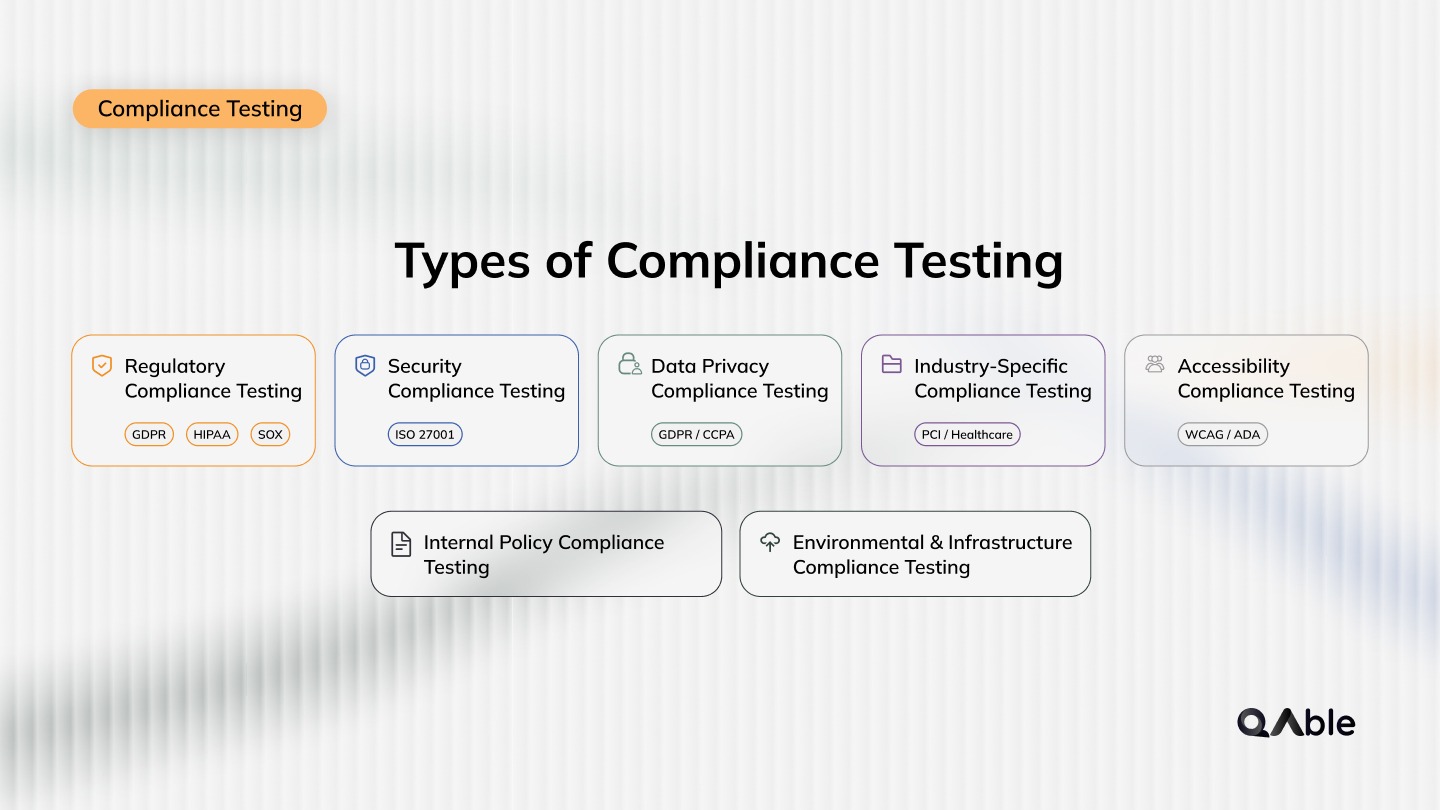
Most modern applications are subject to multiple compliance requirements simultaneously, making it essential to understand how different types of compliance testing apply across the system.
Below are the key types of compliance testing, along with what they involve in practice.
1. Regulatory Compliance Testing
Regulatory compliance testing ensures that software systems adhere to laws and regulations defined by governing bodies.
These regulations are often mandatory and vary based on geography, industry, and the type of data being handled.
Common regulatory frameworks include:
- GDPR (data protection in the EU)
- HIPAA (healthcare data protection)
- SOX (financial reporting compliance)
In practice, this type of testing focuses on validating how the system handles sensitive data and enforces regulatory requirements.
Key validation areas include:
- Data collection practices
- User consent handling
- Data storage and retention
- Audit trails and logging
- Data access and deletion controls
Regulatory compliance testing is critical because violations can lead to legal penalties, operational restrictions, and reputational damage.
2. Security Compliance Testing
Security compliance testing focuses on ensuring that systems meet security standards and guidelines designed to protect data and infrastructure.
While security testing identifies vulnerabilities, security compliance testing ensures that required security controls are implemented correctly.
This includes validating:
- Authentication mechanisms
- Authorization rules
- Encryption standards
- Secure data transmission
- Access control policies
Typical frameworks and standards include:
- ISO 27001
- NIST guidelines
- OWASP recommendations
This type of testing ensures that security is not only implemented but also aligned with recognized compliance requirements. These controls are equally important in Software Testing in Logistics and Transportation.
3. Data Privacy Compliance Testing
Data privacy compliance testing ensures that user data is handled in accordance with privacy laws and user rights.
With increasing emphasis on data protection, this type of compliance has become a critical requirement for most digital products.
Key focus areas include:
- User consent management
- Data minimization practices
- Data anonymization and masking
- Right to access and deletion
- Data sharing and third-party integrations
Regulations driving this testing include:
- GDPR
- CCPA
- other regional data protection laws
This type of testing ensures that organizations respect user privacy while maintaining transparency and control over personal data.
4. Industry-Specific Compliance Testing
Certain industries have their own compliance standards that define how systems should operate.
These standards are often designed to address industry-specific risks and operational requirements.
Examples include:
- PCI DSS (payment and financial systems)
- Healthcare compliance frameworks
- Telecom and banking regulations
Testing in this category focuses on validating workflows and system behavior specific to the domain.
This includes:
- Transaction security
- Data integrity
- System reliability
- Regulatory reporting requirements
Industry-specific compliance testing ensures that systems are aligned with domain expectations and operational standards.
5. Accessibility Compliance Testing
Accessibility compliance testing ensures that digital platforms are usable by people with disabilities and meet accessibility standards.
This type of compliance is increasingly becoming both a legal requirement and a usability standard.
Common standards include:
- WCAG (Web Content Accessibility Guidelines)
- ADA (Americans with Disabilities Act)
- regional accessibility laws
Testing focuses on:
- Screen reader compatibility
- Keyboard navigation
- Color contrast and readability
- Semantic structure
- Assistive technology support
Accessibility compliance ensures that digital products are inclusive and usable across diverse user groups.
6. Internal Policy Compliance Testing
Internal compliance testing ensures that systems follow organization-defined rules, policies, and governance standards.
These policies are often designed to enforce consistency, security, and operational discipline within the organization.
Examples include:
- Internal security policies
- Access control rules
- Workflow validations
- Data handling procedures
Testing ensures that systems behave in accordance with internal expectations, even when external regulations may not explicitly require them.
This type of compliance is critical for maintaining organizational control and process integrity.
7. Environmental and Infrastructure Compliance Testing
Some systems must comply with requirements related to infrastructure, hosting environments, and operational setups.
This includes validating whether systems meet:
- Cloud compliance standards
- Data residency requirements
- Infrastructure security guidelines
- Deployment environment rules
For example:
- Ensuring data is stored in specific geographic regions
- Validating secure cloud configurations
- Enforcing environment-specific access controls
This type of testing ensures that compliance is maintained not just at the application level, but also at the infrastructure and deployment level.
Overview
Compliance testing spans multiple domains, each addressing a specific aspect of system behavior, security, and regulatory alignment.
Understanding these types helps organizations design comprehensive compliance strategies, ensuring that systems meet both external regulations and internal expectations.
As systems grow more complex, compliance testing must evolve into a multi-layered, continuous process that supports long-term reliability and risk management.
Related Read: The Secret Sauce to Ensure HIPAA-Compliance
How to Perform Compliance Testing?
Compliance testing is not a one-time validation step. It requires a structured, repeatable process that aligns with both regulatory requirements and the software development lifecycle.
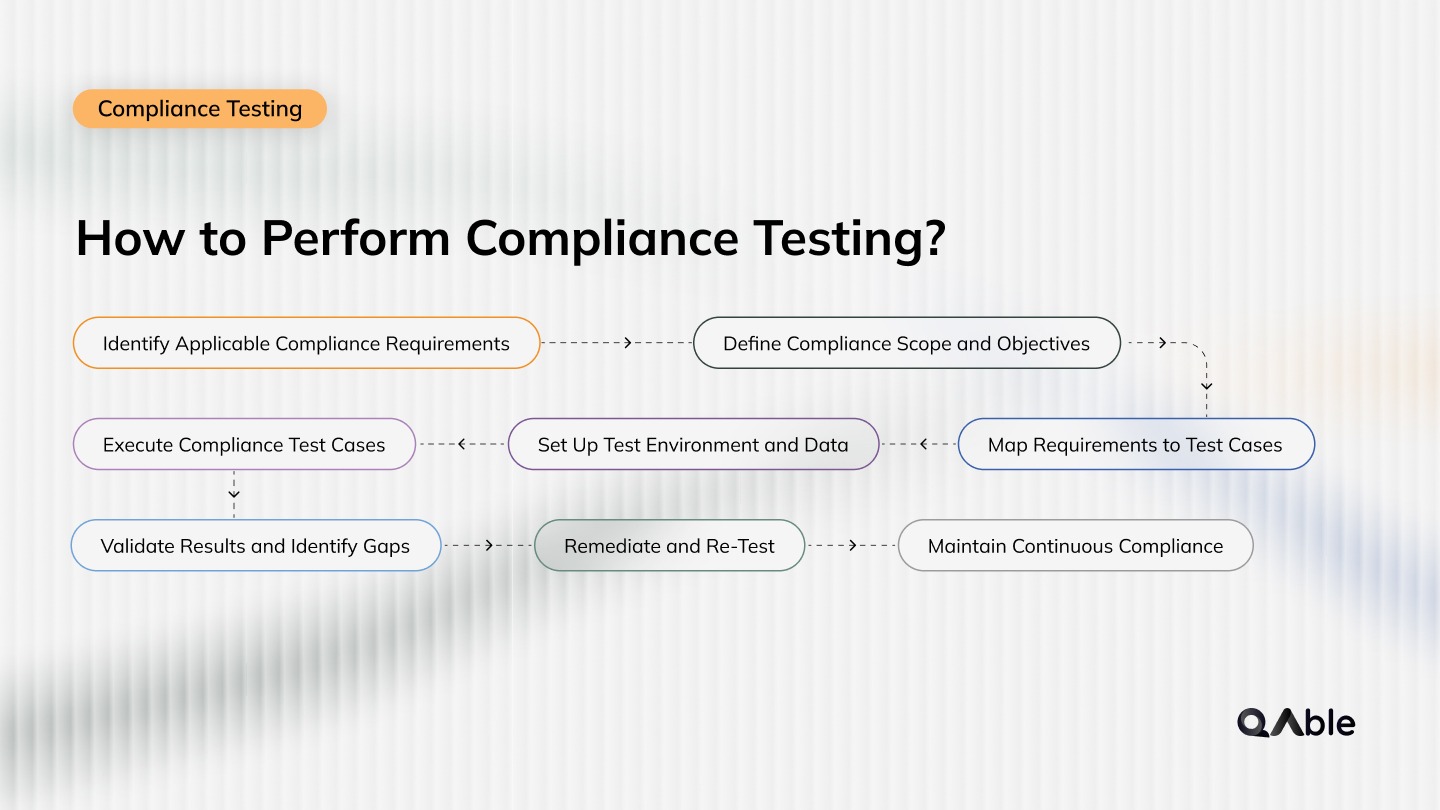
In modern systems, compliance needs to be treated as a continuous activity, integrated across development, testing, and release workflows.
Below is a step-by-step approach to performing compliance testing effectively.
Also Read: What Is Compliance Testing How To Do It
1. Identify Applicable Compliance Requirements
The first step is to clearly define which regulations, standards, and policies apply to your system.
This depends on:
- Industry domain
- Geographic presence
- Type of data handled
- User base
Organizations often need to comply with multiple frameworks simultaneously, such as:
- GDPR for data privacy
- PCI DSS for payment systems
- ISO standards for security
Without a clear understanding of applicable requirements, testing efforts may become incomplete or misaligned.
From a quality intelligence perspective, this step establishes the foundation for risk identification and compliance mapping.
2. Define Compliance Scope and Objectives
Once requirements are identified, the next step is to define what parts of the system need to be tested for compliance.
This includes:
- Application features
- APIs and integrations
- Data flows
- User interactions
- Infrastructure components
At this stage, teams should clarify:
- What needs validation
- What level of compliance is required
- Which areas carry higher risk
This helps ensure that compliance testing is targeted and relevant, rather than broad and inefficient.
3. Map Requirements to Test Cases
Compliance requirements need to be translated into testable scenarios.
This involves mapping each requirement to specific validation points within the system.
Examples include:
- Validating user consent flows
- Checking data encryption mechanisms
- Verifying access control rules
- Testing audit logging
This step ensures traceability between:
- Regulatory requirements
- System behavior
- Test coverage
From a quality intelligence perspective, this creates a structured link between compliance rules and testing outcomes, improving visibility and accountability.
4. Set Up Test Environment and Data
Compliance testing often requires controlled environments and specific types of data.
This includes:
- Test environments that mimic production
- Masked or anonymized data
- Controlled access configurations
- Secure data handling setups
Special attention is needed to ensure that:
- Sensitive data is not exposed
- Test data reflects real-world scenarios
- Environments follow compliance constraints
This step ensures that testing conditions are both realistic and compliant.
5. Execute Compliance Test Cases
Once the setup is complete, test cases are executed to validate whether the system meets compliance requirements.
Execution may involve:
- Manual validation
- Automated test scripts
- Tool-based scanning
- Assistive technology validation (for accessibility)
Key areas tested include:
- Data handling behavior
- Access controls
- Security configurations
- Workflow compliance
In modern QA environments, automation is often used to ensure:
- Repeatability
- Consistency
- Faster execution
However, certain compliance areas still require human validation for context and accuracy.
6. Validate Results and Identify Gaps
After execution, results are analyzed to identify:
- Compliance violations
- Gaps in implementation
- Inconsistent behavior
- Potential risks
This step goes beyond identifying failures. It involves understanding:
- Why the issue occurred
- How it impacts compliance
- What risk it introduces
From a quality intelligence perspective, this transforms test results into actionable insights, enabling teams to prioritize remediation effectively.
7. Remediate and Re-Test
Once issues are identified, they must be resolved and validated again.
This includes:
- Fixing compliance gaps
- Updating configurations
- Improving workflows
- Enhancing security controls
Re-testing ensures that:
- Fixes are effective
- No new issues are introduced
- Compliance requirements are fully met
This iterative process helps maintain accuracy and reliability in compliance validation.
8. Maintain Continuous Compliance
Compliance is not static. Regulations evolve, systems change, and new risks emerge over time.
To maintain compliance, organizations should:
- Integrate testing into CI/CD pipelines
- Perform periodic audits
- Monitor compliance continuously
- Update test cases as requirements evolve
This ensures that compliance testing becomes an ongoing process rather than a one-time activity.
From a quality intelligence standpoint, continuous compliance allows teams to:
- Detect risks early
- Adapt to regulatory changes
- Maintain long-term system integrity
A Quality Intelligence Perspective
Traditional compliance testing focuses on validation after development.
A quality intelligence approach shifts this by:
- embedding compliance checks early
- aligning testing with risk areas
- using data to guide validation
- maintaining continuous visibility
Instead of asking: “Did we pass compliance testing?”
Teams should ask: “Where are we most at risk, and how continuously are we validating it?”
This shift enables more proactive and reliable compliance strategies.
Overview
Performing compliance testing effectively requires a structured, iterative, and continuous approach.
By combining:
- Requirement mapping
- Targeted validation
- Structured execution
- Continuous monitoring
Organizations can ensure that compliance is not just achieved but sustained over time.
Related Read: What Is API Security Testing and How Does It Work?
Benefits of Compliance Testing
Compliance testing is often viewed as a regulatory requirement, but in practice, it delivers broader technical and business value.
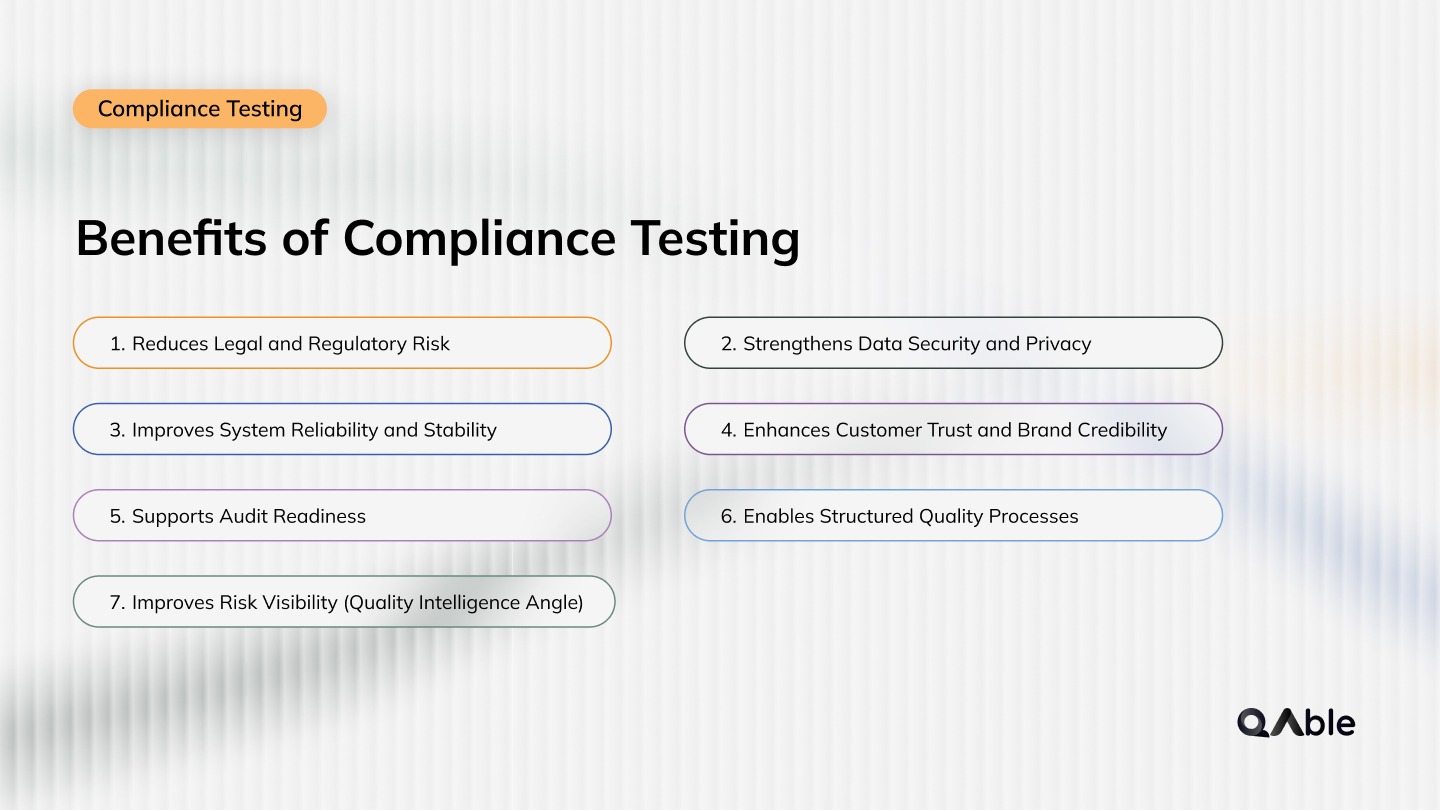
When implemented correctly, it strengthens not just compliance posture, but also system reliability, security, and user trust.
1. Reduces Legal and Regulatory Risk
Non-compliance can result in:
- Legal penalties
- Regulatory fines
- Operational restrictions
- Reputational damage
Compliance testing ensures that systems align with required regulations, reducing the risk of violations.
By validating requirements early and continuously, organizations can avoid costly remediation efforts later in the lifecycle.
2. Strengthens Data Security and Privacy
Many compliance frameworks focus heavily on data protection and security controls.
Compliance testing helps validate:
- Data encryption practices
- Access control mechanisms
- Secure data handling
- Authentication workflows
This ensures that sensitive information is protected against unauthorized access and misuse.
From a quality intelligence perspective, this enables teams to identify security risks as part of testing workflows, rather than as separate activities.
3. Improves System Reliability and Stability
Compliance requirements often enforce structured system behavior, such as:
- Consistent workflows
- Audit logging
- Controlled access
- Predictable system responses
Validating these requirements improves overall system reliability.
Systems that follow compliance standards tend to be:
- More stable
- Easier to monitor
- Less prone to unexpected failures
4. Enhances Customer Trust and Brand Credibility
Users are increasingly aware of how their data is handled.
Compliance with standards such as GDPR or accessibility guidelines signals that an organization:
- Values user privacy
- Follows industry standards
- Prioritizes user safety
This builds trust and improves brand perception, especially for platforms handling sensitive data.
5. Supports Audit Readiness
Organizations are often required to demonstrate compliance during audits.
Compliance testing helps maintain:
- Audit trails
- Documentation
- Traceability of actions
- Validation reports
This makes it easier to:
- Respond to audits
- Provide evidence
- Demonstrate compliance status
6. Enables Structured Quality Processes
Compliance introduces discipline into development and testing workflows.
It requires teams to:
- Define clear rules
- Document processes
- Validate consistently
- Maintain traceability
This improves overall QA maturity and aligns testing with structured engineering practices.
7. Improves Risk Visibility (Quality Intelligence Angle)
One of the most important benefits of compliance testing is improved visibility into risk.
Instead of treating compliance as a pass/fail outcome, teams gain insights into:
- Where violations occur
- Which areas are most sensitive
- How risks evolve over time
This enables:
- Risk-based prioritization
- Proactive issue detection
- Better decision-making
Compliance testing becomes a risk intelligence layer, not just a validation step.
Overview
Compliance testing delivers value beyond regulatory alignment. It strengthens security, reliability, and trust, while also improving visibility into system risks.
When approached strategically, it becomes an integral part of quality engineering, helping teams build systems that are not only functional but also secure, compliant, and dependable.
Final Thoughts
Compliance testing is no longer a one-time validation activity. As systems become more complex and regulations continue to evolve, compliance must be treated as a continuous and structured part of quality engineering.
Organizations that rely only on periodic checks often face gaps in visibility, delayed issue detection, and higher remediation costs. In contrast, integrating compliance into development workflows enables teams to identify risks early and maintain alignment as systems evolve.
A modern approach to compliance testing combines:
- Automation for scale and consistency
- Expert validation for context and accuracy
- Continuous monitoring for ongoing alignment
This is where a quality intelligence-driven approach becomes essential.
By connecting compliance requirements with real system behavior, historical data, and risk patterns, teams can move beyond checklist validation and build systems that are proactively compliant, secure, and reliable.
At QAble, our compliance testing services are designed around this philosophy; integrating automation, structured validation, and continuous feedback into the development lifecycle. This enables organizations to manage compliance not just as a requirement, but as a core part of product quality and engineering maturity.
Related Read: Software Quality and Business Risk