


Automation testing is now a core part of software delivery. As release cycles shorten and systems grow more complex, manual testing alone cannot keep up with the regression load, so most teams move toward automation-first testing.
Adoption is not the hard part. Capgemini's World Quality Report 2025 found that 89% of organizations are already piloting or implementing AI-augmented quality engineering, yet only 15% have reached enterprise-wide implementation. The gap between trying AI in testing and running it at scale is where most of the cost sits.
Gartner's survey of automated testing found that 40% of organizations run automated testing continuously throughout the development cycle. The same survey found that 60% of organizations adopt automation to improve product quality, and 58% to increase deployment speed. Respondents named higher test accuracy (43%), increased agility (42%) and wider test coverage (40%) as the main benefits.
The problems that send teams looking for a partner are familiar:
- Unstable test suites and flaky runs
- High maintenance effort on every product change
- Poor integration with CI/CD pipelines
- Suites that slow down as the product grows
This guide lists 11 automation testing companies that serve clients in India, the USA or both. It sets out what each one offers, who it suits and how to judge their automation before you sign. If you are still deciding between an outside partner and your own team, read Why Product-Based Companies Should Rely on External QA Services Over Internal QA Teams? first.
How this list was built
Every fact about a company below comes from that company's own website, read on 13 and 14 October 2026. Where a fact was missing from the company's site and we used its Clutch profile, we say so. Where a fact could not be found, we left it out.
Three rules shaped the list:
- Automation is a core service, with its own page describing how the company does it
- Serves clients in India, the USA or both, as the company publishes it
- No ratings we cannot show you. Earlier versions of lists like this rate "automation maturity" as high or medium. Nobody outside a company can measure that, so we describe what each company offers instead
For the wider case for outsourcing, see the Benefits Of QA Outsourcing Software Testing.
The 11 at a glance
Top automation testing companies in India and USA
1. QAble
QAble is a quality engineering company founded in 2018 and headquartered in Ahmedabad, India, certified to CMMI Dev Maturity Level 3, ISO/IEC 27001:2022, ISO 9001:2015 and ISO 42001:2023. Automation is the centre of its practice, not one service among many. It builds and runs its own automation platform, Tesbo-X, which underpins its automation engagements, and its own bug reporting product, BetterBugs.
Its automation page says QAble "is tool-agnostic and selects the right framework for your application and stack". The suite lives in the client's repository, follows the client's pull request and review standards, and runs in the client's CI pipeline on every pull request, schedule or release gate. QAble suits product teams shipping weekly or faster that want automation they can trust as a release signal, not a dashboard of green ticks.
Core capabilities:
- Web UI, API and mobile test automation, built from scratch or repaired.
- Regression automation running inside CI/CD on every pull request.
- API test automation with REST Assured, Postman and Karate.
- Testing of AI-powered products, including validation of AI-generated output.
- Functional, performance, security and accessibility testing alongside automation.
- QA audits, managed automation and embedded automation engineers, ramped up in 2 weeks.
Automation focus:
- Selenium, Playwright and Cypress for web, REST Assured, Postman and Karate for APIs, and Appium for mobile.
- Tests selected by risk: critical business flows and release impact come first, not test volume.
- Framework structure designed before tests are written, with page objects, data providers and reusable components.
- Parallelised execution with a runtime budget, so the suite stays fast as it grows.
- Smaller test batches run independently, so an infrastructure problem does not fail a whole run.
- Every failure recorded with a trace, screenshots, video, logs and build-level diagnostics.
- Test data isolated per run, predictable, and cleaned up after execution.
Tesbo-X, QAble's automation platform:
Tesbo-X is the platform QAble uses to run automation as an engineering system. It has five modules: stability governance, agentic test development with a defined human review loop, a CI execution engine with release gates, Tesbo Report for test intelligence, and notifications with signal-to-noise controls. QAble publishes the standards it holds every Tesbo-X suite to:
- A flaky-test threshold below 2%, tracked and reviewed against agreed targets.
- 100% of failures classified as application, test, environment or data-related.
- Unstable tests isolated within 24 hours, then tracked and resolved.
- A suite runtime kept under 10 minutes.
- A test counted as done only when CI clearly signals ship or hold.
What defines the approach:
- Automation starts from risk, so the first tests protect the journeys that would cost the most if they broke.
- AI generates automation at speed, and a defined human review loop checks it before it is committed.
- Failure clustering, flake tracking and stability trends turn test results into release readiness decisions.
- A five-step delivery process: analyse, plan, execute, report and close, with feedback from each cycle into the next.
- Tools are chosen to fit your application and stack, not the other way round.
What strengthens execution:
- Certified delivery: CMMI Dev Maturity Level 3 for process, ISO/IEC 27001:2022 for security and ISO 42001:2023 for AI management.
- 50+ ISTQB-certified engineers and 100+ projects delivered across fintech, gaming, SaaS and healthcare.
- Saleshandy, a B2B email platform with more than 10,000 customers: over 100 untested APIs brought under manual and REST Assured automated testing, raising the API testing success ratio to 90%.
- Docyt, a California fintech: a 150-case Selenium and Appium suite across web and mobile, stabilised with static and fluent waits, delivered 100% on time.
- HireLogic, an AI interview platform: QAble built the QA function from scratch and now leads the client's whole QA team, including validation of AI-generated notes, summaries and candidate scores.
- Three ways to start: a Tesbo-X pilot of 2 to 4 weeks, a monthly managed service, or engineers embedded in your repository.
- BetterBugs attaches the screenshot, console logs, network requests and environment data to every bug, so developers can reproduce it at once.
2. ImpactQA
ImpactQA lists its headquarters in Plano, Texas, with an office in Houston and offices in Noida and Chennai, India. It states "150+ Certified Automation Engineers" and suits enterprises that need packaged-application automation alongside custom web and mobile suites.
Core capabilities:
- Automated web, mobile, API, UI and performance testing.
- Continuous test automation for every release cycle.
- Test data management with synthetic data and data masking.
- Robotic process automation and cloud automation.
Automation focus:
- Selenium, Playwright, Cypress, Tricentis Tosca, Appium and REST Assured.
- A proprietary scriptless test automation framework for APIs, microservices and cloud apps.
- Kubernetes automation across the CI, CT and CD pipeline.
- Service virtualisation to replicate real conditions for continuous execution.
What defines the approach:
- A technology-agnostic approach to tools.
- Automated tests integrated with bug tracking and test case management.
- Test data provisioning built into the CI/CD pipeline.
What strengthens execution:
- Partnerships with Tricentis and OpenText.
- A focus on SAP, Oracle and ERP testing for global enterprises.
3. Cigniti (now part of Coforge)
Cigniti was founded in 1998 in Hyderabad, India. Coforge closed its acquisition of Cigniti on 30 April 2026, and cigniti.com now redirects to Coforge's quality engineering pages. It suits large enterprises that want automation as part of a wider engineering contract.
Core capabilities:
- End-to-end test automation.
- Performance engineering, monitoring and analysis.
- Security testing and test data management.
- Chaos engineering, observability and AI model validation.
Automation focus:
- Generative AI that derives test cases, scripts and test data from requirements and user stories.
- Low-code and no-code automation for business and engineering teams.
- Self-healing frameworks that adapt to application and UI changes.
- BlueSwan, its AI-led quality engineering suite.
What defines the approach:
- Shift-left controls and CI/CD-based validation.
- Targeted regression selected by AI.
- Continuous assurance with production monitoring.
What strengthens execution:
- Domain-led quality frameworks for regulated environments.
- Automation delivered inside Coforge's wider engineering services.
4. ThinkSys
ThinkSys was founded in 2012 and is registered in Sunnyvale, California, with its engineering team in Noida, India. It says tools are chosen "based on project needs not trends", and suits product teams in regulated sectors.
Core capabilities:
- Web, mobile (iOS and Android), desktop and API automation.
- Enterprise software automation for ERP, CRM, HR and finance systems.
- Automation for cloud, SaaS, on-premises and hybrid systems.
- QA for LLM-based applications.
Automation focus:
- Selenium, Playwright, Cypress, Appium, RestAssured and Postman with Newman.
- CI/CD with GitHub Actions, Jenkins and Azure DevOps.
- Allure for test reporting.
- Low-maintenance framework architecture that grows sprint over sprint.
What defines the approach:
- Automation strategy tailored to the application architecture and delivery model.
- Defect visibility earlier in development.
- A structured automation process with measurable outcomes.
What strengthens execution:
- A choice of managed testing or a dedicated QA team.
- A published zero critical bug guarantee.
5. QASource
QASource was founded in Pleasanton, California, in 2002, with its largest engineering centres in Chandigarh and Bhubaneswar, India. It states ISO 27001:2022 and ISO 9001:2015 certification, and suits teams that want a long-term dedicated automation team.
Core capabilities:
- Functional, regression, API, UI and cross-browser automation.
- Data-driven and performance test automation.
- Automation for workflows regulated by HIPAA, GDPR, SOC2 and PCI DSS.
- Traditional and AI-augmented test automation.
Automation focus:
- Playwright, Selenium and Cypress for UI, and REST, SOAP and GraphQL for APIs.
- Continuous testing with Jenkins, CircleCI, Azure DevOps or GitLab.
- Modular, reusable frameworks designed for long-term maintenance.
- QASIP, its own platform, included with its dedicated teams.
What defines the approach:
- Tool selection after analysing your stack, architecture and goals.
- Human-in-the-loop review of every AI-generated test case.
- Cycle analysis that finds and closes coverage gaps.
What strengthens execution:
- Ongoing suite maintenance, framework updates and test quality audits.
- Dedicated teams that stay on a product for years.
6. DeviQA
DeviQA operates as a specialised quality engineering and intelligence partner founded in 2010, focused on building scalable QA systems tightly aligned with modern development workflows. Backed by 300+ engineers, the company has successfully supported 300+ clients across 40+ industries, including major names like Abbott, Tipalti, BP, Mimecast, and Compass, with particular strength in fintech and healthcare.
Their strategic approach combines comprehensive automation, AI-assisted validation (powered by an in-house AI toolset for test-case generation and defect triage), and structured execution to support both fast-growing product teams and complex enterprise environments.
Core capabilities:
- Quality engineering and quality intelligence systems.
- Automation-first testing systems covering 90 to 95%+ test coverage metrics.
- AI-assisted QA and next-gen testing (AI/ML, IoT, chatbot testing).
- CI/CD-integrated automation execution (e.g., GitHub Actions, Jenkins integration).
- Enterprise QA and quality maturity assessment.
- API, performance, security, and contract testing.
Automation focus:
- System-driven automation across coverage, execution, and reporting achieving fast regression runs (e.g., 10-minute cycles).
- Automation frameworks built on Playwright, Selenium, Cypress, Appium, TestNG, Robot, Cucumber, and WebdriverIO.
- Language-agnostic suites developed in JavaScript, Python, Java, etc.
- Parallel and multi-browser execution for accelerated release cycles.
- CI/CD integration enabling continuous testing and rapid feedback loops.
- AI-assisted workflows to optimise test coverage and reduce manual effort.
- Structured reporting with granular insights for debugging and failure analysis.
What defines the approach:
- Quality intelligence layer delivering multi-perspective insights across coverage, risk, and execution.
- Data-driven decision-making powered by actionable test results and deep failure analysis.
- Feedback loops that continuously refine test coverage and execution stability.
- Risk-based prioritisation mapped directly to business-critical workflows.
What strengthens execution:
- End-to-end automation lifecycle support encompassing planning, tool selection, execution, and ongoing maintenance.
- Quality maturity assessment aligning testing strategies with business risk and product complexity.
- Flexible engagement models featuring dedicated QA teams and outsourcing.
- Proven delivery across high-complexity verticals including AI, AdTech, Blockchain, FinTech, Healthcare, and SaaS.
7. QualityAI (formerly Qualitest)
QualityAI is the name Qualitest has used since 17 June 2026. Founded in 1997, it describes itself as an independent software testing and quality assurance company, and suits large regulated enterprises standardising automation across many applications.
Core capabilities:
- Functional, regression, API, UI and mobile automation.
- Performance and accessibility automation.
- Data validation and AI validation.
- Cross-platform testing workflows.
Automation focus:
- Automation strategy and framework architecture.
- Regression automation with predictive test selection.
- CI/CD enablement for continuous testing and delivery.
- Self-healing locators.
What defines the approach:
- Automation that supports resilience, governance, observability and compliance.
- Reusable frameworks that replace repetitive manual testing.
What strengthens execution:
- Design, implementation, execution, maintenance and optimisation across the lifecycle.
- Independent assurance for regulated industries.
8. TestingXperts
TestingXperts says it is "Headquartered in Harrisburg, Pennsylvania, and London, UK", with a facility in Chandigarh, India. It states "1400+ engineers and specialists", and suits enterprises that want a managed automation centre of excellence.
Core capabilities:
- Automation advisory and maturity assessment.
- Continuous testing and DevOps integration.
- Test script development and maintenance.
- A managed automation centre of excellence and governance.
Automation focus:
- Selenium, Playwright, Cypress, Postman, Jenkins and Tricentis.
- Tx-Automate, its own AI-powered automation framework.
- AI-assisted test design and self-healing automation.
- CI/CD-triggered risk suites.
What defines the approach:
- An automation roadmap, governance model and KPI framework from the assessment.
- Tool evaluation matched to coverage, integration and return on investment.
What strengthens execution:
- Reusable accelerators across enterprise programmes.
- A Leader position in Everest Group's 2025 QE Specialist Services assessment.
9. Avekshaa Technologies
Avekshaa lists its corporate headquarters in Bengaluru, with offices in Mumbai and Sydney and a US contact address in Cincinnati, Ohio. Its core business is performance engineering for banking and financial services, and it suits firms whose automation sits inside a performance engineering programme.
Core capabilities:
- Test automation across web, mobile and point-of-sale devices, as in its published retail case.
- Automation framework development for API, cloud, SOA and microservices.
- Test automation integrated into CI/CD pipelines.
Automation focus:
- A standardised, unified automation approach.
- Modular and reusable components for all application types.
- Behaviour emulated across environments for consistent results.
What defines the approach:
- Automation aligned with enterprise goals.
- Detailed tool evaluation for a cost-effective tool inventory.
What strengthens execution:
- Performance engineering alongside automation.
- Centralised execution and reporting through CI/CD tools.
10. Innowise
Innowise "was officially established in 2007" and "is headquartered in Warsaw, Poland". It is a full-cycle software development company, and suits companies that want automation from the same partner that builds their software.
Core capabilities:
- Functional, mobile, UI, performance, API and security automation.
- CI/CD automation.
- Framework development.
- Complete QA ownership, from test management to automation.
Automation focus:
- Selenium, Playwright, Cypress and Appium.
- Test suites architected to scale with the project.
- Automated quality gates in the delivery process.
What defines the approach:
- Ground-up automation or integration into an existing pipeline.
- Support for both regulation-heavy and agile environments.
What strengthens execution:
- ISTQB Gold Partner status.
- It states 70+ automation QA engineers and 400+ QA testing projects.
11. TestYantra
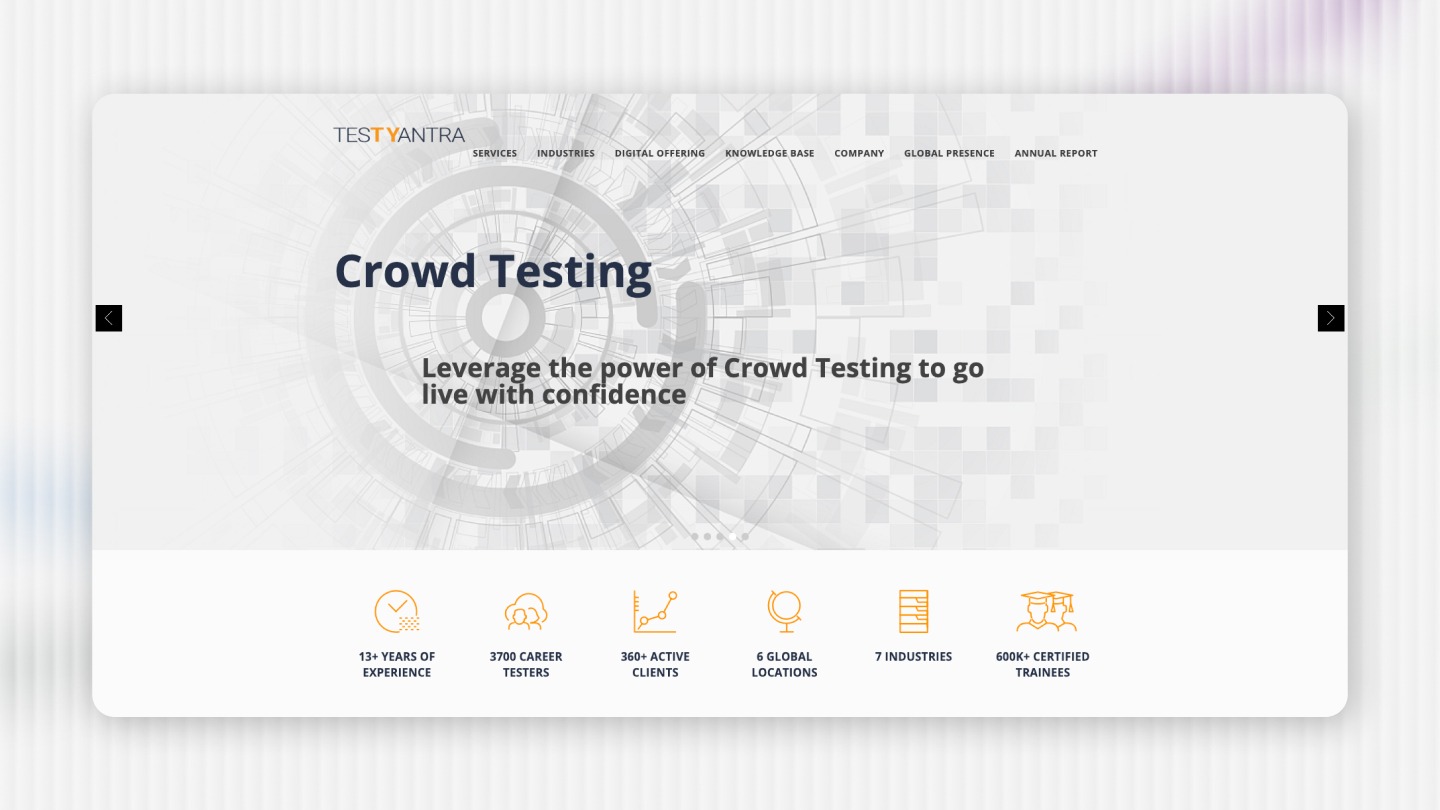
TestYantra lists its global headquarters in Bengaluru and a US office in Plano, Texas, and its group also owns FireFlink, a scriptless automation platform. It suits enterprises that want custom automation frameworks gating releases in their CI/CD pipeline.
Core capabilities:
- Custom framework design.
- API and UI test automation in one suite.
- CI/CD pipeline test execution and gating.
- Framework migration and consolidation.
Automation focus:
- Playwright, Selenium, Cypress, Appium, JUnit and TestNG.
- AI-augmented self-healing and smart test execution.
- Modular frameworks built for reuse and long-term team ownership.
What defines the approach:
- Tests on every build, with clear pass and fail release gates.
- Defects found at the right layer, earlier in the cycle.
What strengthens execution:
- Fragmented frameworks unified under one governance model and one pipeline.
- FireFlink, its group's scriptless automation platform.
For the companies that cover more than automation, see our wider list of software testing companies in India and USA. If you have settled on Playwright, our list of Top Playwright Testing Service Providers in India goes further.
What the industry data says
The pattern is consistent: most teams automate, but fewer than half run it continuously, and implementation and skills are the main obstacles. Those are exactly the problems a partner should solve. A partner that only adds more scripts does not solve them.
What that means for AI claims
Nearly every company above now sells some form of AI-assisted automation: self-healing locators, generated test cases or agent layers. The World Quality Report suggests most clients are still experimenting. Ask any provider to show AI-assisted automation running on a real client suite, and what share of its tests it generated.
Four questions for any AI-assisted automation pitch
Will testers be replaced by AI? Not on this evidence. AI now writes and repairs some tests, but choosing what to test, judging whether a failure is a real defect and owning the release decision are still people's work. What changes is how a provider uses AI, so ask these four questions.
- Self-healing: when a locator is healed, what is logged, and who reviews it? A silent heal can hide a real change in the product
- Generated tests: who reviews a generated test before it enters the suite, and how is a weak assertion caught?
- Test selection: if AI picks which tests to run on a change, how was that choice checked against defects it might have missed?
- Your code and data: does any of your source code, test data or screens leave your environment for a third-party model, and under what agreement?
A provider with real AI-assisted automation answers all four with examples. A provider selling a label answers in general terms.
What to settle in the contract
Who owns the suite at the end
Automation code is an asset you pay to build, so the contract should say that the framework, the tests and the pipeline configuration belong to you, and live in your repository from day one. Watch for suites that only run on a provider's own platform or licence. If the contract ends, you should be able to keep running every test without them. Ask for a handover clause, and ask how long the provider's last handover took.
Cost
We do not publish rate ranges. Automation cost depends on the scope, the number of platforms and how much of an existing suite has to be repaired, and any range without your scope would be invented. Compare quotes on the same scope: the same user journeys, platforms and maintenance commitment.
Triage times
A failing nightly run is only useful if someone reads it before your developers start work. Agree in writing who reviews overnight failures and when your team receives a triage note. Agree what the note contains too: the failing test, the likely cause, and whether it is a product defect, a test defect or an environment problem. Each finding should carry its evidence, such as a screenshot, a trace or a log. Track the time from red build to triage note during the pilot, alongside the flaky rate. If triage regularly arrives after your stand-up, the suite will be ignored, however good the tests are.
Four automation jobs, and why they cost differently
Most automation engagements are one of four jobs. Name yours before you ask for quotes, because each needs a different team and a different timeline.
Building a new suite
You have little or no automation. The provider chooses a framework, designs its structure and automates your most important journeys first. The risk is a suite that grows fast and then becomes expensive to maintain, so ask how they will keep maintenance effort flat as the test count rises.
Repairing an existing suite
You have automation, but nobody trusts it. Runs are slow, failures are ignored and every release still needs a manual pass. The work here is diagnosis first: which tests are flaky, which are redundant and which cover nothing important. Ask the provider how they would measure the suite's health in the first two weeks, before writing anything new.
Mobile adds a device question
Most automation providers can automate mobile apps with Appium. The harder question is where the tests run. Emulators are cheap and fast but miss hardware, network and vendor-skin behaviour. Real devices catch those, at a cost. Ask which devices and operating system versions the suite will run on, and whether they are real or emulated.
Migrating to a new framework
You want to move, often from Selenium to Playwright. Migration tooling can make this cheaper than a manual rewrite. Ask what a provider will do with tests that do not translate cleanly, and how both suites will run in parallel until the new one is trusted.
What a pilot should prove, worked
A pilot is the cheapest way to test a provider's claims, but only if you measure the right thing. Test count is the wrong thing. Stability over time is the right one.
Why a small flaky rate matters
In the example, 9 flaky failures in 3,750 executions sounds trivial. Applied to a full suite of 500 tests, the same rate turns about 70% of runs red for no reason, and a team that sees red builds every day learns to ignore them. Our regression testing strategy guide works through the same arithmetic for test selection. Agree a flaky-rate threshold for the pilot in writing, and ask how the provider will hold it as the suite grows. Agree a second number too: how long it takes from a red build to a triage note that says whether the failure is a product defect or a test problem.
How to choose the right automation testing company
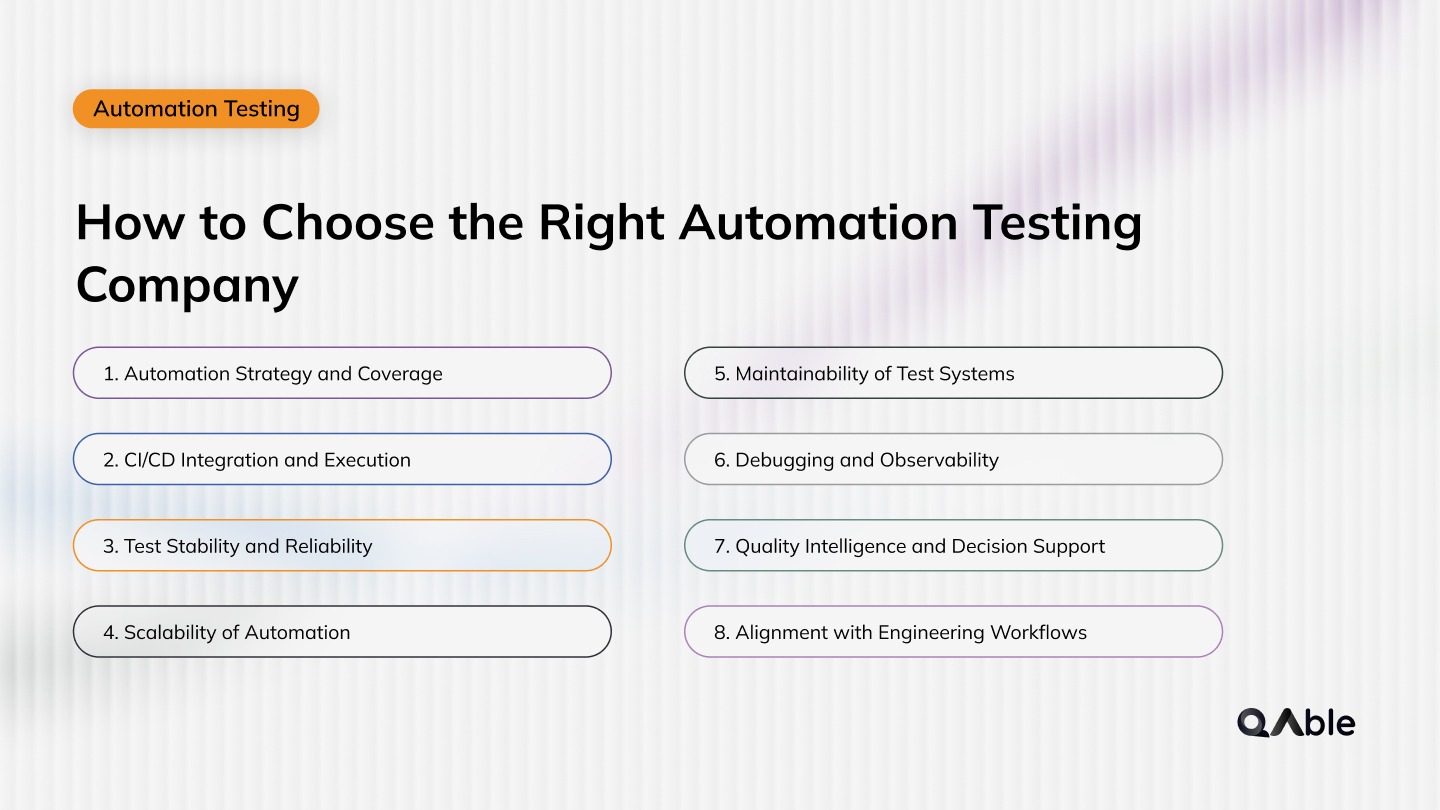
Most providers describe similar services. The difference lies in how they design, run and maintain automation inside your engineering system. These eight checks expose it.
1. Automation strategy and coverage
Ask how they decide what to automate first. A good answer starts from your critical user journeys and highest-risk areas, then balances UI, API and system-level tests. A poor answer is a target number of test cases.
2. CI/CD integration and execution
Ask to see a real pipeline run from an existing client, with names removed. You want tests running on every merge, results reported in the pipeline, and a failure linked to logs and traces. Ask which CI tools they have worked with, such as GitHub Actions, GitLab CI or Jenkins.
3. Test stability and reliability
Ask for the flaky-test rate on one current suite, and what they do when a test fails for no real reason. Playwright's documentation on test retries gives a usable definition: a flaky test is one that "failed on the first run, but passed when retried". Strong teams treat each one as a defect with a root cause. Weak teams turn on retries and stop counting.
4. Scalability
Ask what happens to run time when the suite doubles. Parallel runs and good test distribution keep execution predictable as the product grows. Ask for the run time of their largest current suite, and how many machines or workers it uses. A suite that takes an hour on every merge will soon be run only at night.
5. Maintainability
Ask how much effort goes into keeping tests working each sprint. Look for reusable components, clear selector and fixture conventions, and tests reviewed like production code. Our QA Testing Best Practices covers the habits that keep a suite healthy.
6. Debugging and observability
Ask for a sample failure report. It should include logs, traces or screenshots, the environment, and a clear statement of whether it is a product defect or a test problem.
7. Quality reporting
Ask what they report beyond pass and fail: coverage against risk, trends in failures, and readiness for release. Good reporting lets you decide whether to ship, not just how many tests ran. Ask for a sample weekly report from a current client, with names removed. Check that it shows which journeys were covered, which failures were product defects and which were test problems, and what changed since the previous week. A report you cannot act on is a cost, not a control.
8. Fit with your engineering workflow
Check they have automated your stack before: your frameworks, your cloud, your architecture. Ask how they work with your developers day to day. If you are weighing a partner against hiring, our comparison of External QA vs. Internal QA sets out the trade-offs.
How to put a number on it
Automation should be judged on outcomes such as faster releases and fewer escaped defects, not test counts. Our guide to Measuring Test Automation's Business Impact shows how to build that case.
The full engagement is in our Docyt case study.
A shortlist sequence that works
- List the three user journeys that must never break, and your CI tool
- Decide whether you need a new suite, a repair or a framework migration
- Shortlist three providers that name your framework and have your platforms
- Ask each for a real pipeline run, its flaky-test rate and a sample failure report
- Run a paid pilot that automates one real journey end to end in your pipeline
- Judge the pilot on stability over two weeks, not on how many tests it produced
- Sign with maintenance effort and triage times written into the contract
Final thoughts
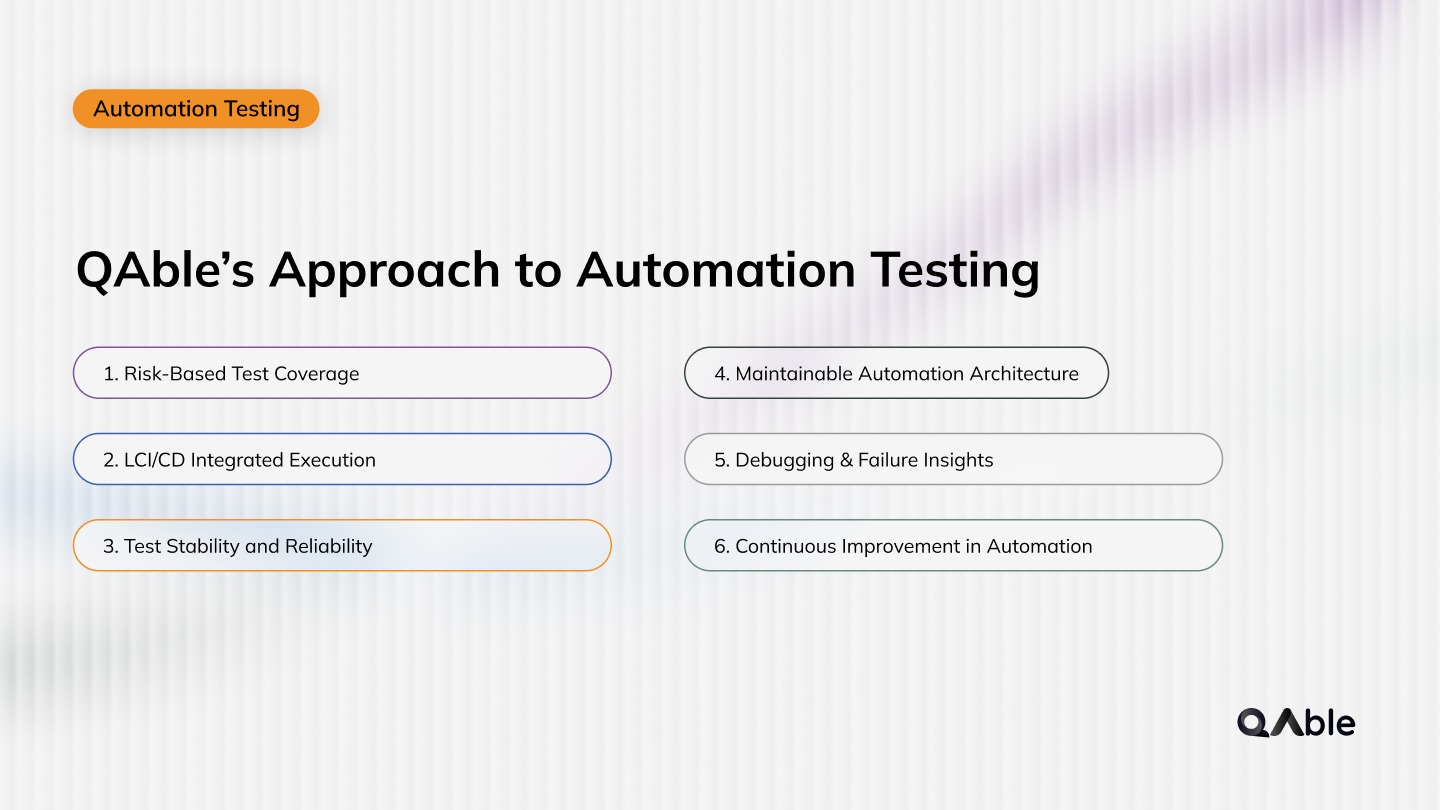
Most automation testing companies offer similar capabilities. The real difference is execution: how automation fits into your pipeline, how reliably it runs at scale, and how quickly a failure becomes a decision.
At QAble, automation is part of a wider quality engineering system, built to run inside the client's pipeline and produce failure evidence a developer can act on.
If you want a second opinion on your current suite or a plan for a new one, QAble's automation testing service starts with a review of your pipeline and the journeys that matter most.