


Software quality is no longer just a testing function. It decides how fast you can release, what your users experience and how much your engineers spend fixing production.
India is one of the largest places to buy that work. Market Research Future estimates the India outsourced software testing market was valued at $2.58 billion in 2024, and projects it to reach $11.1 billion by 2035, a compound annual growth rate of about 14%.
The reasons buyers outsource have changed. Deloitte’s Global Outsourcing Survey 2024 found that 67% of executives had adopted managed or operate services, up from 45% two years earlier. Only 34% now name cost savings as the main reason to outsource, down from 70% four years before the survey.
Quality has also moved closer to the core of the business. As per Capgemini’s World Quality Report 2023-24, 67% of organisations have incorporated quality engineering at the core of their business operations.
So the question is not whether an India team is cheaper. It is whether the company you pick can run testing inside your delivery process, across a time difference of up to 13.5 hours, under a contract that protects your data.
This guide covers ten QA outsourcing companies in India, how to work across the time zones, what India's data protection law means for your contract, and eight questions that separate a strong partner from a weak one.
Related Read: External QA vs. Internal QA
How this list was built
Every company here delivers QA from India and publishes its services on its own website. Each entry was checked against that website on 30 October 2026, and two companies on earlier versions of this list now trade under new names.
Each entry follows the same structure:
- An introduction: where the company is based, how it describes itself and who it suits.
- Core capabilities: the testing services it offers.
- Outsourcing focus: how it delivers outsourced QA and what shapes its engagements.
The 10 at a glance
Top QA Outsourcing Companies in India (2027)
Selecting the right QA outsourcing company in India depends on how well the partner fits your engineering workflow, your automation needs and your release rhythm.
Below is a structured list of QA outsourcing companies based on capabilities, delivery models and typical use cases. For organizations specifically evaluating Playwright automation expertise, see our guide to Playwright Testing Service Providers in India.
1. QAble
QAble is a quality engineering and QA outsourcing company founded in 2018 and based in Ahmedabad, India. It is certified to CMMI Dev Maturity Level 3, ISO/IEC 27001:2022, ISO 9001:2015 and ISO 42001:2023, and has delivered 100+ projects with 50+ ISTQB-certified engineers.
QAble runs outsourced QA as an engineering function, not a supply of testers. Its own automation platform, Tesbo-X, and its own bug reporting product, BetterBugs, sit under every engagement. Test suites live in the client's repository and run in the client's pipeline, and every test artefact belongs to the client. It suits product teams in India and the US that ship often and want one partner accountable for quality across the time difference.
Core capabilities:
- Managed QA engagements, where QAble owns the QA function: strategy, test design, execution, reporting and improvement.
- Dedicated QA teams assigned to one product, with weekly and release reporting and a quarterly QA health review.
- Release-cycle QA: pre-release execution, regression suite management, release sign-off, hotfix validation and post-release monitoring.
- Test automation setup: framework selection and design, CI/CD integration and an initial suite your team can maintain.
- Functional, regression, exploratory and user acceptance testing.
- Performance, security, accessibility, mobile and compatibility testing.
- QA audits, QA consulting and process transformation for teams repairing a test process.
Outsourcing focus:
- Test strategy, scope and reporting defined before any execution begins.
- An engagement lead accountable for every sprint and release.
- Team size adjustable with two weeks' notice as scope changes.
- Work done in your existing tools, such as Jira or Linear, rather than a new toolset.
- Weekly execution summaries, defect density trends, coverage progress and sprint sign-off records.
- All test cases, automation scripts, defect logs and reports owned by the client and handed over with full documentation.
- A five-stage onboarding: scope and team alignment, context building, test strategy, execution with continuous reporting, then review.
How QAble runs offshore QA from India:
- A written engagement charter with SLAs, a severity rubric and an agreed overlap window, settled before the first engineer is onboarded.
- Follow-the-sun handover, so your team finishes the day and QAble tests the build overnight.
- Least-privilege access, hardware token authentication, secure virtual desktops for sensitive work and quarterly access reviews.
- ISO 27001-aligned operations, GDPR and data residency review, and audit-ready evidence.
- KPIs reviewed at sprint, release and quarterly governance cadence.
Ways to engage QAble:
- Release-focused support for 2 to 4 weeks, scoped and reported against each release milestone.
- A dedicated QA team assigned to your product, delivering weekly and release reporting, a test case library you own, an automation framework and a quarterly QA health review.
- QA process transformation over 4 to 8 weeks: a QA maturity assessment, a process improvement roadmap, tooling recommendations and an automation strategy.
Tesbo-X, QAble's automation platform:
Tesbo-X treats automation as a governed system. Flake thresholds are defined and tracked to keep the flake rate under 2%. Every failure is classified as an application, test, environment or data problem, unstable tests are isolated within 24 hours, and suite runtime is held to a budget of under 10 minutes. The result is a clear ship or hold signal in CI.
What QAble has delivered:
- Torrid, a US fashion retailer: QA engineers embedded in its delivery team, backend database testing across environments and Go/No-Go governance, with zero missed release deadlines.
- Exact Sciences, a US cancer diagnostics company: functional and cross-browser testing on Chrome, Firefox, Safari and Edge across Windows and macOS, with zero critical defects missed in release.
- HireLogic, an AI interview platform: QAble built the QA function from scratch and now leads the client's QA team.
- Saleshandy, a B2B email platform with more than 10,000 customers: over 100 untested APIs brought under test, raising the API testing success ratio to 90%.
- Docyt, a California fintech: a 150-case Selenium and Appium suite across web and mobile, delivered 100% on time.
2. Cigniti (now part of Coforge)
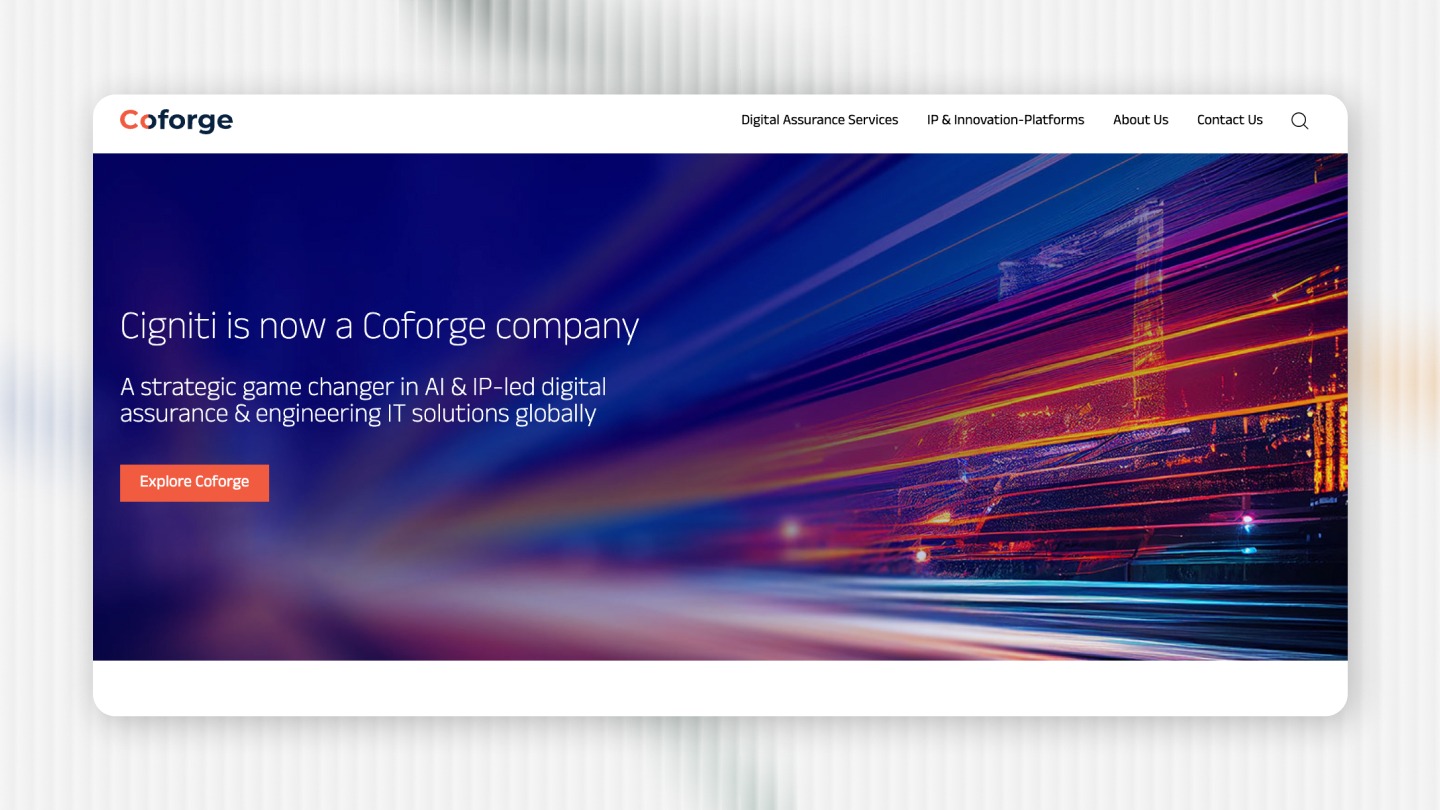
Cigniti Technologies is now part of Coforge. Coforge announced on 30 April 2026 that it had closed its acquisition of Cigniti, and cigniti.com now redirects to Coforge's quality engineering page. Coforge has offices in Greater Noida and Hyderabad, and in Princeton, New Jersey, and Texas. It suits large enterprises that want quality engineering inside a wider IT services relationship.
Core capabilities:
- Advisory and transformation services for quality engineering.
- Quality engineering services and digital assurance across web, mobile, cloud and data.
- Compliance and regulatory assurance.
- Non-functional testing, and data and device testing.
Outsourcing focus:
- BlueSwan, the AI-led quality engineering suite Cigniti built, now part of Coforge's Nuuron approach.
- Named a Leader in Everest Group's 2025 PEAK Matrix assessment for enterprise quality engineering services, it states.
- Delivery as part of a company of 45,000+ professionals across all services.
3. Indium
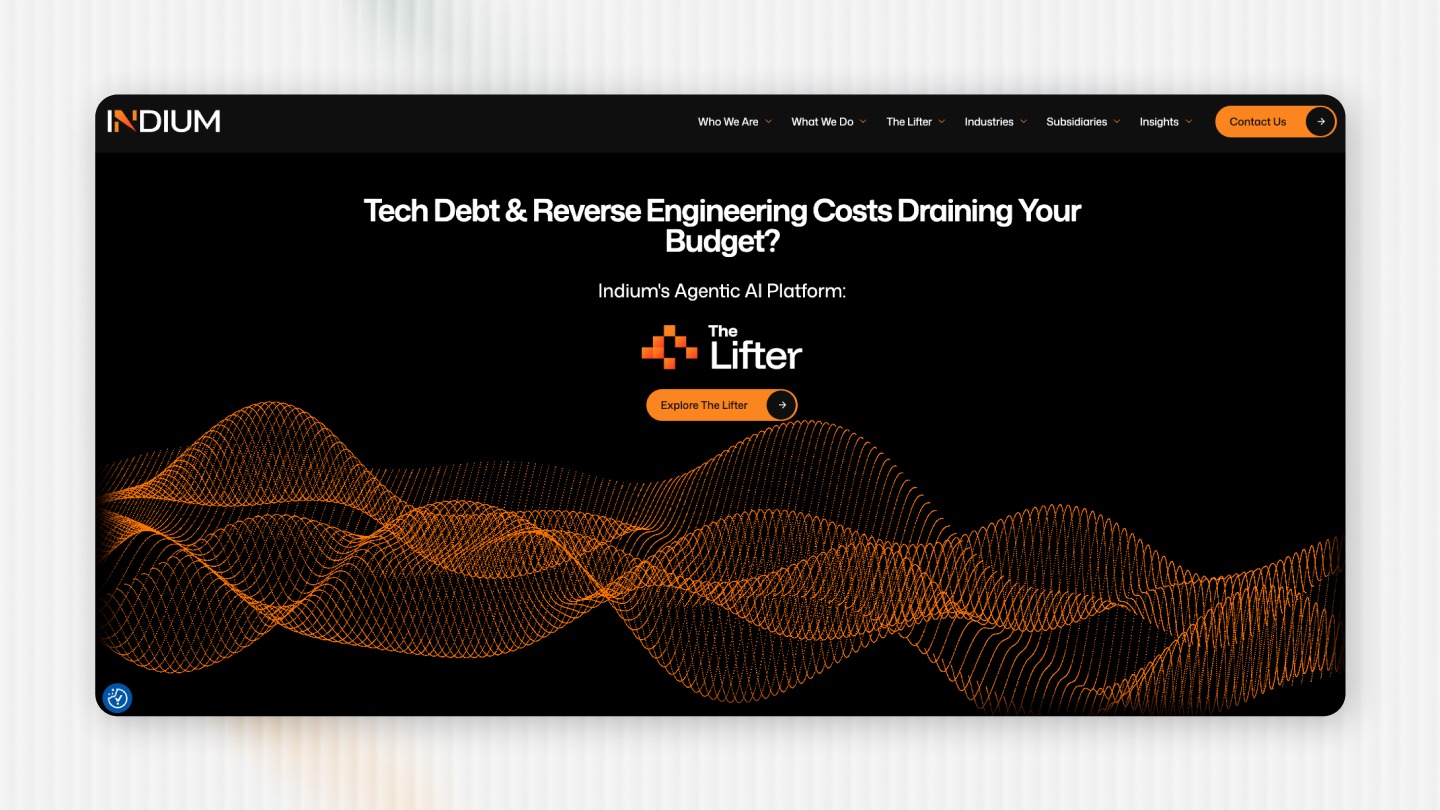
Indium, formerly branded Indium Software, describes itself as an AI services company working in agentic AI, data and analytics, application engineering and quality engineering. Its head office is in Chennai, with offices in Bengaluru, Hyderabad and Mumbai, and a US headquarters in Cupertino. It suits teams that want AI-assisted test generation alongside conventional automation.
Core capabilities:
- Release validation, automation execution and connected system testing.
- AI-driven testing and the testing of AI systems.
- Performance readiness, data assurance and IoT testing.
Outsourcing focus:
- Test Lifter, its own platform, which it says "supports Tosca, Selenium, Playwright, and Appium for test script generation".
- A certified Tosca partner, as it states.
- Named a Major Contender in Everest Group's PEAK Matrix for quality engineering services three years in a row, it says.
4. QualityAI (formerly Qualitest)
Qualitest renamed itself QualityAI on 17 June 2026, and qualitestgroup.com now redirects to the new site. It says it is built "on almost 30 years of software testing expertise" and draws on 5,000+ quality engineers. Its India offices are in Bengaluru, Hyderabad, Noida, Chennai, Coimbatore and Pune. It says it serves organisations "across complex and regulated industries".
Core capabilities:
- AI assurance and engineering, and data assurance.
- Functional testing and automation testing for complex enterprise environments.
- AI-powered non-functional testing.
- Enterprise platform assurance and digital engineering.
Outsourcing focus:
- Its own accelerators: COCO for the software delivery lifecycle, Qualisense for machine learning and Qualibuddy, an AI assistant.
- Global offshore delivery from testing centres around the world.
- Proprietary AI in testing since 2019, it states.
5. BugRaptors
BugRaptors was established in 2016 and describes itself as a pure-play QA and testing company headquartered in India and the US. Its test labs and corporate office are in Mohali, Punjab, with a US corporate office in Emeryville, California. It says it serves everyone "from agile startups to Fortune 500 enterprises".
Core capabilities:
- Manual and automation testing.
- Performance and security testing.
- Web, mobile and AI testing.
Outsourcing focus:
- Automation with Selenium, Playwright, Cypress and Appium.
- A team of 200+ ISTQB-certified testers, as it states.
- Its own tools, including BugBot, MoboRaptors and RaptorVista.
6. Appsierra
Appsierra delivers QA from Noida, which it calls its delivery headquarters, and signs contracts through entities in Delaware and London. It is part of Appsierra Group, which also runs ten SaaS products. It names SaaS, fintech, banking and healthcare technology firms, startups and Fortune 500 companies as the clients it serves.
Core capabilities:
- Quality assurance with risk-based test strategy and release gates.
- Test automation for web, mobile, desktop and API.
- Performance, load and security testing.
Outsourcing focus:
- QA pods that pair AI-accelerated testing with senior review, working inside the client's CI/CD pipeline.
- Tools including Playwright, Cypress, Selenium, Appium, k6 and JMeter, adopting the client's tools first.
- Lists ISO 9001 and ISO 27001 among its certifications.
7. HikeQA
HikeQA delivers testing from Noida, with a US business entity in Oro Valley, Arizona. It states a team of 150+ software QA professionals and 700+ apps tested. Its two-week trial assessment suits teams that want to try a vendor before committing.
Core capabilities:
- Mobile, web, SaaS and enterprise application testing.
- API, database, performance and security testing.
- Test automation, managed testing, QA staffing, and QA audit and consulting.
Outsourcing focus:
- A two-week trial assessment, as it states.
- Automation with Selenium, Cypress and Playwright, run through Jenkins and GitHub.
- ISTQB-certified QA professionals and access to its own testing laboratory.
8. ThinkSys
ThinkSys was established in 2012 and lists its address in Sunnyvale, California, with an engineering team in Noida. It says that team works "during US Eastern mornings" so regression runs complete overnight. It describes its best fit as teams that need to scale QA fast, automate regression or pass compliance audits.
Core capabilities:
- Automation, functional and regression testing.
- Mobile, performance and security testing.
- Localisation testing.
Outsourcing focus:
- A Zero Critical Bugs Guarantee, which it describes as a contract-backed commitment.
- CMMI Maturity Level 3, as it states.
- Automation with Selenium, Playwright, Cypress and Appium, and CI through GitHub Actions, Jenkins and Azure DevOps.
9. Testvox
Testvox has worked in software testing since 2017. It operates from Kottakkal in Kerala and from Dubai Airport Freezone, and says it has clients in India, the USA, the UK and the Middle East. It names startups and SMEs as its main clients.
Core capabilities:
- Automation and functional testing.
- Performance and security testing.
- AI-powered, IoT and crowd testing.
Outsourcing focus:
- One-day onboarding, as it states.
- Selenium with Java and TestNG, and Playwright, for web; Appium on real devices through BrowserStack for mobile.
10. QASource
QASource was founded in 2002 and is headquartered in Pleasanton, California, with delivery centres in Chandigarh and Bhubaneswar and an engineering centre in Mexico. It states 1,100+ engineers. It suits engineering leaders who want a QA function run for them rather than built in-house.
Core capabilities:
- Dedicated QA teams and managed quality engineering.
- Functional and regression testing across web, mobile and desktop.
- AI assurance and human validation of AI systems.
Outsourcing focus:
- The QASource Intelligent Platform (QASIP), whose generated tests are verified by engineers before entering a suite.
- Suites built in the client's framework: Playwright, Selenium, Cypress or Appium.
- ISO 27001:2022 and ISO 9001:2015 certificates, held by its Indian delivery company, it states.
Related Read: QA Testing Best Practices
Working with an India team across time zones
India runs on a single time zone, 5.5 hours ahead of UTC, with no daylight saving. Your overlap with an India team depends on where you are and the time of year.
On a normal 09:00 to 18:00 day on both sides, New York and San Francisco share no working hours with India at all. London shares 3.5 hours in January and 4.5 in July. Dubai and Singapore share most of the day.
You can calculate this for your own office. This is the script behind Figure 1, exactly as it ran:
"""Working-hour overlap between an India team and client offices (09:00-18:00 local), on a January and a July
Wednesday of 2027, computed with the IANA time zone database. India works 09:00-18:00 IST, or a late shift."""
import json
from datetime import datetime, timedelta
from zoneinfo import ZoneInfo

IST = ZoneInfo("Asia/Kolkata")
CITIES = {"New York": "America/New_York", "San Francisco": "America/Los_Angeles", "London": "Europe/London",
          "Berlin": "Europe/Berlin", "Dubai": "Asia/Dubai", "Singapore": "Asia/Singapore", "Sydney": "Australia/Sydney"}
DAYS = {"January": (2027, 1, 13), "July": (2027, 7, 14)}
INDIA_SHIFTS = {"day": 9, "late": 13}  # start hour IST; every shift lasts 9 hours


def overlap(day, zone, india_start):
    y, m, d = day
    ist_s = datetime(y, m, d, india_start, tzinfo=IST)
    ist_e = ist_s + timedelta(hours=9)
    best = (0.0, None)
    for shift in (-1, 0, 1):  # the client's working day can fall on the previous or next date
        cs = datetime(y, m, d, 9, tzinfo=ZoneInfo(zone)) + timedelta(days=shift)
        s, e = max(cs, ist_s), min(cs + timedelta(hours=9), ist_e)
        hours = max(0.0, (e - s).total_seconds() / 3600)
        if hours > best[0]:
            best = (hours, f"{s.astimezone(IST):%H:%M} to {e.astimezone(IST):%H:%M} IST")
    return {"hours": best[0], "window": best[1]}


out = {c: {f"{shift} {month}": overlap(day, z, start) for shift, start in INDIA_SHIFTS.items()
           for month, day in DAYS.items()} for c, z in CITIES.items()}
json.dump(out, open("overlap.json", "w"), indent=1)
for city, rows in out.items():
    print(f"{city:14}", " | ".join(f"{k}: {v['hours']:.1f} h" for k, v in rows.items()))
It printed these values, in hours, for the day shift and the late shift in January and July:
New York       day January: 0.0 h | day July: 0.0 h | late January: 2.5 h | late July: 3.5 h
San Francisco  day January: 0.0 h | day July: 0.0 h | late January: 0.0 h | late July: 0.5 h
London         day January: 3.5 h | day July: 4.5 h | late January: 7.5 h | late July: 8.5 h
Berlin         day January: 4.5 h | day July: 5.5 h | late January: 8.5 h | late July: 8.5 h
Dubai          day January: 7.5 h | day July: 7.5 h | late January: 6.5 h | late July: 6.5 h
Singapore      day January: 6.5 h | day July: 6.5 h | late January: 2.5 h | late July: 2.5 h
Sydney         day January: 3.5 h | day July: 4.5 h | late January: 0.0 h | late July: 0.5 h
No shared hours does not have to mean a lost day. When the handover is written and complete, the time difference becomes an overnight test cycle.
In January, a build handed over at 18:00 in New York reaches India at 04:30 the next morning. The India team tests it during its day and files results at 18:00 India time, which is 07:30 in New York, before your team starts work.
That only works with discipline on both sides. Your team writes down what changed, what is risky and what to skip. The India team writes down what failed, why, and whether the build can ship.
Three ways to structure the engagement
The time difference shapes the engagement. Choose the structure from the work you need done, then check the overlap it gives you.
Most companies on this list offer all three. Ask which one they recommend for your product, and why. A good partner asks about your release rhythm and your time zone before it answers.
What India's data protection law means for your contract
If your vendor will test with personal data of people in India, the Digital Personal Data Protection Act, 2023 applies. Under it, you are the Data Fiduciary and your QA vendor is your Data Processor.
The safest answer is to keep real personal data out of testing altogether. Use synthetic or masked data, and say so in the contract. Where real data is unavoidable, name the safeguards, the people with access and the deletion process.
Ask each vendor for its information security certification and its edition. ISO/IEC 27001:2022 is the current edition, and certificates to the 2013 edition are no longer valid. This guide is not legal advice, so check your obligations with your own counsel.
How to choose the right QA outsourcing company in India
Every company above lists similar services. The difference is how those services run inside your process. Ask each shortlisted company the same questions, in writing, and compare the answers.
1. Evaluate the testing approach, not the service list
Ask how they would test your product in its first month. A strong partner starts from risk: the journeys that would cost most if they broke. A weak one sends a list of testing types.
2. Assess automation maturity
Ask where the test code will live, who reviews it and how they measure flaky tests. Automation you cannot see or run yourself is a dependency, not an asset.
3. Check CI/CD and DevOps alignment
Tests should run in your pipeline on every pull request. A separate test cycle at the end of a sprint finds defects too late to fix cheaply.
4. Understand the coverage strategy
Coverage is not a count of test cases. Ask which user journeys are covered, how tests trace to stories and how coverage grows as the product changes.
5. Evaluate debugging and reporting
A failed test should come with a trace, logs, screenshots and a clear owner. A weekly spreadsheet of passes and fails tells you little about release risk.
6. Assess how execution scales
Ask how many tests run in parallel, how long the full suite takes and what happens when it doubles. Ask for the notice period to add or remove engineers.
7. Review the communication and collaboration model
Agree a named lead, the overlap window and the handover format before the first sprint. With India and the US, the written handover matters more than any meeting.
8. Validate domain and technical expertise
Ask for case studies in your industry and on your stack. Look for named clients and specific results, not general claims.
9. Look for long-term partnership capability
Ask what you keep if the contract ends. The answer shows whether the partner builds your capability or its own lock-in.
Summary
Choosing a QA outsourcing company in India is less about comparing service lists and more about finding a partner that can:
- Fit your engineering workflow and your time zone.
- Scale with your product.
- Improve your confidence at every release.
The right choice shows up in release speed, product quality and the time your engineers get back.
Related Read: Why Software Quality is a Business Risk?
Run a paid pilot before you sign
The surest test of a vendor is a short paid pilot on your own product. Two to four weeks is enough to see how the team works across the time difference.
Agree the success measures before it starts. Measure how long the suite takes to run, how many tests are flaky, which real defects were found and how clear the evening handovers were. Keep the pilot's test code in your repository, so the work is yours whatever you decide.
Final thoughts
QA outsourcing in India has moved beyond cost. Deloitte's survey shows buyers now pay for outcomes and capabilities, and the companies above compete on how well they deliver them.
The time difference can work for you or against you. With a written handover, a clear overlap window and tests that live in your pipeline, an India team can test every build while your team sleeps.
At QAble, QA outsourcing is approached through a combination of:
- Automation that lives in your repository and runs in your pipeline.
- A written engagement charter with SLAs and an agreed overlap window.
- Governance, security and access controls set before work begins.
- Reporting at every sprint and release, and every artefact handed over to you.
Whether you are building a new product or scaling an existing platform, the aim is the same: software that is stable, scalable and ready for production without slowing your releases. Teams developing games can also benefit from working with experienced Game Testing Service Providers to ensure gameplay quality, performance, and cross-platform compatibility.
If you want an India QA team that works inside your process, talk to QAble about QA outsourcing services.