


Most companies do not start looking for QA automation testing services because they suddenly decide automation is the next logical step.
It usually starts with pressure.
Releases are moving faster, but QA is struggling to keep up. Regression cycles are eating into delivery timelines. Automation may already exist, but the execution is flaky, maintenance is messy, or the framework depends too heavily on a few internal people who are already stretched thin.
Sometimes the issue is not that the team is not working hard enough.
It is that the current setup is no longer built for the speed or scale the business needs.
Without a clear QA automation strategy, many teams end up scaling script volume without improving delivery confidence.
Reliable automation needs the right engineering approach. Stable frameworks. Clean CI/CD integration. Cross-browser execution that does not constantly break. Maintenance practices that keep things usable six months from now, not just during the first rollout.
That is where many teams hit a wall.
Because building that capability internally takes time, hiring, process maturity, and ongoing ownership.
For some businesses, that makes sense.
For many others, it slows everything down.
This is why QA automation testing services are often less about outsourcing testing and more about bringing in the right expertise to move faster, improve release confidence, and build automation that actually holds up under real delivery pressure.
Of course, not every automation partner delivers that.
Some focus on script volume. Some deliver frameworks that look good in demos but become difficult to manage later. Others help teams build automation that becomes a dependable part of engineering delivery.
Knowing the difference matters.
This guide breaks down when QA automation testing services make sense, what businesses should look for in a partner, and how to approach automation as a practical quality engineering investment instead of just another QA initiative.
Key Takeaways
- QA automation testing services help businesses accelerate quality engineering outcomes by bringing specialized expertise, scalable delivery capability, and stronger automation execution maturity.
- Companies typically invest in QA automation services when manual regression becomes expensive, release confidence remains inconsistent, or internal automation ownership starts creating operational friction.
- The biggest advantage of working with an automation partner is often speed to reliable outcomes, not just access to additional testing capacity.
- Building automation in-house offers greater ownership control, while QA automation testing services can provide faster implementation, flexible scaling, and reduced internal engineering overhead.
- Choosing the right QA automation testing partner requires evaluating automation engineering depth, framework flexibility, CI/CD alignment, long-term maintenance capability, and quality visibility practices.
- Automation success depends less on how many tests are created and more on whether automation improves release confidence, execution reliability, and engineering decision-making.
- Structured automation solutions such as QAble’s TesboX can help teams accelerate automation adoption without spending months building framework foundations from scratch.
- The most effective QA automation investments are the ones that create sustainable quality engineering capability, not short-term test execution output.
Related Read: Measuring Test Automation Business Impact
Why Do Businesses Invest in QA Automation Testing Services?
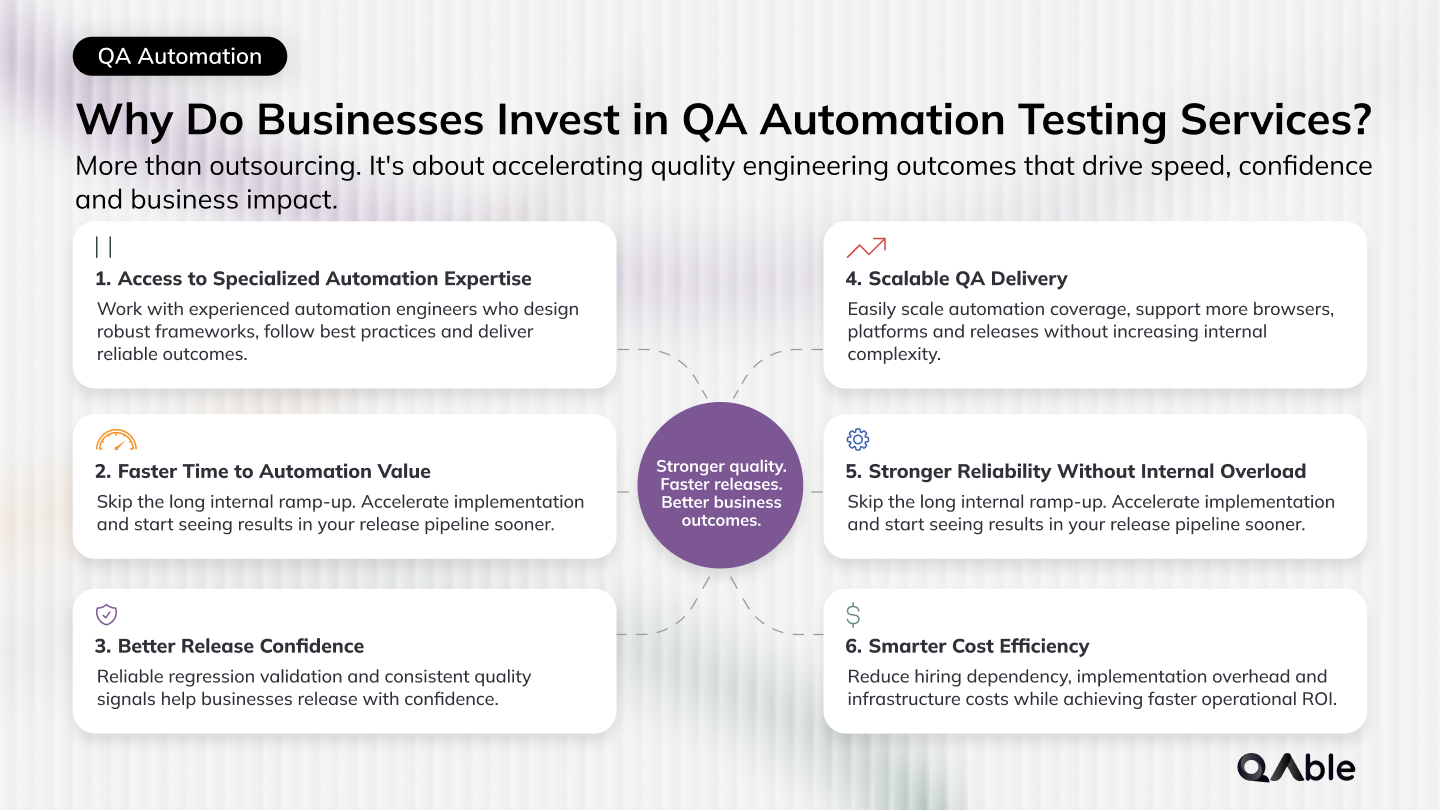
Companies rarely invest in QA automation testing services for just one reason.
Sometimes the trigger is speed. Sometimes it is reliability. Sometimes internal automation efforts are no longer scaling the way the business expected.
In many cases, it is a mix of delivery pressure, engineering constraints, and the need for stronger quality outcomes without expanding internal complexity.
Here are the most common reasons businesses make that move.
1. Access to Specialized Automation Expertise
Building effective automation takes more than knowing how to write test scripts.
Framework design, test architecture, CI/CD integration, flaky test prevention, browser compatibility strategy, and long-term maintenance all require specialized experience that many internal teams are still building.
- Faster access to experienced automation engineers
- Stronger framework implementation decisions
- Better automation engineering practices
- Reduced trial-and-error execution
- More predictable automation outcomes
The value is not just extra execution capacity. It is getting automation right from the start.
2. Faster Time to Automation Value
Internal automation programs often move slower than expected.
Hiring takes time. Framework decisions take time. Process alignment takes time. By the time automation begins creating measurable value, delivery pressure has already increased.
- Faster automation rollout
- Shorter implementation timelines
- Reduced internal ramp-up dependency
- Earlier release workflow integration
- Quicker operational impact
For teams under delivery pressure, speed to value matters as much as automation itself.
3. Better Release Confidence
Automation is often adopted because leadership wants faster releases, but speed without confidence creates risk.
Businesses invest in automation services when they need validation that is consistent, repeatable, and dependable enough to support release decisions.
- Reliable regression validation
- Better release readiness visibility
- Reduced last-minute QA uncertainty
- Faster engineering feedback
- More predictable deployment confidence
The goal is not simply running automated tests. It is making release decisions with more certainty.
4. Scalable QA Delivery
As products grow, QA complexity grows with them.
More workflows, more browsers, more releases, more integration points. What feels manageable with a smaller product often becomes operationally difficult at scale.
- Broader automation coverage
- Cross-browser execution support
- Sustainable QA scaling
- Reduced manual dependency
- Better operational consistency
Automation services help businesses scale quality delivery without scaling effort at the same pace.
5. Stronger Reliability Without Internal Overload
Some teams already have automation, but the results are inconsistent.
Tests fail unpredictably. Maintenance becomes a recurring problem. Ownership is unclear. Internal teams spend more time managing automation than benefiting from it.
- More stable automation execution
- Better maintenance discipline
- Clearer framework ownership
- Reduced operational firefighting
- Higher trust in automation outcomes
Reliable automation should reduce delivery friction, not create more of it.
6. Smarter Cost Efficiency
Building automation internally is not always cheaper.
Between hiring, onboarding, framework setup, infrastructure ownership, maintenance effort, and execution management, internal automation costs can grow quickly.
- Lower hiring dependency
- Reduced implementation overhead
- Faster operational ROI
- More efficient automation investment
- Flexible scaling without fixed internal expansion
For many businesses, the better financial decision is not building everything from scratch.
Summary
Businesses invest in QA automation testing services when speed, expertise, reliability, and scalability become harder to build internally.
The strongest automation partnerships are not about outsourcing test execution.
They are about accelerating quality engineering outcomes.
Related Read: The Hidden Costs of Test Automation Maintenance
When Should You Consider QA Automation Testing Services?
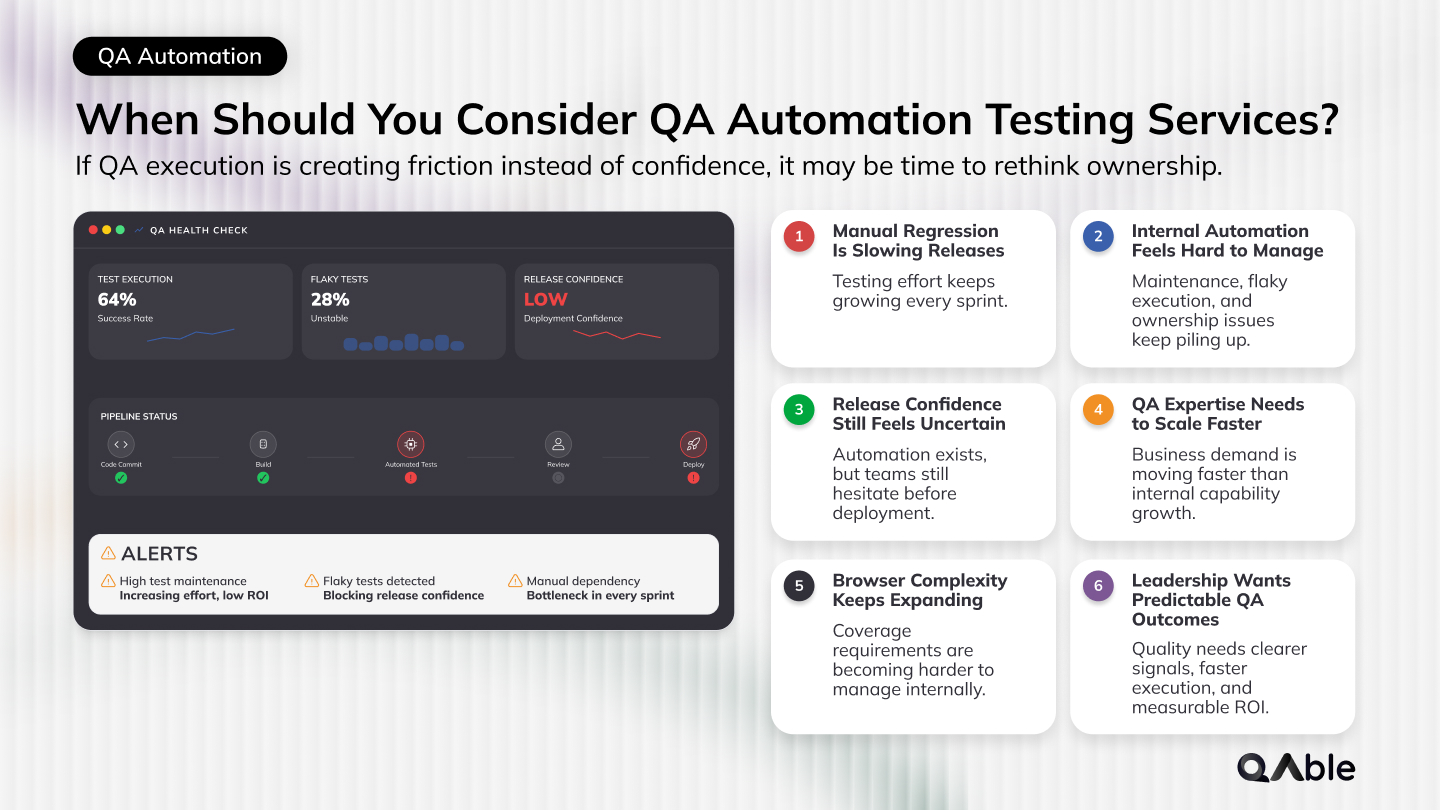
Not every team needs an external automation partner.
Some organizations have the in-house QA engineering maturity, automation ownership, and bandwidth to build everything internally.
But many teams reach a point where continuing the same way becomes slower, more expensive, or harder to scale.
That is usually the real signal.
1. Manual Regression Is Slowing Delivery
Manual testing works for a while.
But as release frequency increases, repetitive regression starts consuming more QA time than it should. Teams begin spending too much effort validating the same workflows instead of focusing on deeper quality work.
- Regression cycles keep getting longer
- Release sign-offs depend heavily on manual effort
- QA bandwidth is consumed by repeatable validation
- Delivery timelines are increasingly affected by testing
If testing effort keeps growing every release, automation usually becomes a scaling decision.
2. Internal Automation Is Becoming Difficult to Manage
Having automation in place does not always mean it is working well.
Many teams already have test automation, but maintaining it becomes a constant operational burden. Failures are inconsistent, framework ownership is fragmented, and engineering trust starts dropping.
- Flaky automation results
- Rising maintenance effort
- Weak framework ownership
- Slow debugging cycles
- Low trust in automation outcomes
This is often when businesses look for external expertise, not because automation failed, but because it stopped delivering value.
3. Release Confidence Still Feels Uncertain
Automation should improve release confidence.
If teams are still relying on manual validation, repeated reruns, or last-minute QA checks before deployment, something in the current automation approach is not creating dependable quality signals.
- Release readiness remains unclear
- Teams hesitate during deployment decisions
- QA sign-offs still require manual confirmation
- Automation exists but does not create trust
When automation cannot support release confidence, the problem is usually execution maturity, not test volume.
4. QA Expertise Needs to Scale Faster Than Hiring
Building strong automation capability internally takes time.
Hiring QA automation engineers, aligning processes, setting framework standards, and creating sustainable ownership does not happen overnight.
Sometimes the business needs outcomes faster than internal expansion allows.
- Hiring timelines are too slow
- Internal expertise is limited
- Delivery demands are increasing
- Automation maturity needs to improve quickly
This is where automation services become a faster path to capability building.
5. Browser or Platform Complexity Is Growing
Testing complexity changes as products evolve.
Supporting multiple browsers, customer environments, integrations, devices, or platform workflows creates execution demands that smaller internal QA setups may struggle to absorb efficiently.
- Cross-browser coverage expectations increase
- More workflows need automated validation
- Product complexity creates QA scaling pressure
- Test execution environments become harder to manage
At this stage, automation becomes an operational scalability decision.
6. Leadership Wants Predictable QA Outcomes
Sometimes the push does not come from QA.
It comes from leadership asking why releases still feel uncertain, why regression effort keeps growing, or why automation investment is not producing clearer operational outcomes.
- Pressure to improve delivery efficiency
- Stronger expectations around release predictability
- Focus on QA scalability
- Need for measurable automation ROI
Automation services often become part of a broader delivery maturity conversation.
Summary
The right time to consider QA automation testing services is usually when internal execution starts creating friction instead of confidence.
That may come from delivery speed, automation instability, expertise gaps, or scaling pressure.
The key question is not whether automation is possible internally.
It is whether internal ownership is still the most efficient path forward.
Related Read: Signs You Need QA Consulting
In-House QA vs QA Automation Testing Services
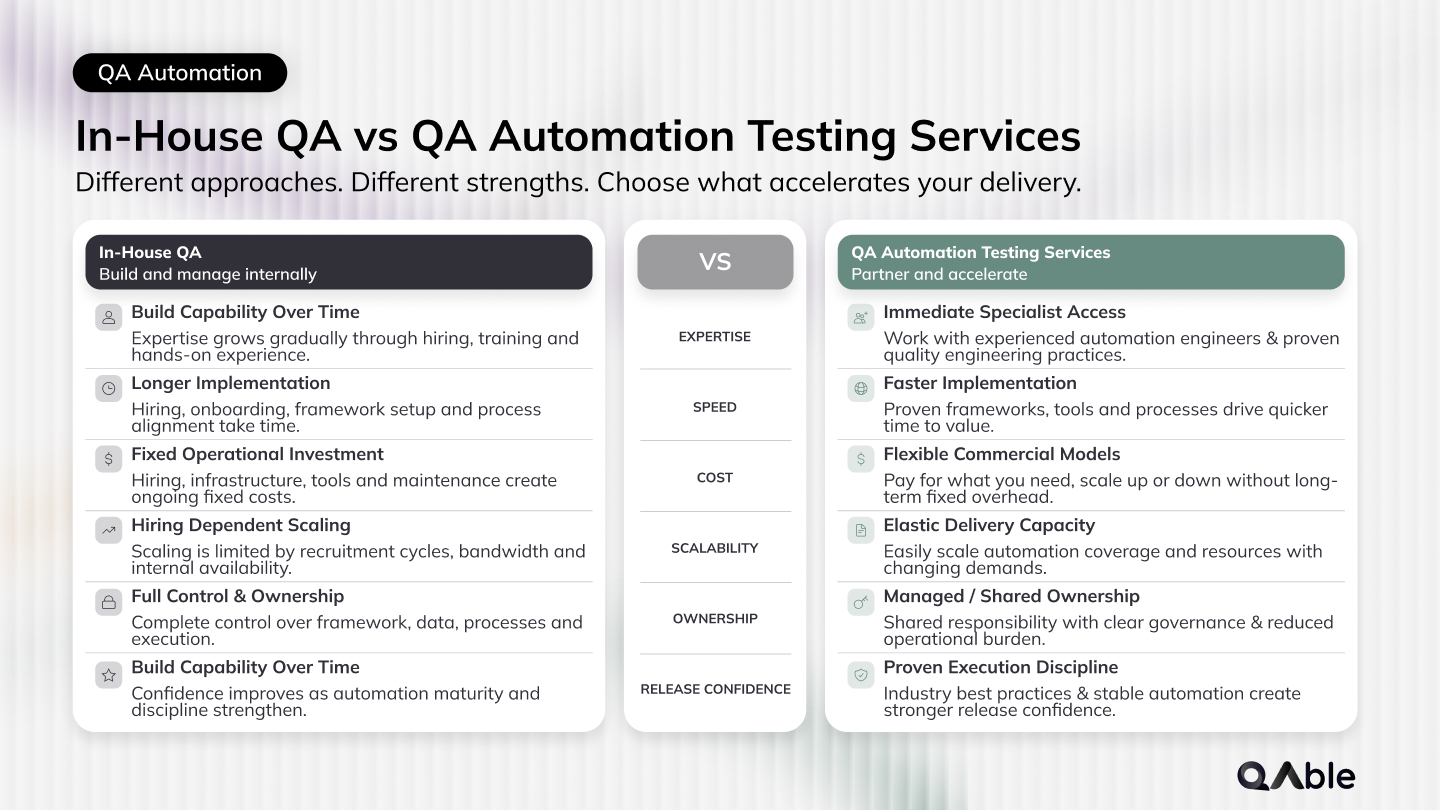
One of the most common questions businesses ask is whether they should build QA automation internally or work with an external automation partner.
There is no universal right answer.
The better choice depends on your delivery timelines, internal expertise, automation maturity, and how much ownership your team realistically wants to manage long term.
1. Expertise and Specialization
Building strong automation internally requires more than assigning automation tasks to an existing QA team.
Reliable automation depends on framework architecture, CI/CD integration, debugging discipline, browser strategy, and long-term maintainability. That level of expertise takes time to build.
In-house QA
- Expertise grows over time through internal learning
- Framework quality depends heavily on current team maturity
- Specialized automation knowledge may be limited initially
- Strong results often require dedicated automation leadership
QA automation testing services
- Immediate access to experienced automation specialists
- Proven engineering practices from day one
- Faster framework maturity
- Less dependency on internal capability building
If automation expertise is still developing internally, external support often accelerates better outcomes.
2. Speed to Implementation
Internal automation rarely moves as quickly as teams expect.
Hiring, onboarding, framework planning, tooling decisions, and process alignment all add time before automation starts creating real value.
In-house QA
- Hiring and ramp-up take time
- Framework decisions can slow early progress
- Internal alignment may delay execution
- Value realization often happens gradually
QA automation testing services
- Faster implementation timelines
- Reduced setup friction
- Quicker automation onboarding
- Earlier integration into release workflows
If delivery pressure is already high, implementation speed becomes a major decision factor.
3. Cost Structure
Internal ownership gives long-term control, but it also comes with fixed costs that are often underestimated.
Automation is not just a tooling expense. It includes people, infrastructure, maintenance, process ownership, and continuous engineering effort.
In-house QA
- Fixed hiring and operational costs
- Ongoing training and ownership investment
- Infrastructure management responsibilities
- Higher upfront automation maturity investment
QA automation testing services
- More flexible commercial models
- Lower internal expansion dependency
- Faster time to operational ROI
- Reduced infrastructure and ownership burden
The cheapest-looking option upfront is not always the most efficient long term.
4. Scalability
What works for a smaller automation scope may become difficult as products, releases, and coverage expectations grow.
Scaling automation requires both technical capacity and operational discipline.
In-house QA
- Growth depends on internal hiring and bandwidth
- Scaling may slow as complexity increases
- Ownership pressure rises with larger automation scope
- Resource constraints can affect delivery speed
QA automation testing services
- Easier access to scalable delivery capacity
- Faster adaptation to changing QA demand
- Reduced internal bandwidth pressure
- Better support for larger automation programs
Scalability becomes especially important when delivery expectations continue to increase.
5. Ownership and Maintenance
Some businesses prefer full internal ownership.
Others care more about outcomes than managing the entire automation ecosystem themselves.
Both are valid, but maintenance reality should be considered honestly.
In-house QA
- Full framework ownership and control
- Internal responsibility for maintenance and execution health
- Greater customization flexibility
- Higher operational management effort
QA automation testing services
- Shared or managed automation ownership
- Reduced internal maintenance overhead
- Structured execution governance
- Faster operational issue resolution
The decision often comes down to whether your team wants ownership control or ownership relief.
6. Release Confidence and Reliability
Automation only matters if teams trust the outcomes.
Unstable automation creates hesitation, reruns, debugging overhead, and weak release confidence regardless of who owns it.
In-house QA
- Quality depends on internal engineering maturity
- Strong teams can build highly effective automation
- Weak execution practices create instability
- Reliability improves as automation discipline matures
QA automation testing services
- Proven automation engineering practices
- Faster path to reliable execution
- Stronger release-oriented automation design
- Better consistency in quality signaling
The real question is not who owns the automation.
It is who can create the most dependable release confidence.
Summary
In-house automation offers control, customization, and long-term ownership.
QA automation testing services offer speed, specialized expertise, scalability, and faster operational maturity.
The right decision depends on whether your business is optimizing for ownership, execution speed, engineering capability, or faster quality outcomes.
Related Read: Top QA Outsourcing Companies in India
How to Choose the Right QA Automation Testing Partner?
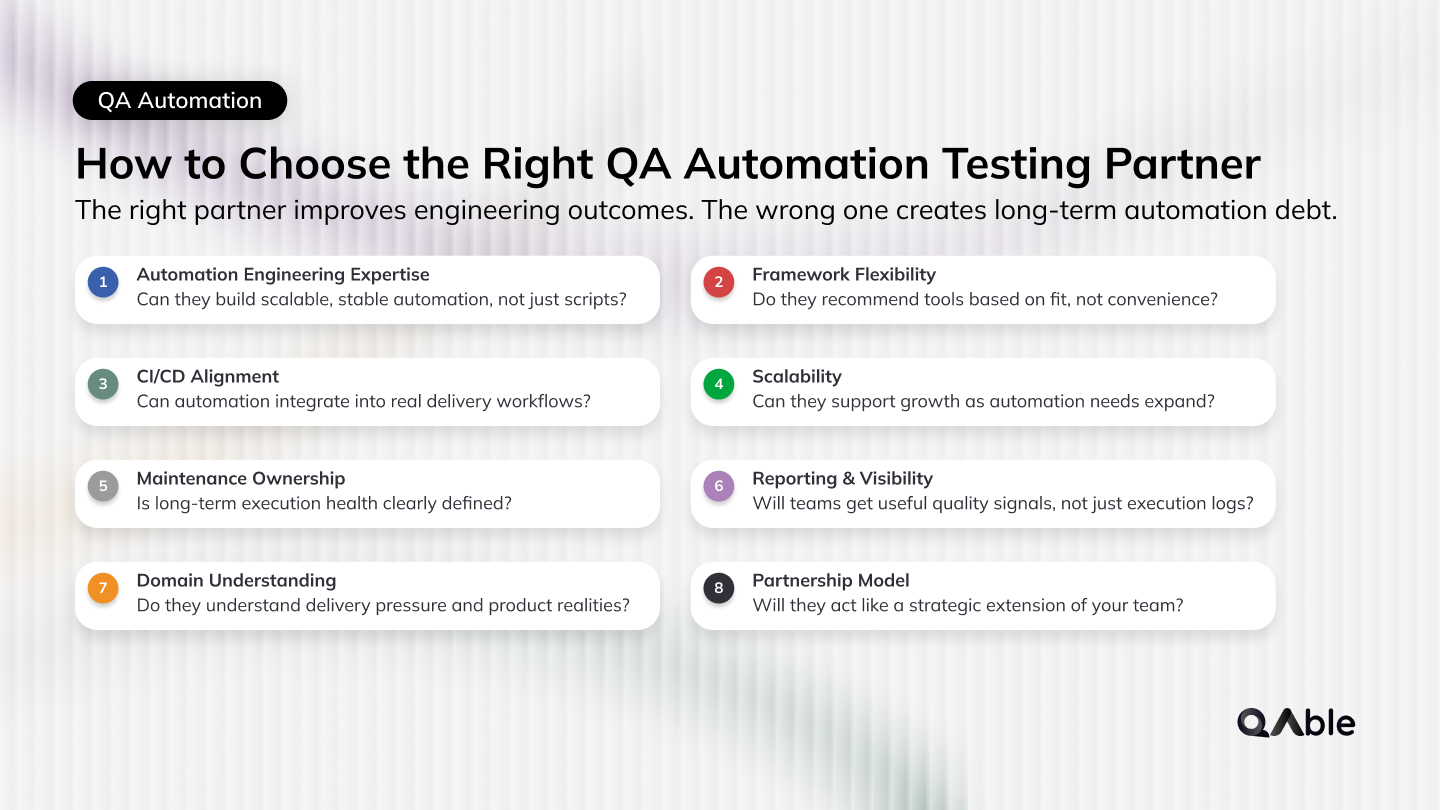
Choosing a QA automation testing partner is not the same as choosing a testing vendor.
The right partner becomes part of your engineering delivery ecosystem. The wrong one can leave you with fragile automation, weak release confidence, and another operational dependency that creates more work than value.
Here is what actually matters during evaluation.
1. Automation Engineering Expertise
Not every QA provider has strong automation engineering depth.
There is a big difference between a team that can execute automated test cases and a team that can design a scalable automation architecture that remains stable over time.
- Experience with automation framework engineering
- Strong debugging and flaky test management practices
- Real understanding of automation scalability
- Capability beyond script execution
- Quality engineering maturity, not just QA staffing
A partner should be able to improve how automation works, not just increase automation volume.
2. Framework and Technology Flexibility
A provider pushing a single tool for every use case is usually a warning sign.
Different products need different automation approaches depending on architecture, browser complexity, delivery workflows, and internal engineering preferences.
- Experience across Playwright, Selenium, Cypress, and relevant ecosystems
- Framework recommendations based on fit, not convenience
- Ability to align with your technical environment
- Flexibility around browser automation strategy
- Practical technology decision-making
The best automation partner chooses the right engineering path for your needs, not theirs.
3. CI/CD and Engineering Workflow Alignment
Automation that sits outside engineering workflows rarely creates meaningful delivery value.
A strong automation partner should understand how releases happen inside modern engineering teams and ensure automation supports that process.
- CI/CD integration capability
- Release validation alignment
- Fast feedback workflow design
- Pipeline execution understanding
- Compatibility with engineering delivery models
Automation should help your teams move faster, not become another disconnected QA layer.
4. Scalability and Delivery Capacity
Automation needs often change quickly.
What starts as regression automation for one product can expand into broader browser coverage, multiple release streams, platform complexity, or enterprise-scale validation needs.
- Ability to scale delivery with business growth
- Support for larger automation scope
- Operational maturity for long-term scaling
- Resource flexibility when priorities shift
- Experience handling evolving QA demand
A strong partner should be able to grow with your delivery needs, not just solve today’s backlog.
5. Maintenance and Long-Term Ownership Model
Automation does not stop after implementation.
Framework upkeep, workflow updates, flaky test fixes, browser compatibility changes, and execution monitoring all require continuous attention.
This is where many engagements start falling apart.
- Clear ownership expectations
- Defined maintenance approach
- Long-term automation sustainability planning
- Execution health management
- Ongoing automation reliability support
If ownership becomes unclear after implementation, automation quality usually declines quickly.
6. Reporting, Visibility, and Quality Signals
Running automated tests is only part of the story.
Engineering teams need useful signals they can act on. Leadership needs visibility into quality confidence. QA teams need execution clarity that makes debugging faster.
- Actionable reporting visibility
- Failure analysis support
- Debugging context and execution evidence
- Release readiness insights
- Meaningful automation performance tracking
Automation creates more value when it improves decision-making, not just test execution counts.
7. Domain and Delivery Understanding
Technical capability matters, but context matters too.
A QA automation partner that understands delivery pressure, product risk, customer expectations, and real-world engineering workflows will usually create better outcomes than one operating only at the execution layer.
- Experience across relevant industries
- Understanding of product delivery realities
- Risk-aware quality thinking
- Familiarity with engineering team collaboration
- Practical approach to business-critical quality outcomes
Good automation engineering becomes stronger when paired with delivery understanding.
8. Partnership Model and Collaboration Style
Some vendors operate like external task executors.
Others work like true engineering partners.
That difference becomes very visible once automation is in motion.
- Communication transparency
- Collaborative working model
- Clear escalation and ownership structure
- Strategic involvement when needed
- Long-term partnership mindset
The best automation relationships feel like an extension of your delivery team, not a disconnected vendor handoff.
Summary
The right QA automation testing partner should bring more than execution capacity.
They should bring engineering expertise, scalable delivery capability, practical technology judgment, and automation outcomes your teams can actually trust.
Related Read: Top Automation Testing Companies in India and USA
QA Automation Testing Services at QAble
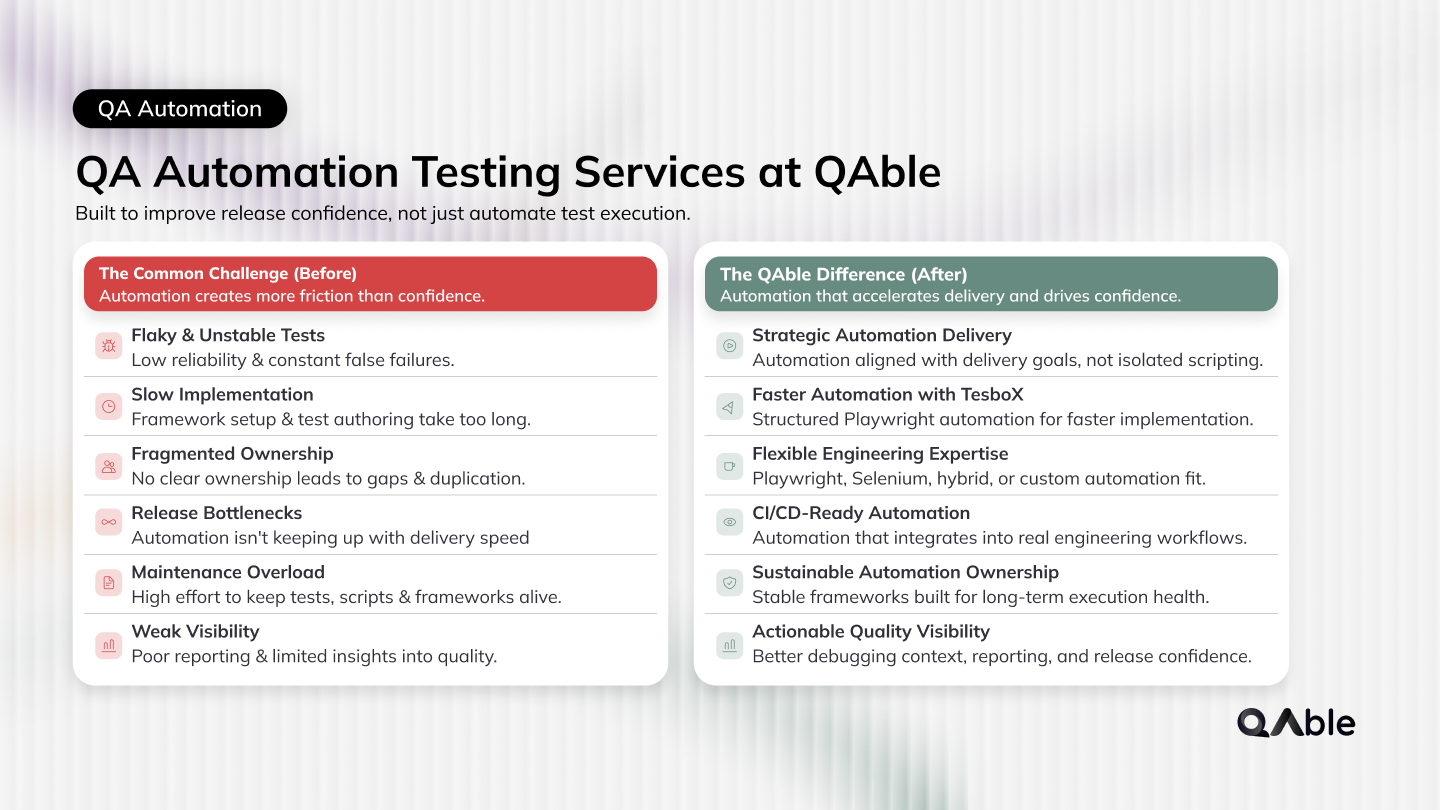
Choosing a QA automation testing partner is one thing.
Working with a partner that can actually improve how quality engineering operates inside your delivery workflow is another.
At QAble, automation is not treated as a script execution exercise.
It is approached as a structured quality engineering capability built around release confidence, automation reliability, and long-term delivery efficiency.
1. Strategic Automation Delivery
Automation creates the most value when it solves the right business and engineering problems.
That is why QAble starts with automation strategy, not just execution planning. The focus is on understanding delivery workflows, product complexity, regression pain points, release expectations, and where automation creates the strongest operational impact.
- Automation aligned to delivery priorities
- Risk-aware automation planning
- Practical framework decision-making
- Quality engineering-led execution
- Outcome-focused automation strategy
The goal is not to automate for the sake of automation. It is to create measurable quality and delivery outcomes.
2. Faster Automation Adoption with TesboX
For teams that want faster automation maturity without spending months building frameworks from scratch, QAble offers TesboX.
TesboX is QAble’s structured Playwright-based automation solution designed to accelerate implementation through a proven delivery model. Instead of starting from a blank framework build, teams get a pre-engineered automation foundation that adapts into their workflows with minimal disruption.
- Faster automation onboarding
- Reduced framework setup effort
- Structured Playwright automation delivery
- Faster path to release-ready automation
- Lower implementation friction
This helps teams move from automation planning to practical execution much faster.
3. Flexible Automation Engineering
Not every automation requirement fits the same delivery model.
Some teams want a faster structured automation solution. Others need custom framework ownership, Selenium-based ecosystems, hybrid automation strategies, or automation aligned to highly specific engineering environments.
QAble adapts automation delivery based on what the product and business actually need.
- Playwright automation engineering
- Selenium-based automation support
- Custom automation framework delivery
- Hybrid automation models
- Framework recommendations based on fit
Strong automation partnerships are built around technical alignment, not forcing a one-size-fits-all model.
4. CI/CD-Ready Quality Engineering
Automation becomes significantly more valuable when it supports how software is actually shipped.
QAble designs automation to fit modern engineering workflows so browser validation, regression checks, and release confidence become part of delivery operations instead of isolated QA activity.
- CI/CD-integrated automation workflows
- Release smoke validation
- Continuous regression execution
- Faster engineering feedback loops
- Delivery-aligned automation execution
The result is automation that supports release velocity instead of slowing it down.
5. Sustainable Automation Ownership
Automation that works well during implementation but becomes difficult to maintain later creates long-term friction.
QAble focuses on building automation that remains stable, maintainable, and scalable as products evolve.
- Stable automation architecture
- Long-term maintenance discipline
- Framework governance
- Reduced flaky execution risk
- Scalable automation lifecycle management
The strongest automation investments are the ones teams can continue relying on long after rollout.
6. Actionable Quality Visibility
Automation should create clarity, not just execution output.
Teams need useful signals around failure behavior, debugging context, release readiness, and automation health so quality decisions become faster and more informed.
- Execution visibility
- Faster debugging context
- Better automation health insights
- Release confidence reporting
- Actionable quality intelligence
Automation becomes far more valuable when it helps teams make better engineering decisions.
Summary
QA automation testing services create the most value when they improve how engineering teams deliver software, not just how tests are executed.
At QAble, that means combining strategic quality engineering, flexible automation expertise, and structured solutions like TesboX to help teams build automation that scales, stays reliable, and strengthens release confidence.
Explore our Automation Testing Services
Final Thoughts
QA automation testing services are rarely just about reducing manual testing effort.
Most businesses reach this decision because something bigger is happening.
Release timelines are tightening. Product complexity is growing. QA expectations are increasing. Internal teams are being asked to move faster without compromising reliability.
At that point, automation becomes less about adding scripts and more about building a dependable quality engineering capability.
That is where many businesses make the wrong assumption.
They believe automation success comes from choosing the right framework or simply increasing automation coverage.
In reality, the bigger differentiator is execution maturity.
Because automation that is unstable, difficult to maintain, disconnected from delivery workflows, or lacking clear ownership does not improve engineering confidence. It simply shifts operational complexity into a different form.
The strongest automation investments create clarity.
Teams release faster because quality signals are trusted. QA effort shifts toward higher-value engineering work. Leadership gets more predictable delivery confidence instead of uncertain release conversations.
Whether you build internally or work with an automation partner, the decision should come down to one question:
Will this approach help us create automation that the business can actually rely on?
That is what makes automation a real quality engineering advantage instead of just another testing initiative.