


Shipping fast is no longer enough. Shipping without quality risk is what defines successful products today.
Modern software teams operate in environments where release cycles are shorter, systems are more complex, and user expectations are significantly higher. At the same time, building and maintaining an in-house QA function that can scale with this complexity is not always straightforward.
Organizations are actively investing in stronger quality engineering capabilities. According to Capgemini’s World Quality Report, 77% of organizations are investing in AI-driven solutions to strengthen their quality engineering capabilities, highlighting a clear shift toward more scalable, intelligence-driven testing approaches.
However, this shift also reveals an execution gap. Despite increasing investments, only 15% of organizations have successfully scaled AI in QA at the enterprise level. This indicates that while intent is strong, many teams still struggle with implementation, scalability, and expertise.
At the same time, quality engineering itself is becoming a significant strategic investment area. Industry projections suggest that the quality engineering market is expected to grow from $54.6 billion in 2025 to approximately $99.7 billion by 2035, reflecting its growing importance in modern software delivery.
As quality becomes more engineering-driven, data-intensive, and continuous, many organizations are turning to external QA expertise to bridge this gap.
Outsourcing QA is no longer just about reducing costs. It has evolved into a strategic approach that helps teams:
- Improve test coverage
- Accelerate release cycles
- Access specialized expertise
- Manage quality risks more effectively
However, outsourcing QA is not a one-size-fits-all decision. It requires understanding where it fits within your engineering workflow and what value it can actually deliver.
In this guide, we explore the key reasons why organizations consider outsourcing QA, along with the strategic advantages it brings to modern software development.
Why Should Companies Outsource QA in Modern Software Development?
Outsourcing QA today is less about reducing testing effort and more about building a scalable, intelligence-driven quality system.
As software systems grow in complexity, testing is no longer limited to validating functionality. It involves understanding risk patterns, analyzing failures, and ensuring that quality decisions are informed by data rather than assumptions.
This is where outsourcing QA aligns closely with a quality intelligence approach, where testing becomes a continuous feedback system rather than a one-time validation activity.
Below are the key reasons, organizations adopt QA outsourcing in this context.
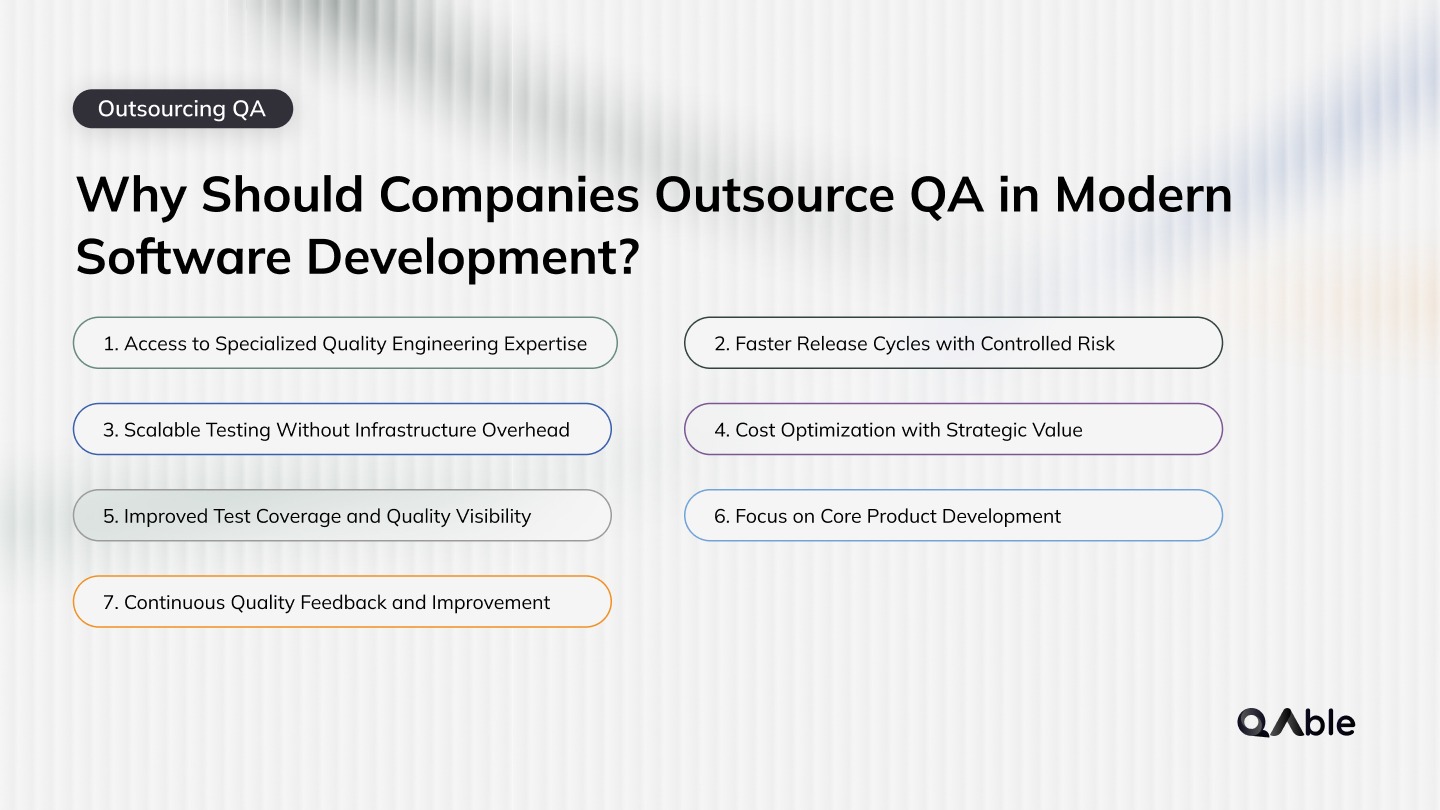
1. Access to Specialized Quality Engineering Expertise
Modern QA requires more than manual testing or basic automation. It involves:
- Automation frameworks
- CI/CD integration
- API and performance testing
- Data-driven validation
- AI-assisted testing workflows
Building this level of expertise internally can take significant time and investment.
Outsourcing QA allows organizations to work with teams that already operate within structured quality engineering environments. In many cases, this includes teams that focus on framework-driven automation, CI/CD alignment, and scalable testing architectures, enabling faster adoption of mature QA practices.
From a quality intelligence perspective, this enables:
- Better test design decisions
- Improved defect detection strategies
- More structured validation approaches
2. Faster Release Cycles with Controlled Risk
Speed without visibility into quality risk can lead to unstable releases.
Outsourced QA teams help organizations maintain release velocity while ensuring that testing is aligned with risk-based priorities.
This includes:
- Regression optimization
- Critical path validation
- Continuous testing in CI/CD
- Early defect detection
In practice, mature QA teams focus not just on execution, but on prioritizing testing based on system risk and historical insights, rather than running exhaustive test suites without direction.
This aligns with quality intelligence by:
- Identifying high-risk areas
- Reducing unnecessary test execution
- Improving release confidence
3. Scalable Testing Without Infrastructure Overhead
As applications grow, testing requirements increase rapidly.
Organizations often face challenges such as:
- Expanding test coverage
- Supporting multiple environments
- Managing device and browser variations
- Handling large regression suites
Outsourcing QA provides immediate scalability without long-term infrastructure commitments. More importantly, it enables organizations to adopt structured testing frameworks that scale with product complexity, rather than scaling effort linearly.
From a quality intelligence standpoint, scalability ensures:
- Consistent test coverage
- Continuous validation across environments
- Better visibility into system behavior
4. Cost Optimization with Strategic Value
While cost reduction is often associated with outsourcing, the real value lies in cost efficiency with improved outcomes.
Maintaining an in-house QA team involves:
- Hiring and training
- Tool and infrastructure costs
- Ongoing management overhead
Outsourcing converts these fixed costs into flexible investments aligned with project needs.
More importantly, organizations benefit from reduced defect leakage, optimized regression cycles, and better quality predictability, which significantly lowers long-term quality costs.
From a quality intelligence perspective, this means:
- Investing in prevention rather than correction
- Reducing rework cycles
- Improving ROI on testing efforts
5. Improved Test Coverage and Quality Visibility
One of the biggest challenges in QA is not execution, it is visibility.
Organizations often struggle to answer:
- What has been tested?
- What remains untested?
- Where are the risks?
- How stable is the system?
Outsourced QA teams bring structured reporting and analysis that improve visibility into testing outcomes.
In mature QA environments, this often includes risk-based reporting, defect trend analysis, and coverage insights that go beyond pass/fail metrics, enabling better decision-making.
This is where quality intelligence becomes critical.
Instead of treating testing as a checklist, it becomes a decision-support system that helps teams:
- Identify weak areas
- Prioritize improvements
- Make informed release decisions
6. Focus on Core Product Development
Engineering teams often face competing priorities between:
- Feature development
- Bug fixing
- Testing and validation
When testing becomes a bottleneck, it can slow down innovation.
Outsourcing QA allows internal teams to focus on:
- Product development
- Architecture decisions
- Feature innovation
While external QA teams handle:
- Test execution
- Automation
- Validation workflows
In structured QA partnerships, this separation is supported by well-defined testing processes and continuous feedback loops, ensuring alignment between development and quality teams.
7. Continuous Quality Feedback and Improvement
Traditional testing often happens in phases. Modern QA requires continuous validation across the development lifecycle.
Outsourced QA teams help establish:
- Continuous testing pipelines
- Feedback loops
- Ongoing quality monitoring
This ensures that quality is evaluated:
- During development
- During integration
- During release cycles
In advanced QA setups, testing is designed to act as a continuous feedback mechanism, where insights from test execution contribute to improving both product quality and testing strategy.
This is the foundation of quality intelligence.
Testing becomes a system that helps teams:
- Detect issues early
- Learn from failure patterns
- Improve over time
Outsourcing QA is no longer just an operational decision. It is a strategic approach to building scalable, insight-driven quality systems.
Organizations that adopt QA outsourcing within a quality intelligence framework gain:
- Better visibility into risks
- More efficient testing processes
- Stronger release confidence
At QAble, automation testing services are built around framework-driven testing, CI/CD alignment, and quality intelligence insights, enabling teams to move beyond execution and make more informed quality decisions.
As software systems continue to evolve, outsourcing QA can play a critical role in helping teams move from reactive testing to proactive quality engineering.
Related Read: Root cause analysis in software testing
In-House QA vs Outsourced QA
Aspect | In-House QA | Outsourced QA |
|---|---|---|
Team Setup | Built and managed internally | Provided by external QA specialists |
Expertise Availability | Depends on hiring and internal skill development | Access to diverse and specialized QA expertise |
Scalability | Limited by team size and hiring speed | Easily scalable based on project needs and release cycles |
Cost Structure | Fixed costs (salaries, tools, infrastructure) | Flexible costs aligned with usage and scope |
Time to Onboard | Requires hiring, training, and ramp-up time | Faster onboarding with pre-established QA processes |
Testing Infrastructure | Needs to be built and maintained internally | Often comes with existing tools, environments, and frameworks |
Release Support | May face constraints during peak release cycles | Can scale support for regression, releases, and hotfixes |
Quality Visibility | Depends on internal reporting maturity | Structured reporting with broader testing insights |
Process Maturity | Varies based on internal QA practices | Typically follows standardized testing frameworks and workflows |
Focus Area | Balances between testing and internal priorities | Focused primarily on testing and quality validation |
Quality Intelligence | Limited to internal data and practices | Broader perspective with cross-project insights and risk-based analysis |
In-house QA offers strong product familiarity and control, while outsourced QA provides scalability, specialized expertise, and structured quality processes.
Many organizations adopt a hybrid model, combining internal product knowledge with external QA expertise to build a more balanced and scalable quality engineering strategy.
Related Read: 5 Signs you Need the Help of Software QA Consulting Service
When Should You Outsource QA?
Outsourcing QA is not always a default choice. It becomes relevant when organizations face specific challenges in scaling, maintaining, or improving quality outcomes.
As software systems evolve, testing is no longer limited to validating individual features. It involves managing complexity across multiple layers, ensuring consistent behavior across environments, and maintaining release confidence under tight timelines.
Instead of viewing outsourcing as a replacement for internal QA, it is more effective to treat it as a strategic extension of quality engineering capabilities, especially in environments where speed, scale, and system dependencies continue to grow.
Below are common scenarios where outsourcing QA becomes a practical and effective approach.
1. When Release Cycles Are Getting Faster
As teams adopt Agile and continuous delivery practices, release cycles become shorter and more frequent. Code changes are pushed more often, and validation needs to happen continuously rather than in isolated phases.
In such environments, testing often struggles to keep up with development velocity. Regression cycles get compressed, and teams may prioritize only critical paths, leaving edge cases and integration points less explored.
In practice, this often leads to:
- Compressed regression
- Selective validation
- Missed edge cases
- Production risks
Outsourced QA teams help establish structured testing aligned with CI/CD pipelines, ensuring that validation happens as part of the development flow rather than after it. This enables teams to maintain consistent quality checks even as release frequency increases.
This includes:
- CI/CD alignment
- Risk-based testing
- Regression stability
- Faster feedback
From a quality intelligence perspective, this improves how teams balance speed with risk awareness, ensuring that faster releases are supported by continuous validation and informed testing decisions.
2. When Test Coverage Is Inconsistent or Limited
As applications grow in size and complexity, maintaining consistent test coverage becomes increasingly difficult. New features, integrations, and platform variations introduce additional layers that require validation.
Without a structured approach, testing efforts may focus heavily on primary workflows while leaving secondary flows, edge cases, and integration scenarios under-tested. These gaps often surface later as production issues.
Common gaps include:
- Edge scenarios
- Integration flows
- Device coverage
- Backend validation
Outsourcing QA introduces a more structured approach to test design, where coverage is planned across different layers of the application rather than isolated features. This ensures that validation includes both expected and unexpected user behaviors.
This enables:
- Layered testing
- Workflow validation
- Coverage visibility
- Gap identification
From a quality intelligence standpoint, this shifts testing from execution-focused activity to coverage-driven validation, where teams gain clarity on what is tested, what is not, and where the risks lie.
3. When QA Becomes a Bottleneck
As products scale, QA teams are required to handle increasing volumes of test cases, regression suites, and validation requirements. Without proportional growth in resources or automation maturity, QA can become a bottleneck in the release cycle.
This creates a situation where teams must either reduce testing scope or delay releases, both of which affect product quality and delivery timelines.
This often results in:
- Delayed testing
- Release slowdowns
- Reduced coverage
- Team overload
Outsourcing QA provides additional capacity that integrates into existing workflows, enabling parallel testing and better distribution of workloads. It helps ensure that testing is not compromised due to time or resource constraints.
This supports:
- Workload balancing
- Parallel execution
- Release support
- Cycle efficiency
From a quality intelligence perspective, this ensures that testing remains aligned with risk and system behavior, rather than being constrained by timelines or team limitations.
4. When Specialized Testing Is Required
Modern applications are no longer limited to front-end functionality. They involve complex backend systems, APIs, third-party integrations, and performance considerations.
Testing such systems requires specialized skills, tools, and frameworks that may not always be available within internal teams.
This includes:
- Performance testing
- API validation
- Security checks
- Cross-platform testing
Developing these capabilities internally requires time, investment, and ongoing learning.
Outsourcing QA allows organizations to access specialists who bring experience across different domains and technologies. These teams are familiar with testing complex systems and can apply proven approaches to identify deeper issues.
This brings:
- Domain expertise
- Tool experience
- Framework knowledge
- System insights
From a quality intelligence perspective, this enhances the ability to analyze system behavior holistically, helping teams identify patterns and risks that are not visible through basic testing.
5. When Scaling QA Internally Is Not Feasible
Scaling QA internally involves multiple steps, including hiring new team members, training them, and setting up the required tools and infrastructure. This process often takes time and may not align with immediate project needs.
In fast-paced environments, the need for additional QA capacity can arise suddenly, especially during product expansion or major releases.
Challenges typically include:
- Hiring delays
- Training time
- Tool setup
- Infrastructure cost
Outsourcing QA provides flexibility to scale testing efforts quickly based on project demands. This ensures that testing capacity can adapt to changing requirements without long-term commitments.
This enables:
- Rapid scaling
- Flexible capacity
- Demand alignment
- Growth support
From a quality intelligence perspective, scalability ensures continuous and consistent validation, preventing quality gaps during periods of rapid growth.
6. When You Need Better Visibility Into Quality
One of the most common challenges in QA is the lack of meaningful visibility into testing outcomes. Many teams rely on surface-level metrics, which do not provide a complete picture of product quality.
Without deeper insights, it becomes difficult to identify risk areas, track defect patterns, or make confident release decisions.
This creates gaps in understanding:
- Defect trends
- Risk areas
- Coverage gaps
- System stability
Outsourced QA teams bring structured reporting and analysis frameworks that provide more actionable insights. Instead of just reporting results, they help interpret what those results mean for the system.
This includes:
- Trend analysis
- Risk reporting
- Coverage insights
- Quality metrics
From a quality intelligence standpoint, this transforms testing into a data-driven feedback system, enabling teams to move from reactive fixes to proactive quality improvements.
7. When Preparing for Critical Releases or Audits
Certain scenarios require a higher level of validation and confidence, such as major product launches, enterprise deployments, or compliance-driven audits.
In these situations, testing must go beyond standard validation and include deeper analysis of workflows, integrations, and system behavior under different conditions.
Common risks include:
- Incomplete validation
- Hidden defects
- Integration failures
- Release instability
Outsourcing QA provides additional support to ensure that testing is thorough, structured, and aligned with release expectations. It helps teams validate not just functionality, but also stability and reliability.
This ensures:
- Full validation
- Edge case coverage
- Release readiness
- Audit support
From a quality intelligence perspective, this ensures that high-impact releases are backed by deeper insights and risk awareness, reducing uncertainty and improving confidence.
Outsourcing QA becomes relevant when organizations need to scale testing, improve visibility, or strengthen quality without slowing development.
Rather than replacing internal teams, it works best as an extension that brings:
- Specialized expertise
- Scalable capacity
- Structured insights
Within a quality intelligence framework, outsourcing QA helps organizations move from reactive testing toward proactive, data-informed quality engineering, where decisions are guided by insight rather than assumption.
Related Read: Agile Testing for Startups
Manual QA Testing vs Automated QA Testing
Aspect | Manual QA Testing | Automated QA Testing |
|---|---|---|
Execution Approach | Tests are executed manually by QA engineers | Tests are executed using scripts and automation frameworks |
Speed | Slower execution, especially for repetitive tasks | Faster execution, suitable for repeated test runs |
Test Coverage | Limited by time and human effort | Scalable coverage across multiple scenarios and environments |
Consistency | Prone to human error and variation | Consistent execution with predefined logic |
Best Use Cases | Exploratory testing, usability testing, ad-hoc validation | Regression testing, repetitive workflows, CI/CD pipelines |
Maintenance Effort | Low initial setup, but repetitive effort over time | Higher initial setup, requires ongoing script maintenance |
Scalability | Difficult to scale for large applications | Easily scalable across large test suites and environments |
Integration with CI/CD | Limited integration capabilities | Strong integration with CI/CD pipelines for continuous testing |
Cost Perspective | Lower upfront cost, higher long-term effort | Higher initial investment, more efficient over time |
Human Insight | Strong contextual understanding and user perspective | Limited to predefined logic, requires human oversight |
Quality Intelligence Role | Relies on human judgment and experience | Enables data-driven insights and continuous feedback loops |
Manual QA plays a critical role in understanding user behavior and exploratory testing, while automated QA enables speed, scalability, and consistency in modern development workflows.
Most organizations adopt a hybrid approach, combining manual testing for exploratory validation with automated testing for continuous and repeatable execution.
How QAble Approaches QA Testing?
Traditional testing focuses on execution; running test cases, identifying defects, and validating functionality. While necessary, this approach often limits QA to a verification role rather than a decision-making function.
At QAble, testing is approached as a quality intelligence system, where every testing activity contributes to understanding product behavior, identifying risks, and improving engineering decisions.
1. From Test Execution to Quality Insights
Testing is not just about pass/fail outcomes. It is about understanding:
- System behavior
- Failure patterns
- Risk concentration
- Stability trends
Instead of treating test results as isolated outputs, QAble focuses on converting them into actionable insights.
This includes:
- Defect trend analysis
- Risk-based reporting
- Test effectiveness evaluation
- Coverage intelligence
This shift enables teams to move beyond validation and toward informed decision-making.
2. Automation as the Foundation, Not the Goal
Automation plays a central role in modern QA, but its purpose is not just speed, it is consistency, scalability, and data generation.
QAble designs automation frameworks that:
- Align with CI/CD pipelines
- Support continuous testing
- Enable reusable test components
- Generate structured execution data
Rather than treating automation as a standalone layer, it is integrated into the broader quality system to support continuous feedback and insight generation.
Related Read: Top 10 Test Automation Frameworks in 2026
3. Human Intelligence in the Loop
While automation enables scale, human expertise remains essential for interpreting results and validating complex scenarios.
QAble combines automation with expert evaluation to ensure:
- Meaningful test coverage
- Accurate interpretation of failures
- Validation of real user scenarios
- Contextual understanding of issues
This balance ensures that testing is both efficient and context-aware, avoiding over-reliance on purely automated outcomes.
4. Risk-Based Testing Approach
Not all parts of an application carry the same level of risk.
QAble applies a risk-based testing strategy where testing efforts are prioritized based on:
- Critical user journeys
- Defect-prone modules
- Integration points
- System dependencies
This approach ensures that testing focuses on areas that have the highest impact on product stability and user experience.
It also helps optimize testing effort by avoiding unnecessary execution of low-impact test cases.
5. Continuous Feedback Across the Development Lifecycle
Quality is not evaluated at the end of development, it is continuously assessed throughout the lifecycle.
QAble integrates testing into:
- Development cycles
- CI/CD pipelines
- Release workflows
This enables:
- Early defect detection
- Faster feedback loops
- Continuous quality monitoring
- Incremental improvements
Testing becomes a continuous feedback mechanism, supporting both development and product decisions.
6. Building Scalable Quality Systems
As products evolve, QA systems must scale without becoming inefficient or difficult to maintain.
QAble focuses on building testing architectures that:
- Scale with product complexity
- Support multiple environments
- Adapt to changing requirements
- Maintain long-term stability
This ensures that QA does not become a bottleneck as the system grows.
Approach Overview
QAble’s approach to QA is built around a simple principle: Testing should generate results, not just insights.
By combining:
- Automation-driven execution
- Human expertise
- Risk-based prioritization
- Continuous feedback
QAble enables organizations to move toward quality intelligence-driven engineering, where testing actively supports better product decisions, not just validation.
Related Read: Business Intelligence (BI) Testing: A Comprehensive Guide
Final Thoughts
Outsourcing QA is no longer just a cost or capacity decision. It has become a strategic approach to managing quality in environments where systems are complex, releases are frequent, and expectations are high.
As quality engineering evolves, the focus is shifting from isolated testing activities to continuous, insight-driven validation. Organizations are increasingly looking for ways to improve visibility into risks, optimize testing efforts, and make more informed release decisions.
In this context, outsourcing QA works best when it is aligned with a structured approach; where automation, human expertise, and data-driven insights operate together.
At QAble, our testing services are designed around a quality intelligence framework, combining automation-driven execution, expert validation, and continuous feedback loops to support scalable and reliable software systems.
Rather than approaching QA as a standalone activity, the focus is on building connected testing ecosystems; where functional testing, automation, performance validation, security, and accessibility work together to provide a complete view of product quality.
This enables teams to move beyond reactive testing and toward proactive quality engineering, where decisions are supported by insight, not assumptions.
As software continues to evolve, the organizations that treat quality as a system rather than a phase, will be better positioned to deliver stable, scalable, and reliable digital products.