


Playwright has become one of the default choices for web test automation. On 26 October 2026, GitHub showed more than 540,000 repositories depending on it, and npm's own download figures put @playwright/test at 49.8 million downloads in a single week. In the State of JavaScript 2024 survey, it was the fourth most used testing tool at work.
Adoption is the easy part. A Playwright suite that runs well on one laptop can still be flaky in CI, slow to finish and expensive to maintain. That is why many teams bring in a specialist for the first framework, an audit of a suite they no longer trust, or the ongoing work of keeping it green.
This guide covers ten companies in India that offer Playwright or broader test automation services, what each one offers, four ways to engage one, a CI-ready configuration you can use today, and the checks that separate a strong partner from a weak one.
Related Read: How to Build Playwright Testing Framework from Scratch?
How this list was built
Every company here offers test automation from India and publishes its services on its own website. Each entry was checked against that website on 26 October 2026. Where a company's site names Playwright on a service page, the entry says so. Where it does not, the entry says that too, so you know what to ask.
Each entry follows the same structure, so you can compare like with like:
- An introduction: where the company is based, how it describes itself and who it suits.
- Playwright and automation services: the testing it offers, as named on its own site.
- Tools and frameworks: the tools it lists, with Playwright called out.
- What sets it apart: checkable facts such as team size, certifications, its own tools and named work.
The 10 at a glance
Top 10 Playwright testing service providers in India
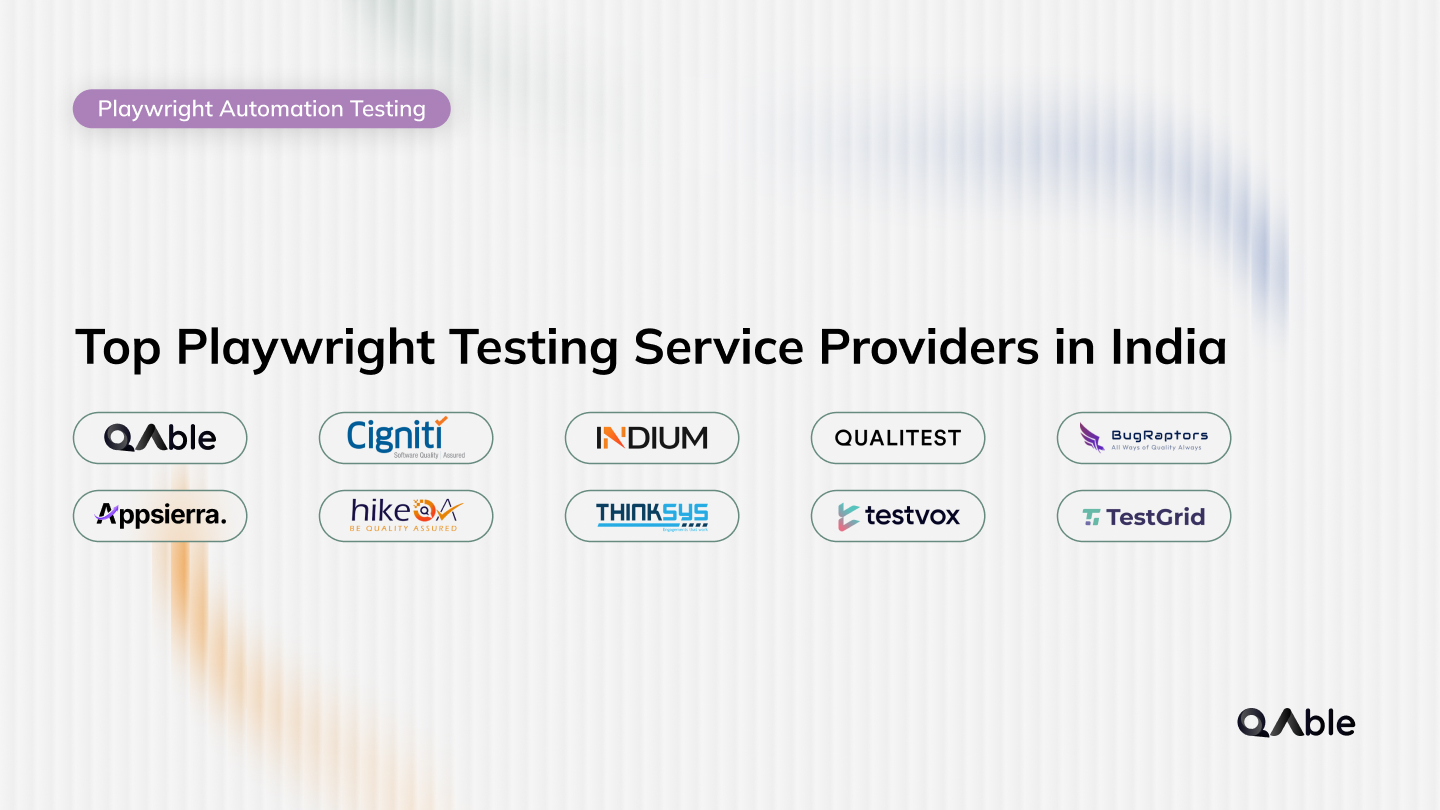
Every company below offers test automation from India. They differ less in the tools they list than in how the work runs: who designs the framework, how it runs in your pipeline, and what you own when the engagement ends.
1. QAble
QAble is a quality engineering company founded in 2018 and headquartered in Ahmedabad, India, serving product teams in the US, the Middle East and India. It is certified to CMMI Dev Maturity Level 3, ISO/IEC 27001:2022, ISO 9001:2015 and ISO 42001:2023, and has delivered 100+ projects with 50+ ISTQB-certified engineers.
Its Playwright testing service starts with framework architecture, not test scripts. Selector strategy, fixtures and environment handling are designed before a single test is written, and every suite is built to run in the pipeline from day one rather than retrofitted from local runs. It suits teams that want one accountable partner to build, stabilise and hand over a Playwright system their own engineers can extend.
Playwright and automation services:
- End-to-end automation of critical user flows, multi-step workflows, and state and session handling, run across environments.
- API test automation for REST and GraphQL with Playwright's request context, covering contracts, authentication, error handling and webhooks.
- Cross-browser testing on Chromium, WebKit and Firefox in parallel, with viewport and device emulation.
- CI/CD integration on GitHub Actions, Jenkins and GitLab CI, with sharding, retries, failure traces and reporting.
- Regression automation mapped to features and release risk, including smoke and sanity suites used as release gates.
- Visual and component testing: snapshot comparison, component interactions, accessibility states and responsive layouts.
Tools and frameworks:
- Playwright with TypeScript and JavaScript, with full type support for fixtures.
- Playwright Trace Viewer, so every failing test carries DOM snapshots, network logs and console output.
- Selenium, Cypress, Appium and WebDriverIO alongside Playwright: QAble's home page lists 12+ frameworks and 80+ tool combinations shipped.
What sets it apart:
- Its own Playwright automation platform, Tesbo-X, with intelligent test selection and CI-native execution. QAble publishes the standards it holds suites to: run time under 10 minutes and a flaky-test rate below 2%.
- Its own bug reporting product, BetterBugs, so every defect arrives with the evidence a developer needs.
- Prevention of six named failure patterns from day one: flaky suites, no CI regression, brittle selectors, no coverage map, sequential runs and missing failure evidence.
- An NDA on day one, a dedicated account manager, certified QA engineers and no lock-in contracts in every engagement model.
How QAble builds Playwright automation:
- Coverage strategy: automation scope mapped to risk and business impact before any test is written.
- Framework design: architecture, selector strategy, fixture structure and environment handling built for stability.
- Test development: deterministic tests covering critical paths, edge cases and API contracts.
- CI integration: parallel execution, retry strategy, failure artefacts and reporting on every build.
- Handover and evolution: documentation, a maintenance guide and a team walkthrough, so your engineers own the result.
What you receive:
- A production-ready Playwright framework: source code, page objects, fixtures, locator strategy and environment configuration.
- A test suite of end-to-end, API, regression and smoke tests, with cross-browser configuration and data-driven cases.
- CI configuration with sharding, plus trace, screenshot and video capture on failure.
- A handover package: architecture documentation, a maintenance guide, a coverage map and an onboarding session.
What QAble has delivered:
- Experience Abu Dhabi, the official tourism platform of Abu Dhabi: a Playwright automation suite for key regression flows, with validation across DEV, UAT and production and every supported language. Read the Experience Abu Dhabi case study.
- EigenRisk, a catastrophe risk analytics platform: a QA practice built from scratch, with 900+ automated test cases and cross-browser coverage on Chrome, Firefox and Safari across Windows and macOS.
- Rocket, an AI app builder: a mini test suite on every pull request, and regression cut from weeks of manual testing to a single overnight run.
Ways to work with QAble:
- A Playwright audit of about 1 week: architecture review, flaky-test root causes, CI assessment and a prioritised roadmap.
- A full Playwright build of 3 to 8 weeks: framework, end-to-end and regression suite, CI integration and handover documentation.
- Ongoing Playwright automation: sprint-aligned test development, flaky-test monitoring and regression maintenance.
Related Read: Choosing the Right QA Testing Ally
2. ThinkSys
ThinkSys was founded in 2012 and is headquartered in Sunnyvale, California, with an engineering team in Noida that works during US Eastern mornings, it says. It states a team of 400+ experts. It suits US and Indian product teams that want a dedicated Playwright practice with contractual quality commitments.
Playwright and automation services:
- Playwright automation for end-to-end web testing across Chromium, Firefox and WebKit.
- Web application, mobile, API and cross-browser automation.
- CI/CD test automation integration.
Tools and frameworks:
- Playwright with JavaScript, TypeScript, Python, C# .NET and Java.
- Selenium, Cypress and Appium.
- Jenkins, GitHub Actions and Azure DevOps.
What sets it apart:
- A dedicated Playwright page, which says it specialises in Playwright automation testing.
- A case study in which end-to-end regression fell from 7 days to under 2 hours with Playwright, it says.
- CMMI Maturity Level 3, a 100% money-back guarantee, and testing that starts within 3 to 7 business days, it says.
3. Testvox
Testvox has worked in software testing since 2017. Its contact page lists a UAE entity in the Dubai Airport Freezone and an Indian entity in Kottakkal, Kerala, with clients in India, the US, the UK and the Middle East. It suits teams that want Playwright automation alongside flexible staffing and crowd testing.
Playwright and automation services:
- Web application test automation and cross-browser testing with Playwright.
- API testing with Playwright.
- CI/CD pipeline integration and regression automation.
- Performance and load validation.
Tools and frameworks:
- Playwright with TypeScript, JavaScript and Node.js.
- GitHub Actions and Jenkins.
- Selenium, Cypress, Appium, JMeter, Postman and BrowserStack.
What sets it apart:
- A dedicated Playwright page, which states 500+ automated test cases delivered and 100+ applications automated.
- QA staff augmentation, with 100+ QA professionals available, and onboarding in one day, it says.
- A crowd testing network across 30+ countries, according to its crowd testing page.
4. BugRaptors
BugRaptors was founded in 2016 by Yashu Kapila and describes itself as a pure-play QA and testing company headquartered in India and the US. Its test labs and corporate office are in Mohali, Punjab, with a US corporate office in Emeryville, California. It suits teams in regulated sectors that want automation within a broader QA practice.
Playwright and automation services:
- Web, mobile, API and database test automation.
- AI-driven test automation.
- Regression, performance and security testing.
Tools and frameworks:
- Selenium, Playwright, Cypress, WebDriverIO, Robot Framework and Appium.
- Postman, REST Assured and Karate DSL for APIs.
- Its own frameworks: RaptorVista for web and MoboRaptors for mobile automation.
What sets it apart:
- A team of 200+ ISTQB-certified testers, it says.
- It states ISO 9001 and ISO 27001 certification.
- BugBot, its suite of AI tools for test data generation and visual bug detection.
5. Appsierra
Appsierra describes itself as an AI-first quality and product engineering firm that works through expert-supervised pods. Its delivery centres are in India, with contracting entities in the US and the UK. It suits teams that want an automation pod quickly, starting with a short paid pilot.
Playwright and automation services:
- Web, mobile and desktop automation.
- API automation and regression suites.
- Cross-browser and performance automation.
- Codeless and keyword-driven automation.
Tools and frameworks:
- Playwright, Cypress, Selenium, Appium and WebdriverIO.
- Postman, REST Assured, k6, JMeter and Gatling.
- GitHub Actions, GitLab CI, Jenkins, Allure and TestRail.
What sets it apart:
- Pre-vetted pods productive in about 7 days, it says.
- Pricing per pod and seniority after a free scoping call, usually starting with a paid, time-boxed pilot.
- It lists ISO 27001 and ISO 9001 certification and CMMI-assessed delivery.
6. Indium

Indium, whose legal entities still trade as Indium Software, is an AI services company headquartered in Chennai, with a US headquarters in Cupertino, California, and offices in Bengaluru, Hyderabad, Mumbai and Pune. It says it started as an engineering team nearly three decades ago. It suits enterprises that want testing as part of a wider AI and data programme.
Playwright and automation services:
- AI-led test generation, script automation and test data.
- Predictive QA and exploratory testing.
- Continuous testing, API, mobile and cloud validation.
Tools and frameworks:
- Playwright, Selenium, Cypress, Appium, TestNG, JUnit and Pytest, shown in the tool list on its AI-led assurance page.
- Azure DevOps, Jenkins, GitLab and Bitbucket.
What sets it apart:
- Test Lifter, its platform for validating real system behaviour before deployment.
- Up to 80% faster release cycles and 40 to 60% fewer critical production defects, it says.
- iXie Gaming and Experion Technologies are its subsidiaries.
7. Coforge (formerly Cigniti)
Coforge completed its acquisition of Cigniti Technologies on 30 April 2026, and cigniti.com now redirects to Coforge's quality engineering pages. Coforge lists 15 offices in India, including Greater Noida, Hyderabad, Bengaluru and Chennai, and states about 45,000 engineers, designers and industry experts. It suits large enterprises that want quality engineering inside a much wider services relationship.
Playwright and automation services:
- End-to-end test automation.
- Performance engineering, security testing and test data management.
- Digital assurance, chaos engineering and AI model validation.
Tools and frameworks:
- BlueSwan iNSta, its AI-powered automation engine, which it says integrates with CI/CD and with Sauce Labs and BrowserStack.
- Its quality engineering service pages do not name Playwright, so ask which framework your suite would use.
What sets it apart:
- BlueSwan, its AI-led quality engineering suite.
- An ISO/IEC 27001:2022 certificate whose scope includes digital assurance.
- Named a leader in quality engineering services in 2025 analyst assessments, it says.
8. QualityAI (formerly Qualitest)
Qualitest rebranded as QualityAI on 17 June 2026. It describes itself as an AI-first quality engineering company and lists Indian offices in Bengaluru, Hyderabad, Noida and Chennai. It added 600+ engineers in India when it acquired Hyderabad-based ZenQ in 2022. It suits large organisations that want an automation roadmap and governance as well as delivery.
Playwright and automation services:
- Enterprise automation strategy, framework architecture and governance.
- Web, mobile, desktop, API and microservices automation.
- Regression automation with predictive test selection and self-healing locators.
- CI/CD integration and continuous testing.
Tools and frameworks:
- Its automation page does not name specific tools. It has published a webinar comparing Playwright and Cypress.
- A case study on the same page describes automation governance built on Tricentis Tosca.
What sets it apart:
- Proprietary AI used in testing since 2019, which it says can make testing up to six times faster.
- Accessibility, visual validation and performance automation in the same service.
- Almost 30 years of software testing, it says.
9. HikeQA
HikeQA lists an Indian office in Noida and a US entity in Oro Valley, Arizona. It states 10+ years of experience, 50+ QA experts and 500+ projects delivered. It suits growing product teams that want a long-term QA partner and a short trial first.
Playwright and automation services:
- Functional, regression and UI test automation.
- API automation testing.
- Performance and load automation.
- Framework development and optimisation.
Tools and frameworks:
- Selenium, Cypress, Playwright, TestNG, Jest and Mocha.
- Jenkins and GitHub.
- REST Assured, Appium and JMeter, used in its case studies.
What sets it apart:
- A two-week trial assessment before a long-term engagement, it says.
- Dedicated team and long-term engagement models, with 700+ apps tested, it says.
- ISTQB-certified testers.
10. TestGrid
TestGrid was founded in 2015. Its contact page gives an address in Alpharetta, Georgia, and its careers page advertises roles in Surat and Hyderabad. It is a testing platform rather than a services firm: you bring your own Playwright tests and run them on its infrastructure. It suits teams that already write Playwright tests and need browsers and devices to run them on.
Playwright and automation services:
- Execution of existing Playwright, Selenium, Appium and Cypress suites without rewrites.
- A real device cloud for iOS and Android, and cross-browser testing.
- Codeless testing, performance testing and visual testing.
Tools and frameworks:
- Selenium, Appium, Cypress, Playwright, Espresso and XCUITest.
- CoTester, its AI agent, which generates tests in Selenium Java or Appium Java rather than Playwright.
What sets it apart:
- SOC 2 Type II and ISO/IEC 27001:2022 certification.
- On-premises and air-gapped deployment for regulated environments.
- Partnerships with GlobalLogic and Capgemini, it says.
Related Read: Benefits Of QA Outsourcing Software Testing
Why teams standardise on Playwright
Playwright is an open-source framework from Microsoft. Its code, releases and issue tracker are public:
https://github.com/microsoft/playwright
One API for three browser engines
Playwright drives Chromium, Firefox and WebKit with the same test code. WebKit is the engine behind Safari, so teams can cover Safari behaviour in CI without a Mac farm.
Auto-waiting removes a whole class of flaky tests
Playwright waits for an element to be visible, stable and ready before it acts. Many timing failures that plague older suites never appear, because the test no longer guesses how long to sleep.
Built for CI, not added later
Parallel workers, test sharding, retries and the HTML reporter are part of the test runner. The Trace Viewer records DOM snapshots, network calls and console output for a failing test, so you can debug a CI failure without reproducing it.
More than browser tests
The same runner handles API tests through its request context, visual comparisons and component tests. Teams can write tests in JavaScript, TypeScript, Python, Java or .NET.
Related Read: Top 10 Test Automation Frameworks in 2026
A CI-ready Playwright configuration
Whoever builds your suite, its configuration should look something like this. We ran this exact file with Playwright 1.64.1, with BASE_URL pointing at a live site: it lists one smoke test in each of the three browser projects, and the Chromium run passes.
import { defineConfig, devices } from '@playwright/test';

export default defineConfig({
  testDir: './tests',
  fullyParallel: true,
  forbidOnly: !!process.env.CI,
  retries: process.env.CI ? 2 : 0,
  workers: process.env.CI ? 4 : undefined,
  reporter: [['html', { open: 'never' }], ['junit', { outputFile: 'results/junit.xml' }]],
  use: {
    baseURL: process.env.BASE_URL ?? 'http://localhost:3000',
    trace: 'on-first-retry',
    screenshot: 'only-on-failure',
  },
  projects: [
    { name: 'chromium', use: { ...devices['Desktop Chrome'] } },
    { name: 'firefox', use: { ...devices['Desktop Firefox'] } },
    { name: 'webkit', use: { ...devices['Desktop Safari'] } },
  ],
});
Five settings in it are worth checking in any vendor's work:
- forbidOnly fails the CI run if someone leaves a
test.onlyin the code, which would otherwise skip the rest of the suite. - Retries only in CI, so a flaky test is visible locally instead of hidden.
- Trace on first retry records a full trace exactly when a test fails once, without slowing every run.
- A JUnit reporter, so results appear in your pipeline rather than in a file nobody opens.
- Three browser projects, so every test runs on Chromium, Firefox and WebKit.
To split a long suite across CI machines, run each machine with a shard flag such as npx playwright test --shard=1/4. Our guide to Playwright test hooks covers set-up and tear-down for the tests themselves.
Six ways Playwright projects fail
Most Playwright problems are not tool problems. They come from how the suite was designed, run and maintained.
The first two are the most expensive. A flaky suite trains the team to ignore red builds, and a suite that never runs in CI protects nothing at the moment a deployment happens. Ask every vendor to show you a real pipeline, its flaky-test rate and its run time, not a slide with a test count.
In-house QA vs outsourced Playwright testing services (India)
A hybrid model often works best. Your own team keeps product knowledge and decides what matters; a partner brings framework experience and the capacity to build quickly. The condition is ownership: the contract should hand over the framework, the documentation and the know-how, so you are never locked in.
Related Read: Why Product-Based Companies Should Rely on External QA Services Over Internal QA Teams?
Four ways to engage a Playwright partner
An audit
Choose an audit when a suite exists but the team no longer trusts it. A good audit names the root causes of flaky tests, the gaps in coverage and the changes that would cut run time, in priority order.
A framework build
Choose a build when you are starting fresh or moving from Selenium or manual regression. Ask for the framework design before the first test, and a CI run on your own pipeline before handover.
Ongoing automation
Choose ongoing work when the product changes every sprint. The partner adds tests for new features, fixes or quarantines flaky tests and keeps regression current.
Embedded engineers
Choose embedded engineers when you want the same people inside your own process for the long run. They work your backlog and attend your stand-ups.
How Playwright engagements are priced
None of the ten companies in this list publishes a rate card for Playwright work. What they do publish is how they start:
- QAble publishes three engagement shapes: a 1-week audit, a 3 to 8 week build and ongoing automation.
- Appsierra prices per pod and seniority after a scoping call, usually with a paid pilot first.
- HikeQA offers a two-week trial assessment.
- ThinkSys offers a money-back guarantee.
Price the outcome, not the hour. A cheaper suite that is flaky costs more in developer time than it saves. Ask each vendor for a fixed-scope pilot on your own application, with agreed measures for run time, flaky-test rate and coverage of critical journeys.
How to choose the right Playwright testing partner in India
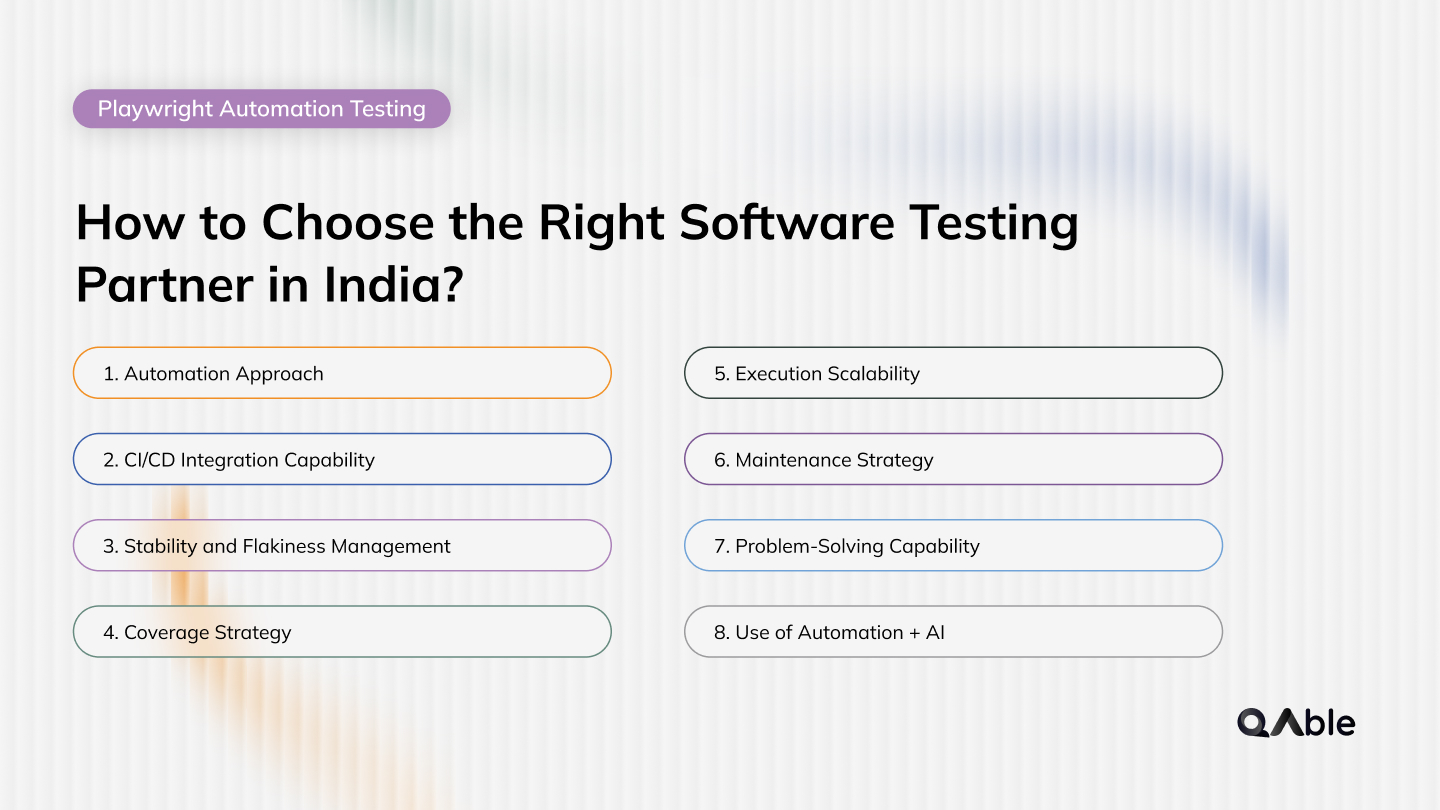
Choosing a partner is choosing an execution model. It decides how fast you release, how far you trust the suite and what maintenance will cost in a year.
Automation approach
A partner should design an automation system, not just write tests. Look for a documented structure that separates test logic from reusable components, and coverage focused on high-impact journeys rather than volume.
CI/CD integration
Automation that does not run in the pipeline has little value. Ask to see tests running on pull requests, sharded across machines, with results reported where your developers already look.
Stability and flakiness
Ask for the vendor's flaky-test rate on a current client suite and its rule for dealing with a flaky test. Stable selectors, test isolation and controlled test data matter more than retries.
Coverage strategy
Not everything should be automated. A good partner starts with critical user journeys, high-risk workflows and regression-prone areas, and can show you the map.
Maintenance and handover
Automation is an ongoing system. Ask who owns updates when the product changes, and what you will receive at handover.
AI-assisted testing
Several companies in this list now use AI for test generation, failure analysis or prioritisation. Ask what the AI does, what a human still reviews, and how its output is checked before it reaches your pipeline.
Related Read: Measuring Test Automation's Business Impact
Playwright testing at QAble
Playwright automation pays off when the framework is designed before the tests and the suite is built for the pipeline. At QAble, every engagement starts with a coverage strategy, ends with a handover, and is judged on run time and flaky-test rate.
Final thoughts
Playwright gives teams fast, cross-browser automation that is built for CI. Whether it delivers depends on the framework design, the pipeline and the maintenance plan, not on the tool.
The ten companies here all offer test automation from India. The real differences are whether Playwright is a dedicated practice or one tool in a list, how the suite runs in your pipeline, and what you own at the end. Judge each one on the eight checks above, in a paid pilot on your own application.
If your suite is flaky or slow, talk to QAble about a Playwright audit or a full framework build.